-
Author: Anindita Barik
-
Updated Date: Jul-16-2026
-
Views: 2 Min Read
AI marketing tools for Indian businesses save time, not strategy — that’s the core takeaway of this 2026 guide. It walks through content creation, SEO, paid ads, analytics, and social media, showing solo founders and small agencies exactly where AI cuts hours (10–15/week) and where human editing remains non-negotiable. With a practical, mostly-free tool stack and real client examples, it’s built for SMBs who want results, not hype.
AI marketing tools for Indian businesses are software platforms — like ChatGPT, Google Analytics, Meta Business Suite, and Ahrefs — that use artificial intelligence to speed up content creation, SEO research, ad optimization, analytics, and social media management. They work best as a productivity layer rather than a replacement for human strategy: they help solo founders and small agencies save roughly 10–15 hours a week on tasks like drafting blog posts, generating keyword clusters, optimizing ad bids, and interpreting analytics data, while humans still handle editing, strategy, and creative decisions.
For most Indian SMBs, the right approach is to start with free tools — ChatGPT for content, Google Analytics 4 for insights, Meta Business Suite for social and ads — which cover about 70% of everyday marketing needs at zero cost. Paid tools like Jasper or Ahrefs are worth adding only once a specific bottleneck (like content speed or keyword research) justifies the spend, typically bringing total monthly costs to somewhere between Rs 0 and Rs 5,000 for a lean, effective stack. If you want to understand the broader shift AI is creating across the full marketing landscape before diving into specific tools, our AI in digital marketing guide covers the strategic picture end to end.
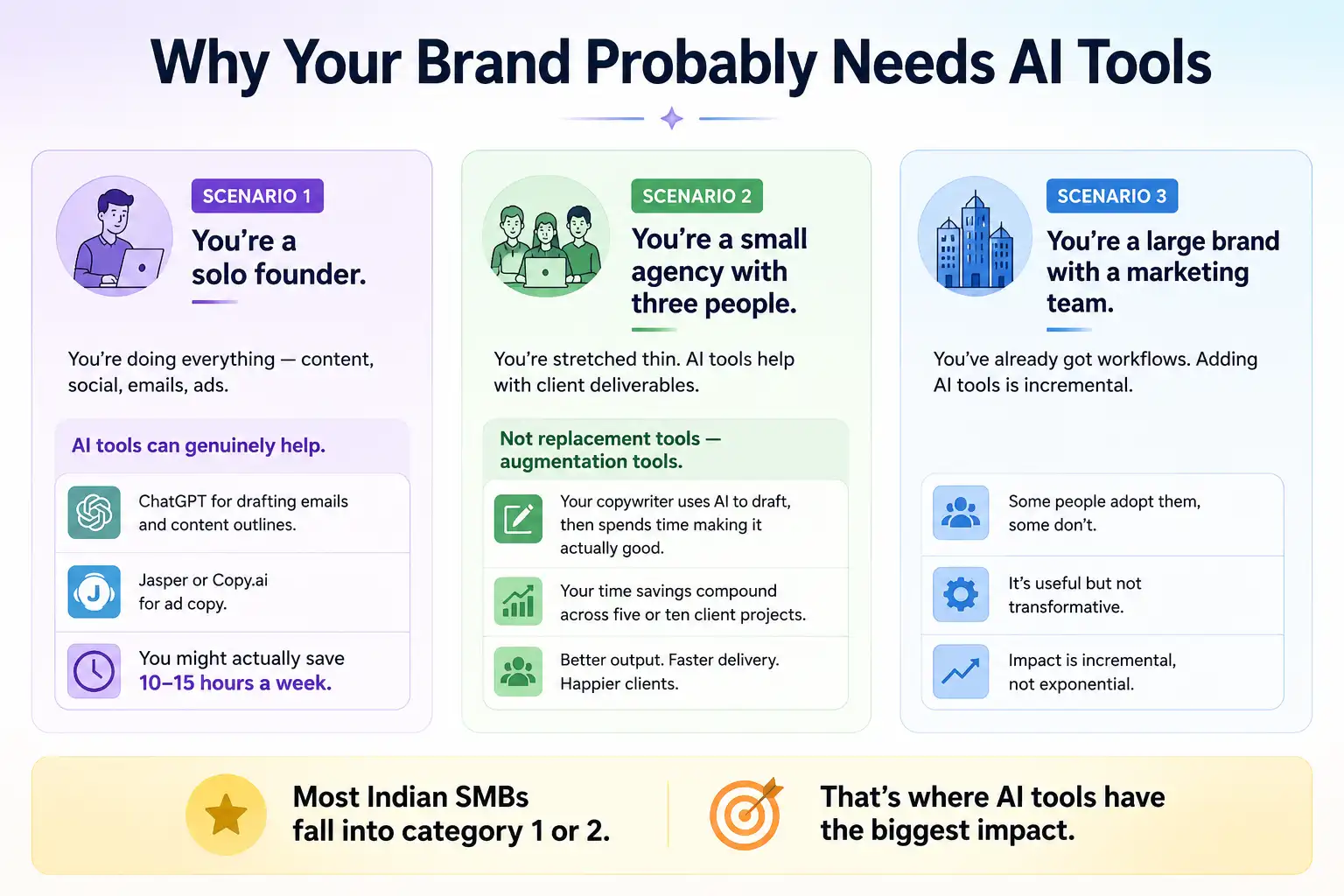
The Awkward Truth About AI Marketing Tools Right Now
Every brand is suddenly obsessed with AI marketing tools. Partly because it’s genuinely useful. Partly because saying “we’re using AI” sounds impressive in board meetings.
Honestly? Most brands are using these tools wrong. They’re treating AI like magic when it’s actually just a productivity layer. A really useful one. But magic? No.
We started experimenting with AI tools at PromotEdge about two years ago. Our content team was spending four hours writing a detailed blog post. Now with AI assistance, it’s two and a half hours. They use the tool to draft, then edit, then make it actually useful. The tool doesn’t replace them. It just… accelerates the boring parts.
This guide is about actually using these tools effectively. Not hype. Not “AI will revolutionise marketing.” Just: which tools work for which jobs, how to use them properly, and when they’re worth the money.
Why Your Brand Probably Needs AI Tools
Three scenarios:
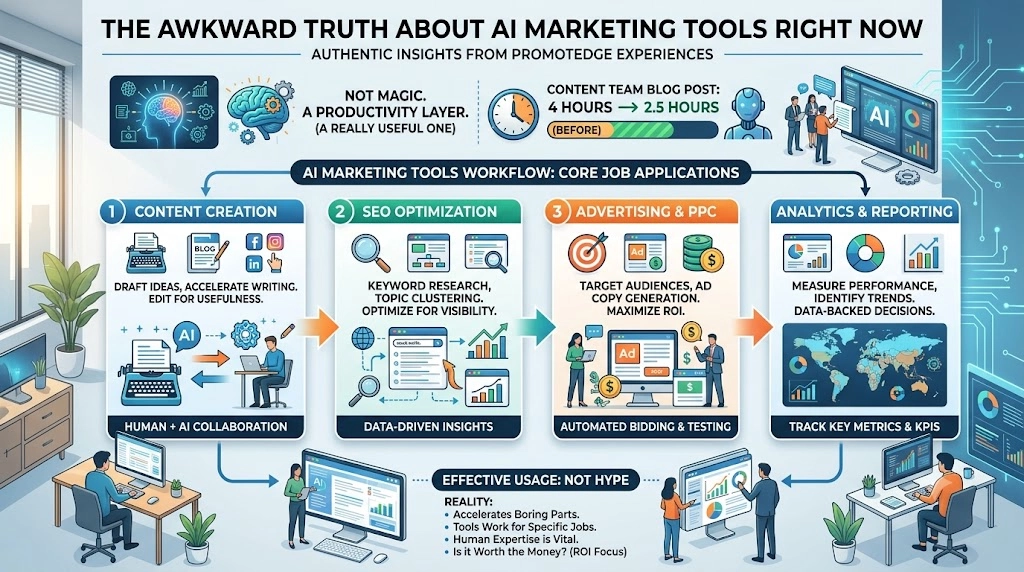
Scenario 1: You’re a solo founder. You’re doing everything — content, social, emails, ads. AI tools can genuinely help. ChatGPT for drafting emails and content outlines. Jasper or Copy.ai for ad copy. You might actually save 10-15 hours a week.
Scenario 2: You’re a small agency with three people. You’re stretched thin. AI tools help with client deliverables. Not replacement tools — augmentation tools. Your copywriter uses AI to draft, then spends time making it actually good. Your time savings compound across five or ten client projects.
Scenario 3: You’re a large brand with a marketing team. You’ve already got workflows. Adding AI tools is incremental. Some people adopt them, some don’t. It’s useful but not transformative.
Most Indian SMBs fall into category 1 or 2. That’s where AI tools have the biggest impact.
AI for Content Creation
This is where most brands start. “Can AI write blog posts?” Yes. Can it write good blog posts? Also yes, but… not without heavy editing.
The workflow is: you give ChatGPT or Claude or Jasper a brief. It spits out 1,500 words. You read it. It’s generic, it doesn’t have your voice, some facts are wrong (hallucinations), some points are redundant.
Then you spend two hours fixing it. Rewriting sections. Removing the AI-speak. Adding examples. Making it actually good.
So you’ve saved maybe an hour? Not super impressive. But here’s where it gets useful: you can do three first drafts in the time you’d normally spend on one. You keep the best one, discard the others. You now have a decent starting point instead of a blank page.
For Indian brands, tools worth looking at: ChatGPT (free version does 70% of what you need), Claude (similar quality, better for longer writing), Jasper (optimised for marketing copy specifically). Pricing varies from free to Rs 15,000 per month. For most SMBs, free ChatGPT + your own editing is enough.
One quirk: AI content scanners now flag AI-generated content. If you’re publishing something that must pass as human-written (which… you probably should be), editing is non-negotiable. Don’t publish raw AI output. That’s how you end up looking like every other brand using the same tool.
AI for SEO
Content is one thing. But AI is genuinely changing how SEO works.
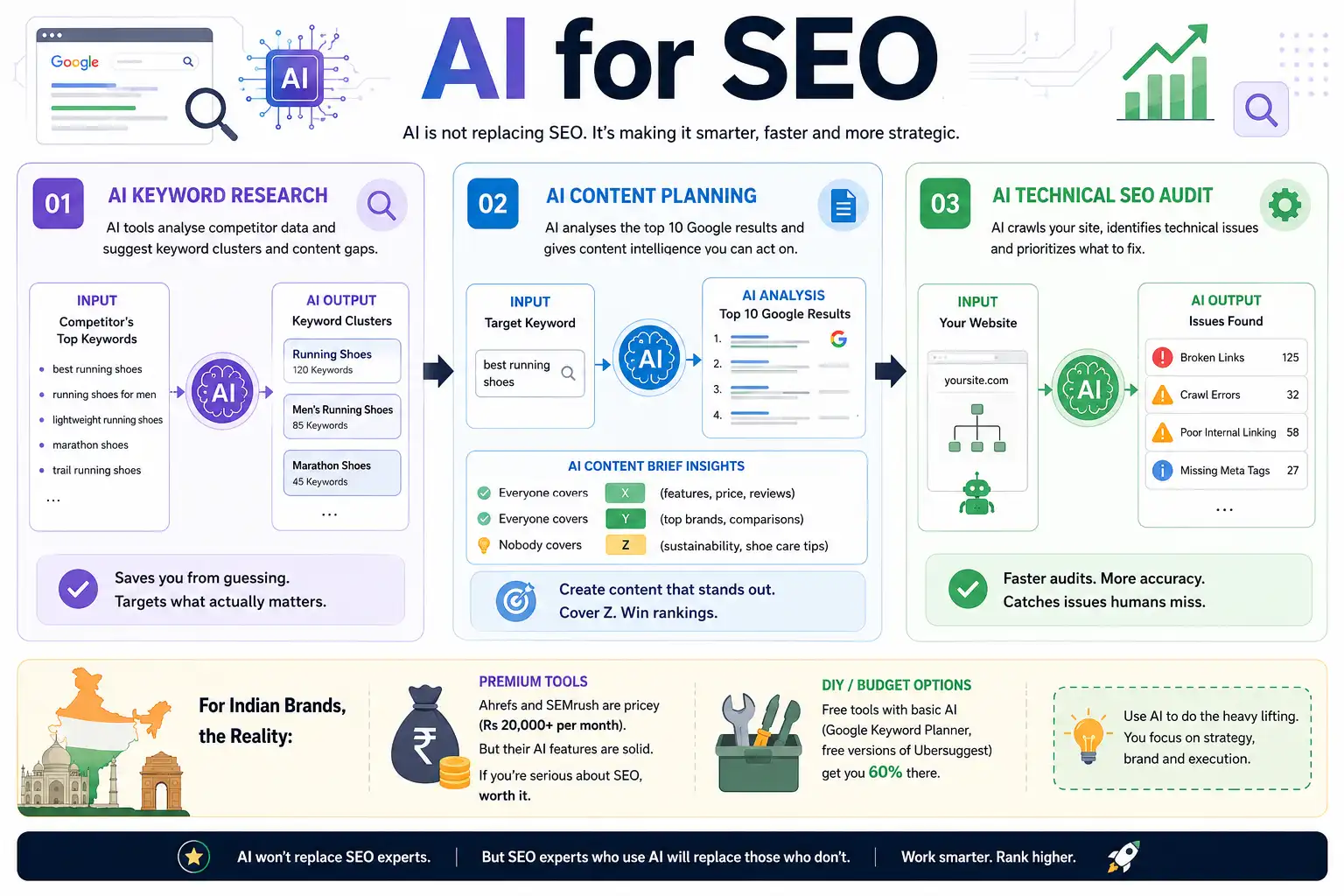
Keyword research: Traditional tools like Ahrefs and SEMrush now have AI that suggests keyword clusters and content gaps. You give it your competitor’s top keywords and it suggests what you should be targeting. Useful because… actually saves you from guessing. This accelerates a process that used to take days — and that our guide on why keyword research is important breaks down as the single most valuable hour you can spend before writing a single word of content.
Content brief generation: You give AI your target keyword and it analyses the top 10 Google results. Then it tells you: “Okay, everyone’s covering X and Y. Nobody’s really touching Z. Your content should cover Z.” That’s valuable intelligence. Saves hours of manual analysis.
Technical SEO audit: Some new tools use AI to crawl your site and flag technical issues. Broken links, crawl errors, poor internal linking. Usually faster than manual audits and catches things humans miss.
For Indian brands, the reality: Ahrefs and SEMrush are pricey (Rs 20,000+ per month). But their AI features are solid. If you’re serious about SEO, worth it. If you’re DIY-ing, free tools with basic AI (Google’s keyword planner, free versions of Ubersuggest) get you 60% there.
AI for Paid Ads
Google and Meta have been quietly adding AI features to their ad platforms for years. Most marketers don’t even realise.
Smart bidding: Google’s AI automatically adjusts your bids based on conversion probability. You set the budget, it optimises. Works actually well for e-commerce and lead gen. Saves time manually tweaking bids.
Ad creative generation: Meta now generates ad variations for you. You give it a product image and some copy, it creates five different ad layouts. You A/B test them. Some perform better, some don’t. It’s… faster than hiring a designer.
Audience expansion: AI identifies people similar to your best customers and targets them. Usually works. Sometimes overshoots your actual target. Requires monitoring.
Honest take: if you’re running ads on Google or Meta, you’re already using AI. The question isn’t “should I use it” but “am I using it well.” Most brands leave money on the table by not configuring these features properly.
We had a clothing brand thinking they needed fancy AI tools for ads. Turns out they just weren’t using Meta’s built-in AI optimisation. Switched on conversion tracking (which Meta’s AI uses to optimise), and their CPA dropped 30%. Cost them nothing. Just configuration.
AI for Analytics
Google Analytics 4 now has “Insights” which is basically AI explaining your data. You load the dashboard and it tells you: “Bounce rate increased 15% this week. Probably due to traffic from low-intent sources.”
That’s useful because normally you’d stare at a dashboard for ten minutes wondering what you’re looking at.
Other tools like Mixpanel and Amplitude have AI that suggests actions. “You’re losing customers at checkout. Here’s why.” Most of the time it’s right. Sometimes it’s off.
For Indian brands, Google Analytics is free. Its AI insights are actually helpful. If you’re running experiments or optimising funnels, worth looking at paid tools with better AI. Otherwise, GA4 + human interpretation gets the job done.
AI for Social Media Management
There are dozens of tools claiming to revolutionise social media with AI. Most just do scheduling and basic analytics repackaging.
Where AI actually helps: content suggestions. Tools like Buffer now suggest what to post based on your audience’s behaviour. You don’t have to guess “is Tuesday good for posting?” It just tells you.
Also useful: caption generation. You upload an image, AI writes five caption options. 90% are garbage. 10% actually work. You pick the best, edit it slightly, and you’re done.
Less useful: sentiment analysis and “AI-powered engagement.” Most of this is gimmick. Reading comments and deciding if they’re positive or negative is easy. You don’t need AI for that.
For Indian brands: free tools like Meta Business Suite + ChatGPT for captions gets you there. Premium tools like Later or Buffer are nice but not necessary for most SMBs.
The Cost Question
Let’s be practical. You’ve got a marketing budget. Should it go to AI tools?
Free tools first: ChatGPT, Google Analytics, Meta Business Suite, free Ahrefs tier. These handle maybe 70% of basic needs. Cost: Rs 0.
Then decide: what’s your actual bottleneck? If it’s content creation speed, maybe Jasper (Rs 3,000-10,000/month). If it’s keyword research, maybe Ahrefs (Rs 20,000+/month). If it’s ad optimisation, you’re probably already using Google/Meta tools.
Our philosophy at PromotEdge: use free tools first. When you’ve maxed them out and you have the budget, invest in paid tools that specifically solve your bottleneck. Don’t just subscribe to everything cool.
A software startup we worked with subscribed to twelve different AI tools because they sounded useful. Monthly cost: Rs 1.5 lakhs. Actual usage: three tools used regularly, the rest forgotten. We consolidated down to five tools and cut the cost in half. Same output, half the spending.
The Future Worry
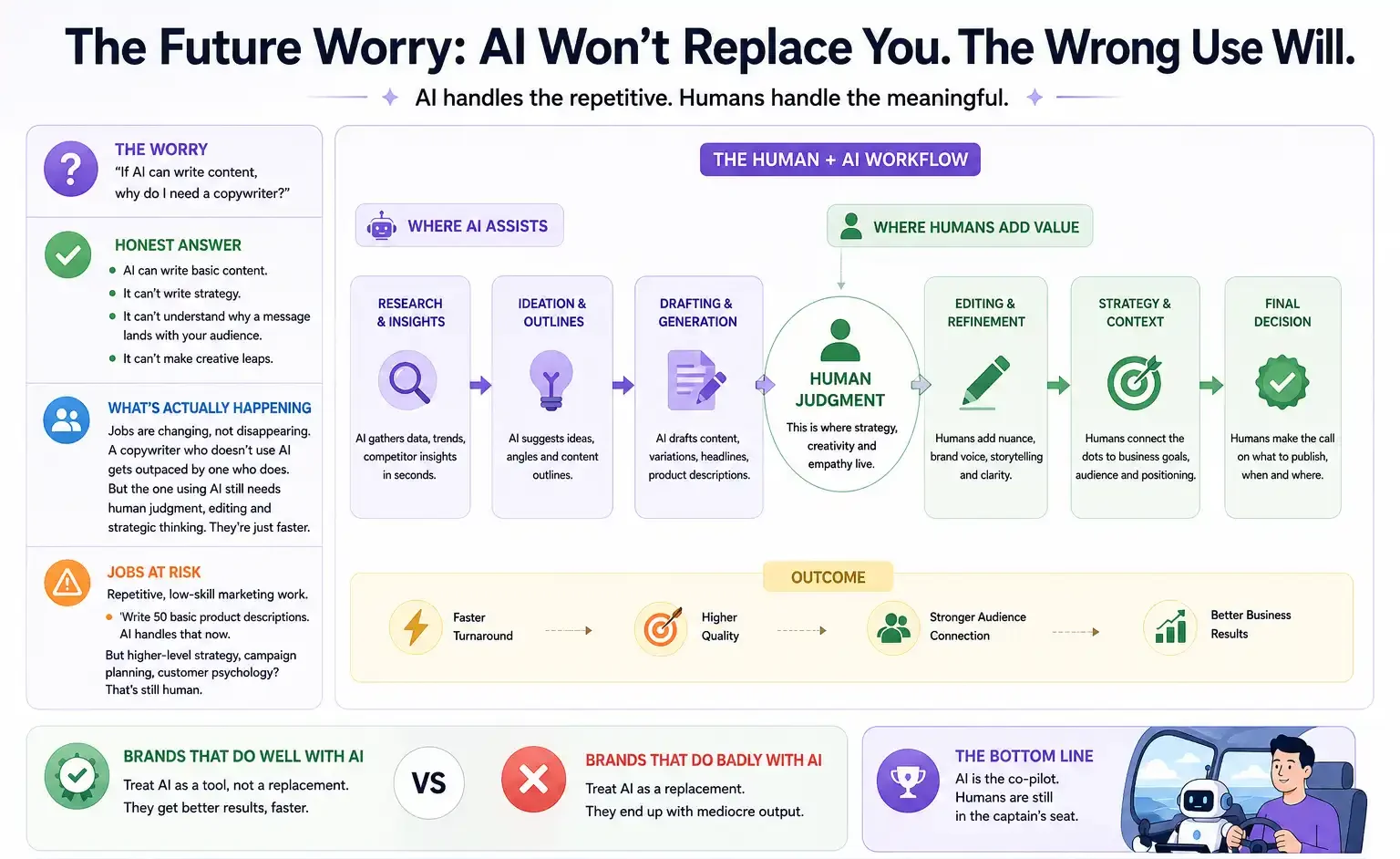
Brands worry about this constantly. “If AI can write content, why do I need a copywriter?”
Fair question. Honest answer: AI can write basic content. Product descriptions, newsletters, email outlines. It can’t write strategy. It can’t understand why a particular message lands with your audience. It can’t make creative leaps.
What’s actually happening: jobs are changing, not disappearing. A copywriter who doesn’t use AI gets outpaced by one who does. But the one using AI still needs human judgment, editing, strategic thinking. They’re just faster.
The jobs that’ll actually get eliminated? Repetitive, low-skill marketing work. “Write 50 basic product descriptions.” AI handles that now. But higher-level marketing strategy? Campaign planning? Understanding customer psychology? That’s still human.
So the brands that do well with AI are the ones treating it as a tool, not a replacement. The ones that do badly are treating it as a replacement and ending up with mediocre output.
How To Actually Choose An AI Tool
Okay, you’re convinced you need something. How do you pick?
First: what’s your actual problem? Not “we need AI tools.” But specifically: “Our content team spends too much time on first drafts” or “We’re not getting data insights from our analytics” or “We’re bad at keyword research.”
Second: does a free tool solve it 70%? If yes, start there. ChatGPT solves 70% of content problems. Google Analytics solves 70% of analytics problems. Free tools are underrated.
Third: if free tools aren’t enough, what’s the second-best option? Paid tools aren’t always better, just more specialised. Sometimes they’re more expensive but not better — just marketed better.
Fourth: trial before buying. Most paid tools have free trials. Use them on your actual work, not made-up examples. See if they actually save you time.
At PromotEdge, our team uses: ChatGPT (content), Ahrefs (SEO), native Google/Meta tools (analytics and ads), and Figma (design). That’s it. We tested dozens of others. These four cover 90% of what we need. Everything else is overkill or reinventing the wheel.
The Practical Stack For Most Indian SMBs
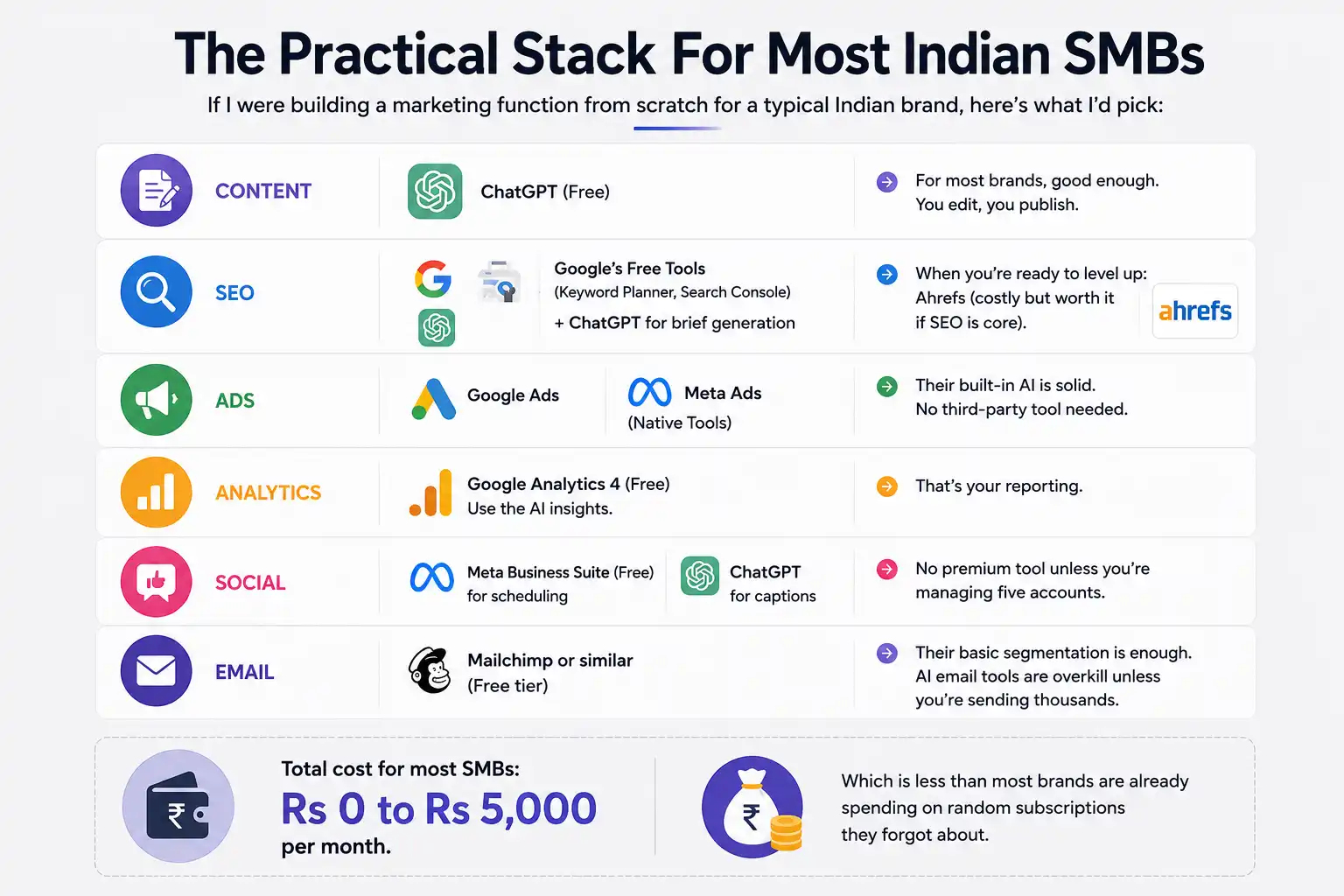
If I were building a marketing function from scratch for a typical Indian brand, here’s what I’d pick:
Content: ChatGPT (free). For most brands, good enough. You edit, you publish.
SEO: Google’s free tools (Keyword Planner, Search Console) plus ChatGPT for brief generation. When you’re ready to level up: Ahrefs (costly but worth it if SEO is core).
Ads: Google Ads and Meta native tools. Their built-in AI is solid. No third-party tool needed.
Analytics: Google Analytics 4 (free). Use the AI insights. That’s your reporting.
Social: Meta Business Suite (free) for scheduling. ChatGPT for captions. No premium tool unless you’re managing five accounts.
Email: Mailchimp or similar (free tier). Their basic segmentation is enough. AI email tools are overkill unless you’re sending thousands.
Total cost for most SMBs: Rs 0 to Rs 5,000 per month. Which is less than most brands are already spending on random subscriptions they forgot about.
One More Thing: Quality Checking Your AI Output
Never — and I mean never — publish raw AI output. Always check.
AI hallucinations are real. It’ll confidently cite statistics that don’t exist. It’ll make up quotes. It’ll state opinions as facts. You publish that, you look unprofessional.
Also, AI voice is generic. If you want your brand to sound like your brand, not like every other ChatGPT user, you need editing. Significant editing sometimes.
The quality check: one human reads the AI output. Checks facts. Rewrites sections that sound robotic. Adds voice. Tests it. Then it’s publishable.
This takes time. But less time than writing from scratch. That’s the actual value proposition.
The Real Talk On AI In Marketing
We’re in the hype cycle. Every conference is “AI will transform marketing.” Most of it is marketing BS.
Real talk: AI is a productivity tool. Good productivity tool. Makes teams faster. Doesn’t replace strategy, creativity, or human judgment.
Brands that win with AI: using it to do existing work faster, then reinvesting that time in higher-level thinking. More strategy, better campaigns.
Brands that lose with AI: treating it as magic, publishing raw output, expecting it to replace human thinking. Usually obvious, usually underperforms.
If you’re a marketing leader, don’t chase every new AI tool. Have a framework: “This tool solves this specific problem, costs this much, saves this much time.” Then decide. That’s it.
Our approach at PromotEdge: we use AI aggressively internally but conservatively in client work. Why? Because client work still requires human judgment, strategy, and creativity. AI speeds up the execution. Doesn’t replace the thinking.
| Approach | Best for | Watch out for |
|---|---|---|
| DIY | Small teams, tight budgets | Slow ramp-up, trial-and-error |
| Freelancer | Specific project bursts | Inconsistency, limited ownership |
| Agency | Ongoing work, senior input | Higher retainer, less control |
Quick checklist before you start:
- Define the one thing you want: leads, sales, awareness — pick one.
- Baseline your numbers: write down where you are today.
- Pick a 90-day window: nothing moves in 2 weeks.
- Agree on success metrics: with whoever is paying the bill.
- Set up proper tracking: GA4, UTMs, call tracking.
- Review monthly: kill what doesn’t work, double down on what does.
The Bottom Line
If you take one thing from this: ai marketing tools for indian businesses complete guide 2026 rewards patience and specificity, not volume or clever tricks. Start small, measure honestly, fix what breaks, and compound what works. The brands doing this well in India aren’t smarter — they’re just consistent. Need a hand with this for your business? Talk to us.
Want Help Building Your AI Marketing Stack?
We’ve been experimenting with AI tools across content, SEO, ads, and analytics for 250+ Indian brands. Let’s figure out what actually works for your situation.
FAQs
-
What are the best AI marketing tools for Indian businesses?
Ans.Depends on your specific bottleneck. For content: ChatGPT (free) or Jasper (paid). For SEO: Ahrefs or native tools. For ads: Google and Meta have excellent built-in AI. For analytics: Google Analytics 4. Start free, upgrade when you have maxed out free versions and have the budget. -
Will AI replace marketers?
Ans.No. AI will replace repetitive, low-skill marketing work. A marketer who does not use AI might get outpaced by one who does. But strategy, creative thinking, client relationships — still human. Use AI to do better work faster, not to avoid thinking. -
Are AI marketing tools worth the cost?
Ans.Free tools handle 70% of needs. If you are spending significant money on marketing, investing Rs 5,000-10,000 monthly in AI tools to save time is usually worth it. But do not just subscribe to everything. Solve a specific problem, then decide.
Author Details

Latest Posts
-
 26 / Aug
Search Engine Optimization Video SEO: How to Rank Your Videos in Google & YouTube
26 / Aug
Search Engine Optimization Video SEO: How to Rank Your Videos in Google & YouTube -
 25 / Aug
Video Production Corporate Video Production: A Practical Guide for Indian Brands
25 / Aug
Video Production Corporate Video Production: A Practical Guide for Indian Brands -
 24 / Aug
-
21 / Aug
Catalogue Design Catalogue Design: How to Create Catalogues That Actually Sell
-
 20 / Aug
Related Knowledge