-
Author: Anindita Barik
-
Updated Date: Jul-13-2026
-
Views: 2 Min Read
Twitter marketing in 2026 is about precision, not scale. This guide explains who should use Twitter (B2B, fintech, professional-facing brands), what content formats actually earn engagement (data-backed insights, behind-the-scenes content, contrarian takes), and why most brands abandon Twitter marketing too soon — right before month 4-5 when compounding growth typically begins. It also covers ad spend benchmarks and the analytics that actually indicate ROI.
X (Twitter) marketing is still relevant in 2026, but only for brands targeting professionals, founders, investors, and B2B decision-makers rather than a mass consumer audience. Platforms like Instagram or Facebook may offer wider reach, but Twitter consistently delivers 5-10x higher engagement rates (2-4% vs. 0.2-0.5%) for brands in fintech, SaaS, insurance, and B2B services, because the people engaging are real professionals actively discussing their industry — not passive scrollers.
Staying relevant on Twitter in 2026 means shifting from broadcasting promotions to sharing specific, data-backed insights, replying genuinely to conversations within the first hour, and committing to at least 4-5 months before expecting meaningful traction. Brands that treat Twitter marketing as a long-term authority-building channel — rather than a quick-win growth hack — are the ones still generating real leads and ROI from the platform today.
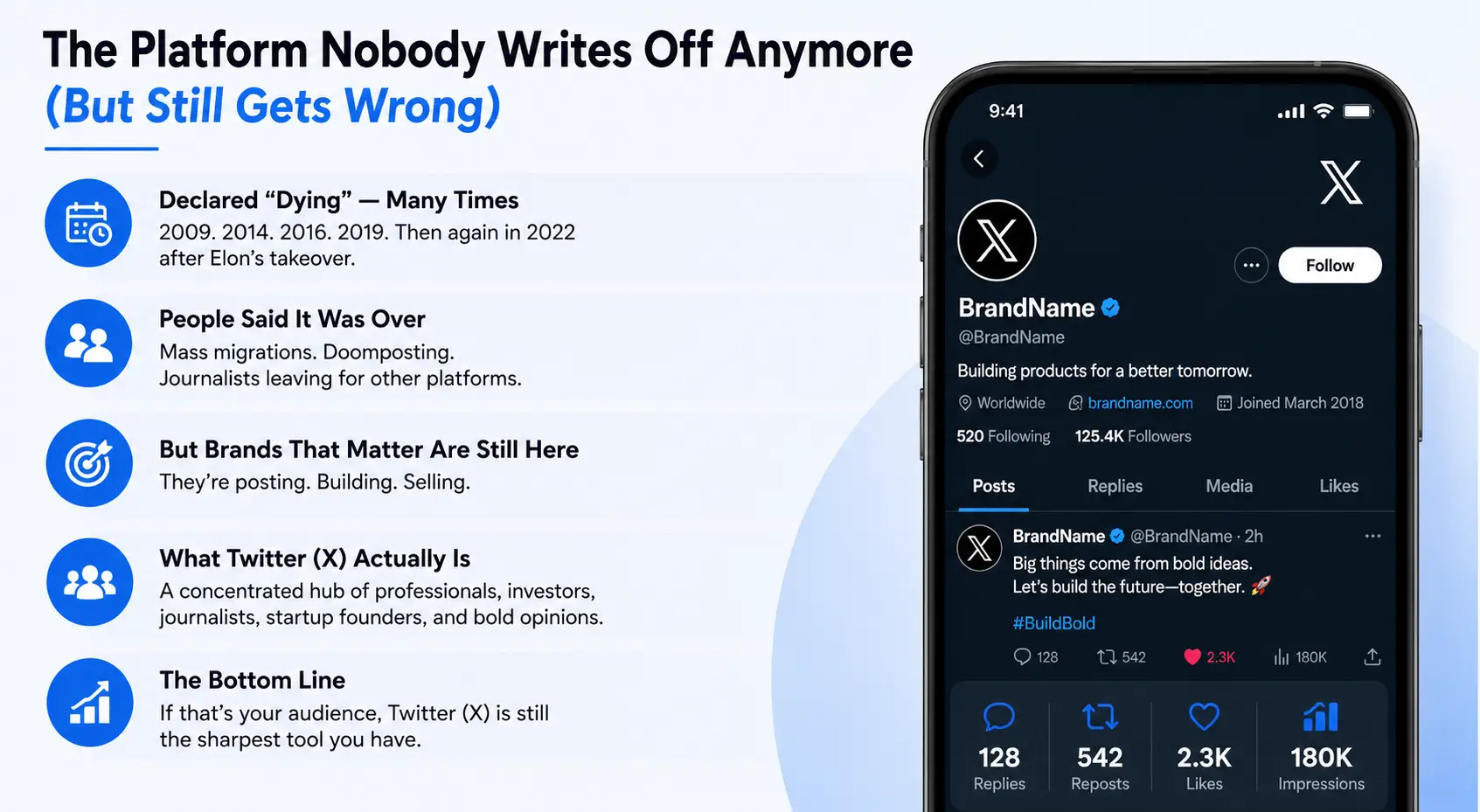
The Platform Nobody Writes Off Anymore (But Still Gets Wrong)
Twitter’s been declared “dying” so many times that I’ve stopped counting. 2009. 2014. 2016. 2019. Then Elon took over in 2022 and everyone said it was genuinely finished. Mass migrations. Doomposting. Journalists leaving for Threads or Bluesky.
And yet — brands that matter? They’re still here. Posting. Building. Selling.
The thing nobody wants to admit: Twitter works if you understand what it actually is. It’s not a mass-audience platform anymore. It’s a concentrated hub of professionals, investors, journalists, startup founders, and people with opinions strong enough to share them publicly. If that’s your audience, Twitter is still the sharpest tool you have.
At PromotEdge, we’ve helped 30+ brands figure out their Twitter strategy over the last 18 months. Some killed it. Some… didn’t. The difference wasn’t luck. It was understanding what works and, more importantly, what doesn’t.
Is Twitter Still Relevant?
Short answer: depends entirely on who you’re trying to reach.
A fashion e-commerce brand selling Rs 3,000 dresses? Twitter might not move the needle. An insurance company trying to reach CTOs and CFOs? You’re literally in the right place. A fintech startup? Twitter is probably generating more qualified interest than your Instagram ever will.
Monthly active users in India are somewhere around 80-100 million (the number keeps shifting). But here’s what matters: engagement rates. A tweet from a major brand might get 0.2-0.5% engagement on Facebook. Same brand on Twitter? 2-4% if the content lands right. That’s 5-10x better. And the people engaging are real — not bots pretending to be real.
We ran a campaign for a logistics SaaS company last quarter. Their target was operations managers and supply chain heads. Instagram brought in 10,000 impressions. 8 likes. Twitter brought in 3,000 impressions. 120 likes and 14 leads in one week. Draw your own conclusion. latform selection is one of the most important decisions in any digital marketing strategy — and the right choice is always determined by where your specific audience actually spends their time, not where you’re most comfortable posting.
How to Actually Build an Audience
Everyone says “post consistently and engage with others.” Fine, that’s true. But here’s what actually happens when you do that:
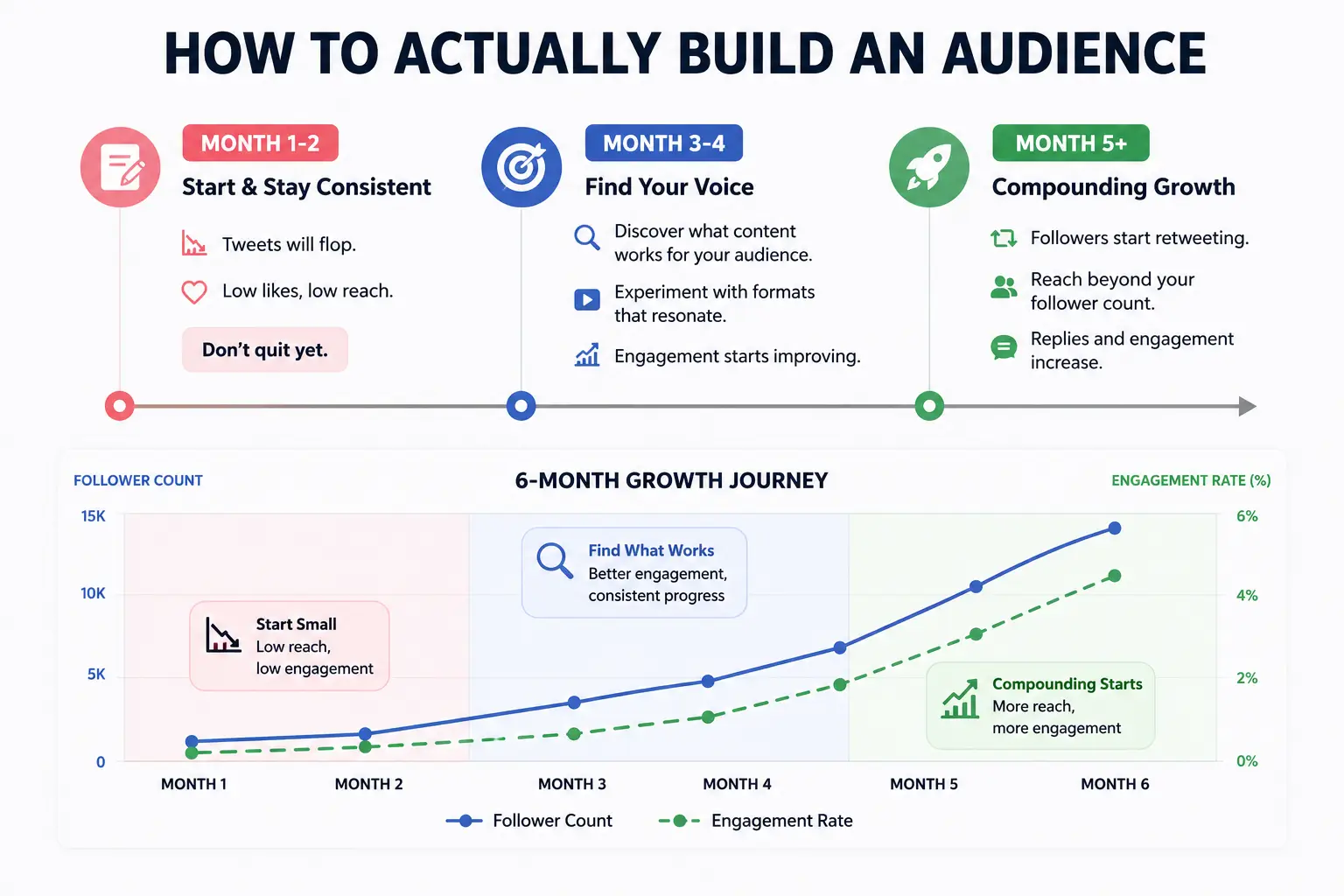
Month 1-2: Your tweets will flop. Massively.
You’ll post 20 tweets about your industry insights. You get 3 likes from your co-founder and someone’s mom. Don’t quit yet.
Month 3-4: You find your voice (or you don’t)
By now you’ve figured out what format works. Short takes? Long threads? Questions? Data? Video clips? We worked with a B2B manufacturing brand that got zero traction until they started posting behind-the-scenes factory footage. Suddenly, 400-500 views per tweet. Their industry cared about seeing the actual process, not generic marketing speak.
Month 5+: Compounding starts happening
Your followers start retweeting. People outside your follower count see your stuff. Replies increase. This is when Twitter becomes actually useful. Before this point, it feels pointless. And that’s the biggest reason brands quit too early.
One key thing: engage authentically. Reply to people in your space. Not to 500 people daily (that’s bot behaviour). But if someone posts about challenges you solve, actually reply. Actual humans notice when you’re genuinely participating versus when you’re just broadcasting.
Content That Works
Inspirational quotes? Dead. Stock photos of people with thumbs up? Nobody falls for it. Vague corporate speak? Instant scroll.
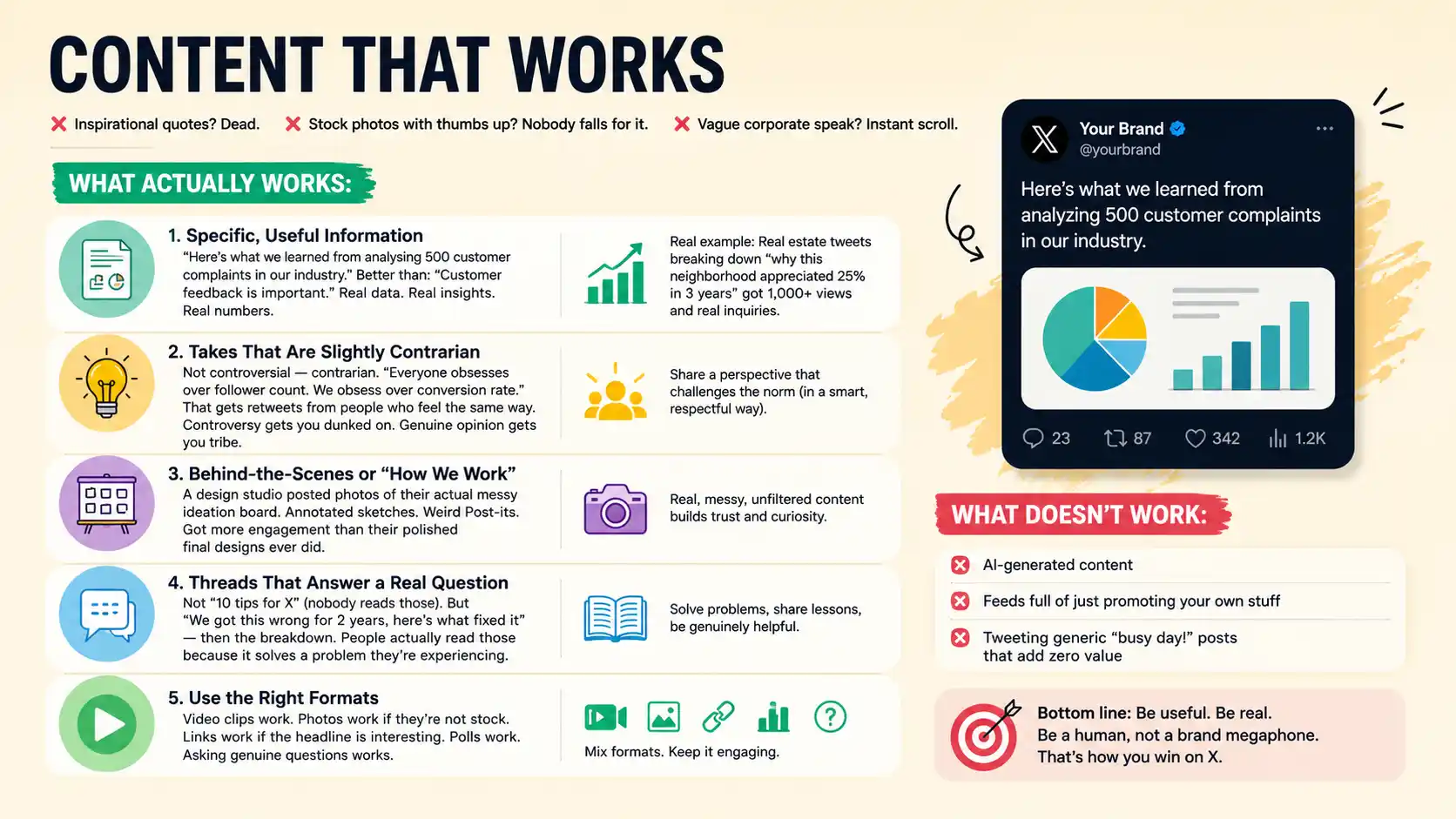
What actually works:
- Specific, useful information. “Here’s what we learned from analysing 500 customer complaints in our industry.” Better than: “Customer feedback is important.” Real data. Real insights. Real numbers. We worked with a real estate company that posted tweets breaking down “why this neighborhood appreciated 25% in 3 years” — not glamour shots of properties. Those tweets got 1,000+ views each. Serious inquiries followed.
- Takes that are slightly contrarian. Not controversial — contrarian. “Everyone obsesses over follower count. We obsess over conversion rate.” That gets retweets from people who feel the same way. Controversy gets you dunked on. Genuine opinion gets you tribe.
- Behind-the-scenes or “this is how we actually work.” A design studio posted photos of their actual messy ideation board. Annotated sketches. Weird Post-its. Got more engagement than their polished final designs ever did.
- Threads that answer a real question. Not “10 tips for X” (nobody reads those). But “We got this wrong for 2 years, here’s what fixed it” — then the breakdown. People actually read those because it solves a problem they’re experiencing.
- Video clips work. Photos work if they’re not stock. Links work if the headline is interesting. Polls work. Asking genuine questions works.
- What doesn’t work: AI-generated content. Feeds full of just promoting your own stuff. Tweeting generic “busy day!” posts that add zero value.
Engagement: The Part Everyone Skips Over
You post a tweet. Then what? Most brands go silent until tomorrow’s post.
Engagement means: replying to comments within the first hour. Asking follow-up questions. Having actual conversations. We had a fintech client getting decent engagement but zero leads. Turns out they were posting but never responding to replies. We told them to flip it — spend 30 minutes daily responding to every single reply. Suddenly those conversations turned into LinkedIn DMs, demos, 3 customers in month 2.
This part requires a human, by the way. You can’t automate this. And yes, it takes time. But if you’re serious about Twitter ROI, this is where it lives.
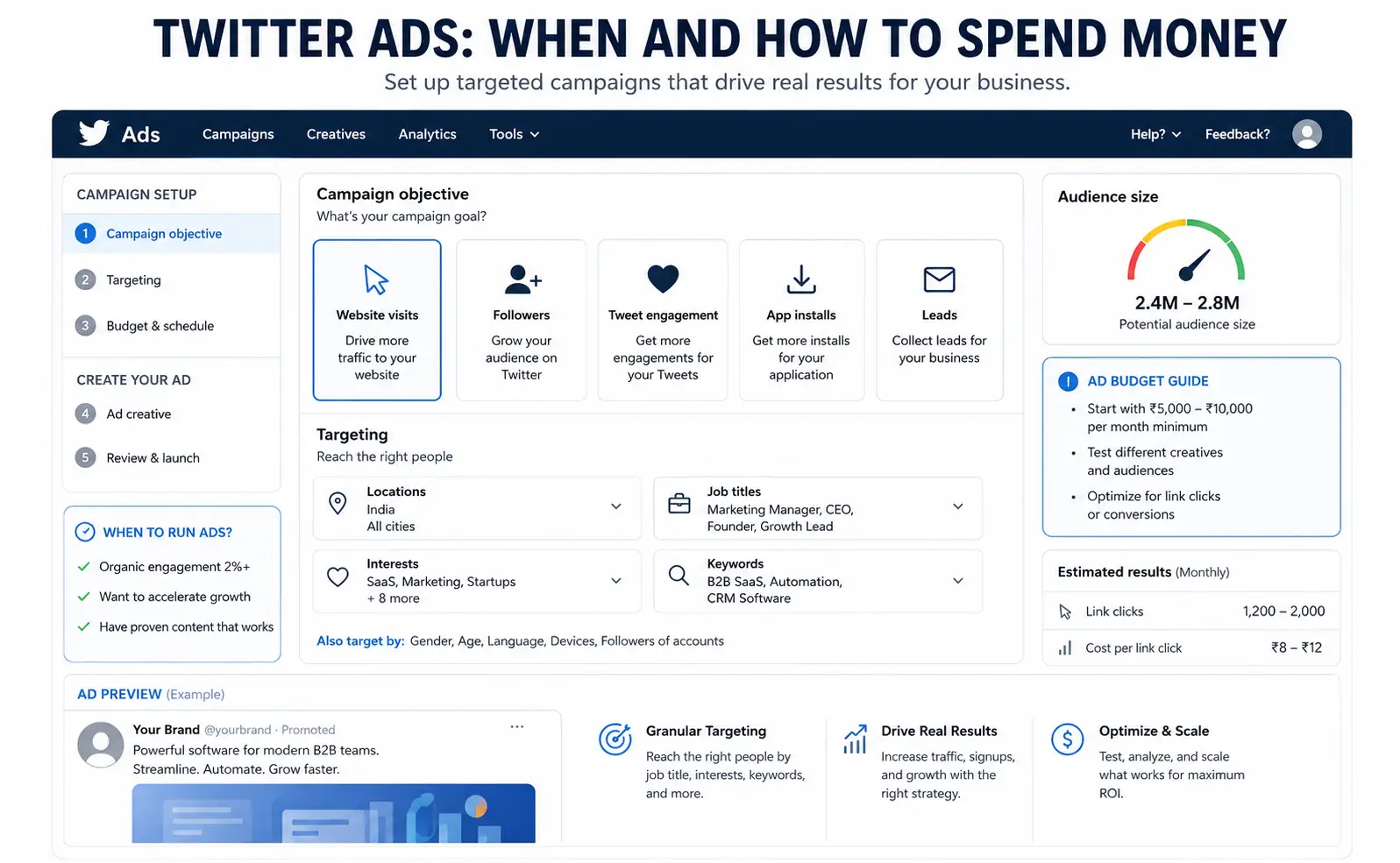
Twitter Ads: When and How to Spend Money
The platform makes money from ads. Obviously you can run them. Should you?
If your organic engagement is solid (2%+) and you want to accelerate, yes. If you haven’t found your organic voice yet, ads will just amplify mediocrity to a bigger audience.
Twitter ads work best for:
- Promoting specific content (link clicks, visits)
- Growing followers quickly (which works if you’re new and want credibility)
- Driving signups or trials for software and services
- Reaching specific job titles or interests in target regions
- Budget? Start at Rs 5,000-10,000 per month minimum to test properly. Lower than that, you’re just burning money on platform fees. We’ve worked with B2B companies spending Rs 40,000/month getting Rs 8-12 cost per click, which converts pretty well if your landing page doesn’t stink.
The targeting is granular — job titles, interests, keywords, followers of your competitors — so you can be pretty surgical. But the creative still has to be good. A bad ad with perfect targeting is still a bad ad.
Analytics: What Actually Matters
Twitter’s analytics dashboard will show you impressions, engagements, followers, retweets. Most of that is noise.
What matters: impressions (are you reaching people?), engagement rate (is it above 2%?), click-through rate if you’re driving traffic, and whether those people are actually turning into leads or customers.
I see brands get obsessed with follower count. “We grew 1,000 followers this month!” Meanwhile they got 12 actual leads. Focus on outcomes. That’s how you know if Twitter is working or if you’re just posting to a void.
We usually connect Twitter to email or CRM to track: which tweets drove visits, which visits became leads, which leads became customers. That’s the actual metric that matters. Nobody cares about a tweet with 5,000 impressions that drove zero revenue.
Real Mistakes We’ve Seen
These are real challenges we’ve encountered while helping brands improve their social media strategy and engagement.
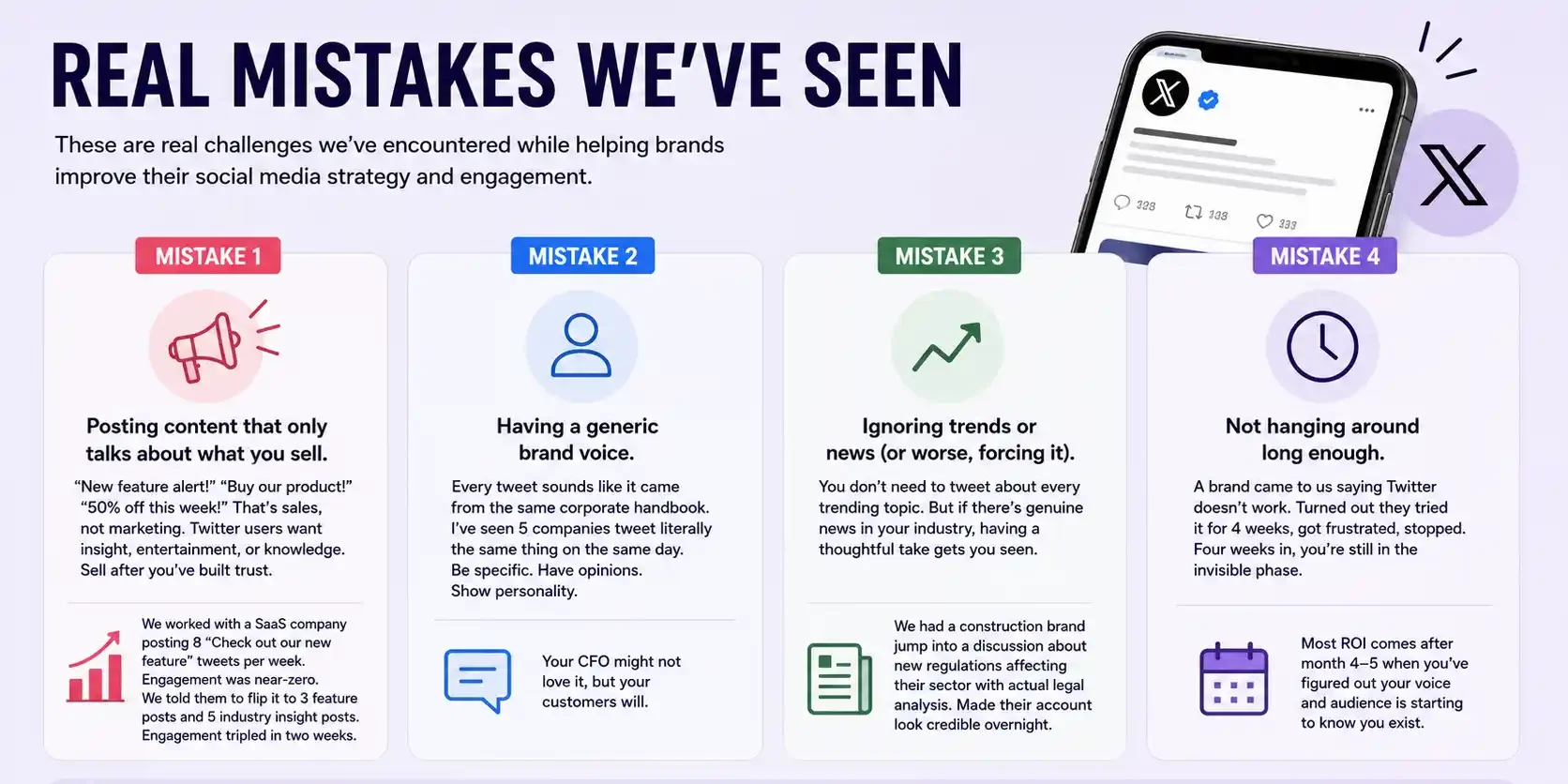
Mistake 1:
Posting content that only talks about what you sell. “New feature alert!” “Buy our product!” “50% off this week!” That’s sales, not marketing. Twitter users want insight, entertainment, or knowledge. Sell after you’ve built trust. We worked with a SaaS company posting 8 “Check out our new feature” tweets per week. Engagement was near-zero. We told them to flip it to 3 feature posts and 5 industry insight posts. Engagement tripled in two weeks.
Mistake 2:
Having a generic brand voice. Every tweet sounds like it came from the same corporate handbook. I’ve seen 5 companies tweet literally the same thing on the same day. Be specific. Have opinions. Show personality. Your CFO might not love it, but your customers will. A distinct, consistent voice is what brand identity design establishes at the foundation — and on Twitter, where every post competes for attention in milliseconds, that distinctiveness is the difference between being remembered and being scrolled past.
Mistake 3:
Ignoring trends or news (or worse, forcing it). You don’t need to tweet about every trending topic. But if there’s genuine news in your industry, having a thoughtful take gets you seen. We had a construction brand jump into a discussion about new regulations affecting their sector with actual legal analysis. Made their account look credible overnight.
Mistake 4:
Not hanging around long enough. A brand came to us saying Twitter doesn’t work. Turned out they tried it for 4 weeks, got frustrated, stopped. Four weeks in, you’re still in the invisible phase. Most ROI comes after month 4-5 when you’ve figured out your voice and audience is starting to know you exist.
Practical Roadmap: What to Do When
Month 1: Set up profile properly. Clear bio (what do you do, not jargon). Profile picture that’s recognizable. Cover image that actually says something. Find your voice in 5-10 test tweets. Follow 100-200 relevant accounts. Don’t promote anything. Just observe and participate.
Month 2: Post 3-5 times per week. Mix of insights, takes, and industry content. Engage genuinely with 30 other accounts’ tweets daily. You probably won’t get traction yet. That’s expected.
Month 3: One of your tweets will probably hit unexpectedly. Notice what made it work. Do more of that. Keep posting, keep engaging. You might be at 500-1,000 followers by now.
Month 4+: You’ve found what resonates. Posts get 2-5% engagement now. You’re getting replies from people outside your follower base. This is when leads can start flowing. Now’s when you could test Twitter ads if you want acceleration.
Should You Mix Twitter With Other Social Channels?
Absolutely. Twitter shouldn’t be your only channel. Most brands need a mix — Twitter for authority and B2B reach, Instagram for awareness and product showcase, LinkedIn for professional positioning, email for actual conversion.
At PromotEdge, we usually build integrated social media strategies where each platform has a role. Twitter drives awareness and authority, Instagram drives engagement and reach, email drives sales. Each channel talks to each other — a Twitter insight becomes an email, a product showcased on Instagram gets discussed on Twitter.
Single-channel marketing rarely works. Twitter is powerful but strongest as part of a bigger picture. We’ve seen social media analytics show that brands mixing channels get 3x better ROI than single-channel brands.
The Tools That Actually Help
You don’t need fancy tools to start. Twitter’s native posting and analytics work fine. But if you want to schedule, batch-create, or analyse better, tools like Buffer or Hootsuite help.
For content ideas, look at trending discussions in your space. For analytics, Twitter’s built-in dashboard is solid. For engagement tracking, spreadsheets work until you outgrow them.
The tool isn’t the constraint. Content quality and consistency are.
| Approach | Best for | Watch out for |
|---|---|---|
| DIY | Small teams, tight budgets | Slow ramp-up, trial-and-error |
| Freelancer | Specific project bursts | Inconsistency, limited ownership |
| Agency | Ongoing work, senior input | Higher retainer, less control |
Quick checklist before you start:
- Define the one thing you want: leads, sales, awareness — pick one.
- Baseline your numbers: write down where you are today.
- Pick a 90-day window: nothing moves in 2 weeks.
- Agree on success metrics: with whoever is paying the bill.
- Set up proper tracking: GA4, UTMs, call tracking.
- Review monthly: kill what doesn’t work, double down on what does.
The Bottom Line
If you take one thing from this: x twitter marketing how brands can stay relevant in 2026 rewards patience and specificity, not volume or clever tricks. Start small, measure honestly, fix what breaks, and compound what works. The brands doing this well in India aren’t smarter — they’re just consistent. Need a hand with this for your business? Talk to us.
Ready to Build Your Twitter Strategy?
We’ve helped 30+ brands figure out their Twitter presence. Some saw massive ROI within 3 months. Others realised Twitter wasn’t their priority. Either way, you’ll know where you stand.
FAQs
-
Is Twitter marketing worth it in India?
Ans.Depends on your audience. If you are B2B, finance, tech, or media — absolutely yes. The people on Twitter in India who are actually active tend to be decision-makers, investors, journalists, and professionals. FMCG brands? Lower ROI usually. But we've seen small SaaS companies in Bangalore build real leads through consistent Twitter activity when they could not crack it on LinkedIn. -
How often should brands tweet?
Ans.One quality tweet per day beats 10 mediocre ones. Consistency matters more than frequency. We have worked with brands posting 3 times a week who get engagement rates of 8-10%. The ones posting 5+ times daily see engagement drop because they're just noise. Quality first. -
Should I use X or Twitter branding?
Ans.Most people still call it Twitter. X is the official name (since 2023), but in India, people search for 'Twitter marketing' more than 'X marketing.' Use X in your profile name but target both terms in your content. It is confusing. We have been calling it both for over a year.
Author Details

Latest Posts
-
 26 / Aug
Search Engine Optimization Video SEO: How to Rank Your Videos in Google & YouTube
26 / Aug
Search Engine Optimization Video SEO: How to Rank Your Videos in Google & YouTube -
 25 / Aug
Video Production Corporate Video Production: A Practical Guide for Indian Brands
25 / Aug
Video Production Corporate Video Production: A Practical Guide for Indian Brands -
 24 / Aug
-
21 / Aug
Catalogue Design Catalogue Design: How to Create Catalogues That Actually Sell
-
 20 / Aug
Related Knowledge