-
Author: Anindita Barik
-
Updated Date: Jun-22-2026
-
Views: 2 Min Read
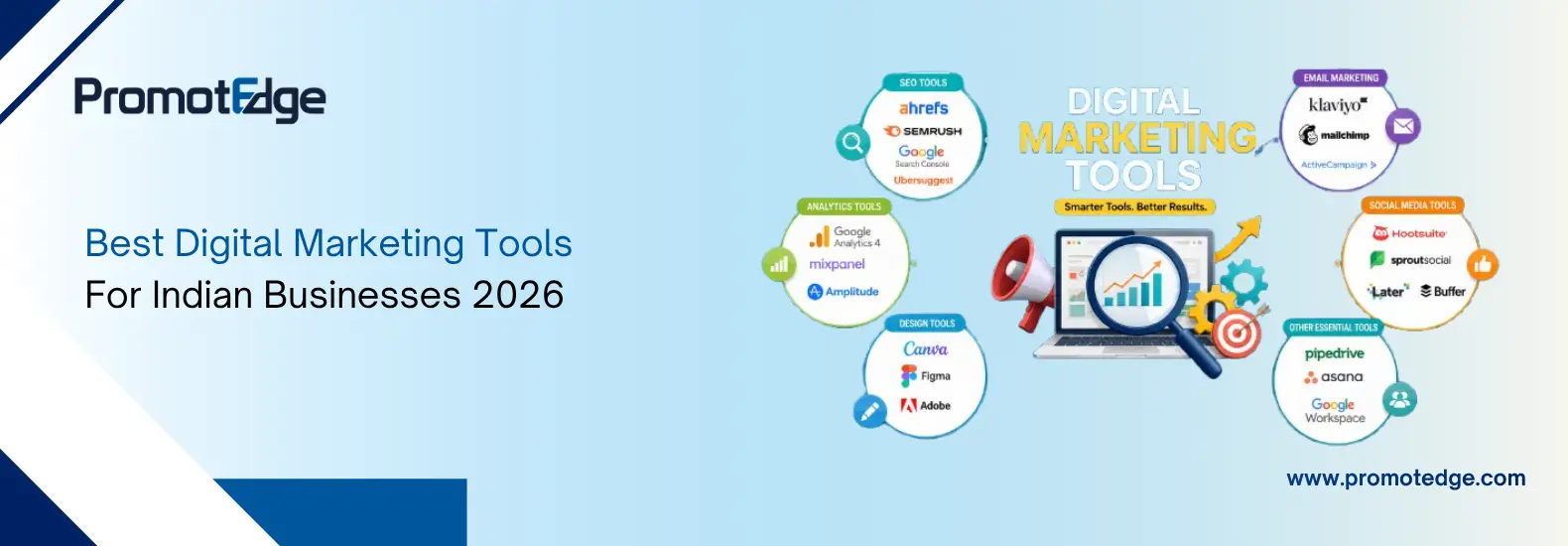
Finding the best digital marketing tools for Indian businesses 2026 isn’t about buying every subscription — it’s about mastering a few. This guide covers SEO tools like Ahrefs and Ubersuggest, email platforms like Klaviyo and Mailchimp, social schedulers, analytics, and design tools — with honest pricing in INR. Learn which tools actually move the needle for Indian brands, when to upgrade, and why discipline beats an expensive stack every time.
The best digital marketing tools for Indian businesses in 2026 depend on your revenue stage and goals. For SEO, Ahrefs remains the industry standard at ₹8,000/month, with Ubersuggest as a budget-friendly alternative. Klaviyo leads for email marketing among D2C and e-commerce brands, while Google Analytics 4 covers most analytics needs for free. For social scheduling, Hootsuite works well for small teams, and Canva Pro handles design at just ₹2,000 annually.
We Tried Replacing Ahrefs. It Didn’t Work
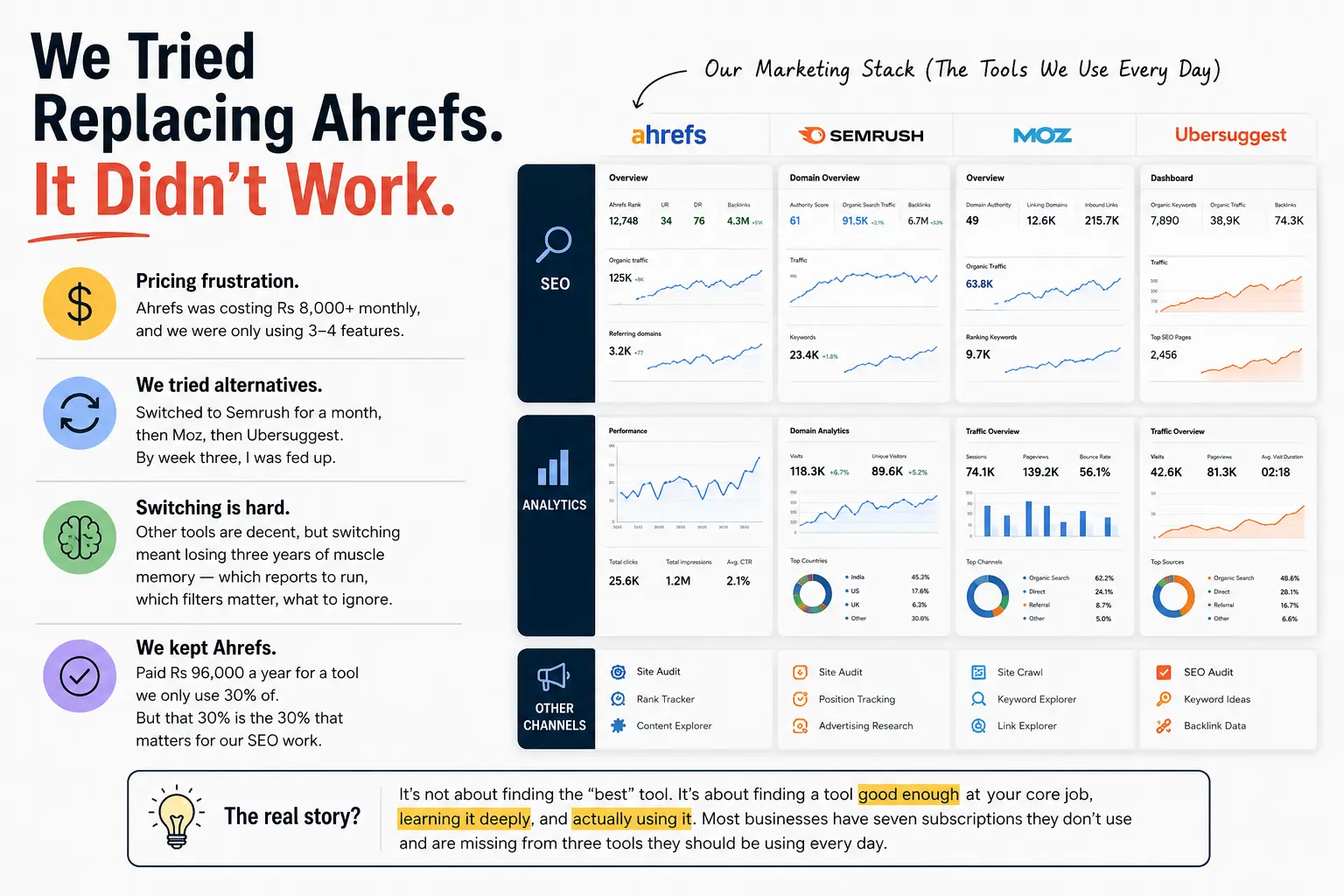
Last quarter, the team was getting annoyed at Ahrefs pricing. Rs 8,000+ monthly, and honestly, most of the time we’re only using 3-4 features. So we tried a rotation. Switched to Semrush for a month, then Moz, then Ubersuggest.
By week three of switching, I got fed up. Not because the other tools are bad — they’re decent. But because I’d spent three years learning exactly which reports in Ahrefs to run, which filters matter, which data to ignore. Switching tools meant losing that muscle memory.
We kept Ahrefs. Paid Rs 96,000 a year for a tool we only use 30% of. But that 30% is the 30% that matters for our SEO work.
This is the real story with marketing tools that nobody tells: it’s not about finding the “best” tool. It’s about finding a tool good enough at your core job, learning it deeply, and actually using it. Most businesses have seven subscriptions they don’t use and are missing from three tools they should be using every day.
Why Tools Matter (But Not As Much As Discipline)
Bad tools slow you down. Good tools give you information. Great tools become invisible — you just use them without thinking.
A bad email tool loses 5% of your emails. Good email tools (Klaviyo, ActiveCampaign) lose almost nothing, and they give you segmentation data that bad tools don’t even track. That translates to better targeting and higher ROI on every campaign.
But here’s what I’ve learned: a brand using Google Analytics and Excel spreadsheets with actual discipline beats a brand with Mixpanel and Amplitude and no process. Tools amplify what you’re already doing. If you’re not measuring anything, expensive tools just give you more numbers to ignore.
We’ve seen FMCG brands in Delhi making Rs 5 crores annual revenue running on Google Sheets and email reminders. And we’ve seen e-commerce brands with Rs 50 lakhs revenue using a stack worth Rs 2 lakhs annually that they barely understand. Sabse pehle ROI (ROI first) means: don’t pay for what you won’t use.
SEO Tools — Because You Need To Know What You’re Competing For
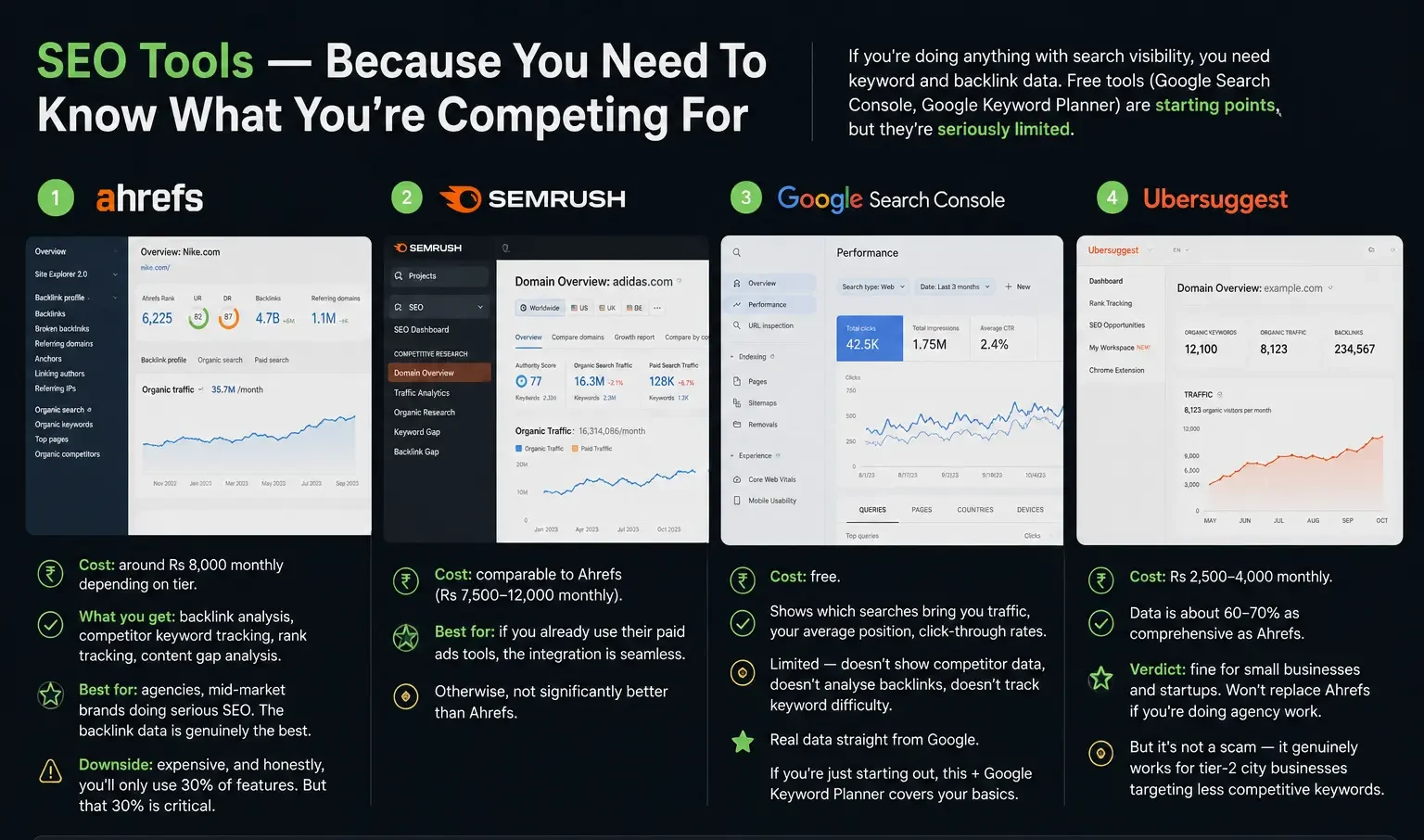
If you’re doing anything with search visibility, you need keyword and backlink data. Free tools (Google Search Console, Google Keyword Planner) are starting points, but they’re seriously limited. Understanding what SEO actually is before investing in tools will save you money and confusion.
1. Ahrefs
The industry standard. Every SEO team uses it. Cost: around Rs 8,000 monthly depending on tier. What you get: backlink analysis, competitor keyword tracking, rank tracking, content gap analysis.
Best for: agencies, mid-market brands doing serious SEO. The backlink data is genuinely the best.
Downside: expensive, and honestly, you’ll only use 30% of features. But that 30% is critical.
2. SEMrush
Slight alternative to Ahrefs. Similar features, different UI. Cost is comparable (Rs 7,500-12,000 monthly).
Best for: if you already use their paid ads tools, the integration is seamless. Otherwise, not significantly better than Ahrefs.
3. Google Search Console
Free. Shows which searches bring you traffic, your average position, click-through rates. It’s limited — doesn’t show competitor data, doesn’t analyse backlinks, doesn’t track keyword difficulty.
But it’s real data straight from Google. If you’re just starting out, this + Google Keyword Planner covers your basics.
4. Ubersuggest
Positioning itself as the “affordable Ahrefs.” Cost: Rs 2,500-4,000 monthly. Data is about 60-70% as comprehensive as Ahrefs.
Verdict: fine for small businesses and startups. Won’t replace Ahrefs if you’re doing agency work. But it’s not a scam — it genuinely works for tier-2 city businesses targeting less competitive keywords.
Social Media Tools — Less Exciting Than You’d Think
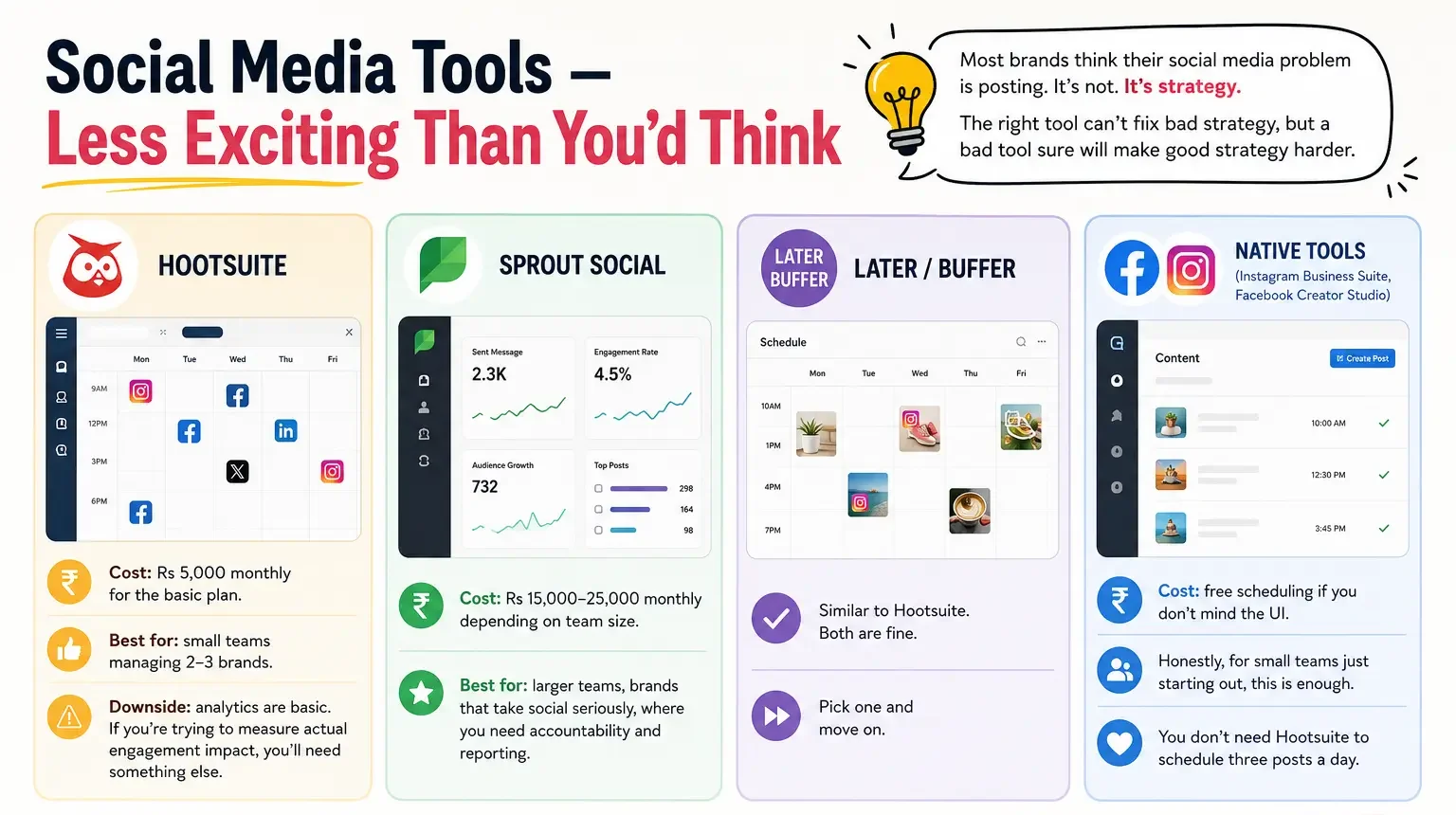
Most brands think their social media problem is posting. It’s not. It’s strategy. The right tool can’t fix bad strategy, but a bad tool sure will make good strategy harder.
Hootsuite
Schedule posts across Instagram, Facebook, Twitter, LinkedIn. Rs 5,000 monthly for the basic plan. Simple UI, reliable posting, nothing fancy.
Best for: small teams managing 2-3 brands. Works fine.
Downside: analytics are basic. If you’re trying to measure actual engagement impact, you’ll need something else.
Sprout Social
Higher-end version of Hootsuite. Better analytics, team collaboration features, engagement tracking. Cost Rs 15,000-25,000 monthly depending on team size.
Best for: larger teams, brands that take social seriously, where you need accountability and reporting.
Later/Buffer
Similar to Hootsuite. Both are fine. Pick one and move on.
Native Tools (Instagram Business Suite, Facebook Creator Studio)
Free scheduling if you don’t mind the UI. Honestly, for small teams just starting out, this is enough. You don’t need Hootsuite to schedule three posts a day.
For social media strategy work (actual audience building, engagement, community), the tool doesn’t matter. Your content and consistency matter. Use whatever you remember to check every day.
Email Marketing — The One Tool That Actually Affects Revenue
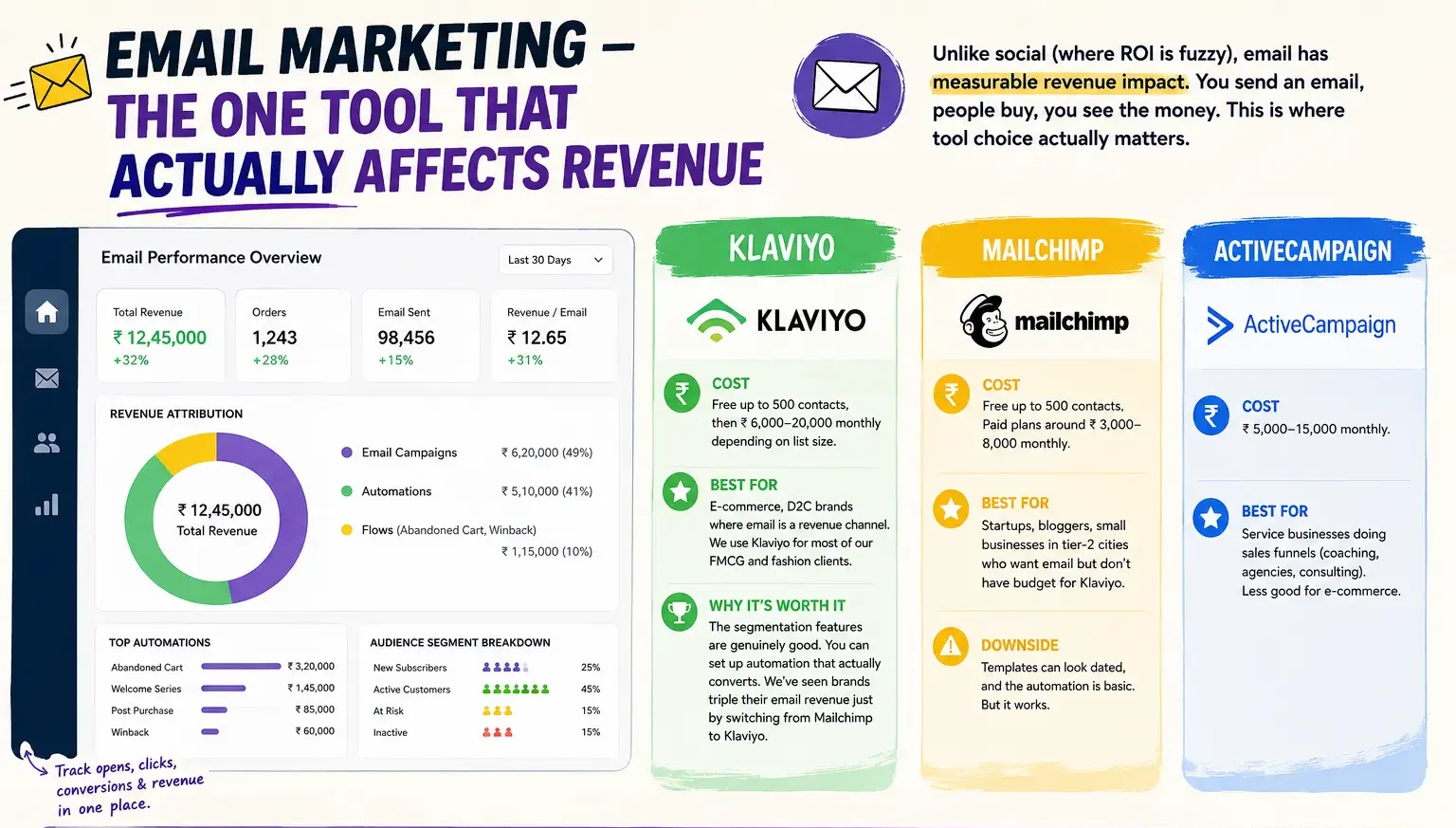
Unlike social (where ROI is fuzzy), email has measurable revenue impact. You send an email, people buy, you see the money. This is where tool choice actually matters. See our full breakdown of email marketing strategies that drive revenue.
-
Klaviyo
Built for e-commerce. Advanced segmentation, automation, analytics. Cost: free up to 500 contacts, then Rs 6,000-20,000 monthly depending on list size.
Best for: e-commerce, D2C brands where email is a revenue channel. We use Klaviyo for most of our FMCG and fashion clients.
Why it’s worth it: the segmentation features are genuinely good. You can set up automation that actually converts. We’ve seen brands triple their email revenue just by switching from Mailchimp to Klaviyo.
-
Mailchimp">Mailchimp
Free up to 500 contacts. Paid plans around Rs 3,000-8,000 monthly. Simpler than Klaviyo, fewer automation options.
Best for: startups, bloggers, small businesses in tier-2 cities who want email but don’t have budget for Klaviyo.
Downside: templates can look dated, and the automation is basic. But it works.
-
ActiveCampaign
Middle ground between Mailchimp and Klaviyo. Better automation than Mailchimp, less e-commerce focused than Klaviyo. Cost Rs 5,000-15,000 monthly.
Best for: service businesses doing sales funnels (coaching, agencies, consulting). Less good for e-commerce.
Here’s the thing: choose one and commit. Don’t switch every six months. Switching means losing segmentation data, losing your email history, losing templates, starting over with automation. The cost of switching is higher than the cost of just staying.
Analytics — Where Most Businesses Get This Wrong
We had an FMCG client ask us last month: “Which analytics tool is best?” So we asked: “What question are you trying to answer?” They looked confused. They just wanted to “see their data.”
That’s the mistake. You don’t need the best analytics tool. You need the right question to ask.
Google Analytics 4
Free. If you’re not using it, start today. It tracks: traffic source, page behaviour, user journey, goals/conversions. This covers 90% of what most businesses need.
But — and this is critical — GA4’s learning curve is steep if you’ve never set it up properly. If you don’t configure goals and events correctly, you’ll get data that means nothing.
Mixpanel
Event-based analytics. More granular than GA4. Cost: free up to 5,000 monthly events, then Rs 10,000+ monthly for higher tiers.
Best for: SaaS companies tracking user behaviour within their app. Overkill for e-commerce or most service businesses.
Amplitude
Similar to Mixpanel. Both are good. Pick one if you actually need event-level data (SaaS, mobile apps). Otherwise, Google Analytics is enough.
The Honest Take
Most businesses should use Google Analytics. Set it up right once (with the help of an actual analytics person, not an online tutorial), and you’re good. Fancier tools don’t give you better insights — they give you more data to confuse you with.
Design Tools — Because Canva Isn’t Always Enough
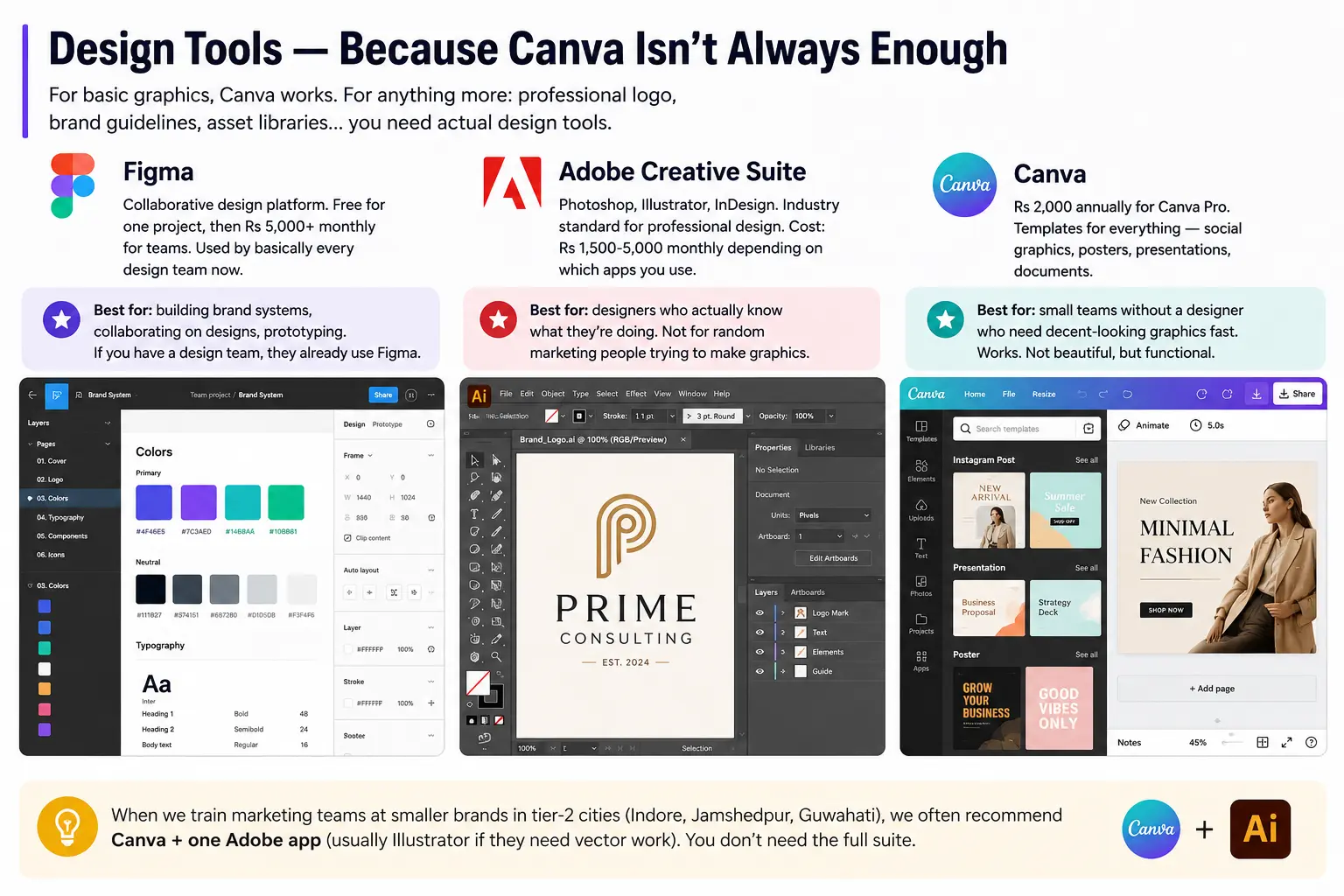
For basic graphics, Canva works. For anything more: professional logo, brand guidelines, asset libraries… you need actual design tools.
Figma
Collaborative design platform. Free for one project, then Rs 5,000+ monthly for teams. Used by basically every design team now.
Best for: building brand systems, collaborating on designs, prototyping. If you have a design team, they already use Figma.
Adobe Creative Suite
Photoshop, Illustrator, InDesign. Industry standard for professional design. Cost: Rs 1,500-5,000 monthly depending on which apps you use.
Best for: designers who actually know what they’re doing. Not for random marketing people trying to make graphics.
Canva
Rs 2,000 annually for Canva Pro. Templates for everything — social graphics, posters, presentations, documents.
Best for: small teams without a designer who need decent-looking graphics fast. Works. Not beautiful, but functional.
When we train marketing teams at smaller brands in tier-2 cities (Indore, Jamshedpur, Guwahati), we often recommend Canva + one Adobe app (usually Illustrator if they need vector work). You don’t need the full suite.
The PromotEdge Stack (What We Actually Use)
SEO: Ahrefs (mandatory), Google Search Console (daily). When we’re broke or working with a tight-budget client, we add Ubersuggest.
Analytics: Google Analytics 4 + Mixpanel for SaaS clients. Sometimes Amplitude if the client insists (it’s fine, but similar).
Email: Klaviyo for 80% of clients (FMCG, fashion, e-commerce). Mailchimp for tiny startups. ActiveCampaign occasionally for service businesses.
Social: Hootsuite for scheduling, Sprout Social for bigger teams. For content creation, we use Figma or the Adobe Suite depending on complexity.
Project management: Asana mostly. Some teams prefer Monday.com. Both work. Don’t overthink it.
CRM: We use Pipedrive for our own business. It’s not fancy, but the sales pipeline tracking is solid.
Not on the list: HubSpot (overkill for most Indian businesses), Hootsuite’s advanced tier (waste), most AI copywriting tools (they’re novelties, not production-grade).
The Real Talk About Tool Switching
Every six months someone finds a “cheaper” tool or a “better” tool and wants to switch. Don’t. The switching cost (data migration, team retraining, lost context) is almost always higher than the savings.
We switched from Pipedrive to Salesforce once. Looked better on paper. Cost Rs 2 lakhs in implementation and training, lost two weeks of sales data, our team hated it. Switched back. Now we tell clients: pick a good-enough tool, stay with it for at least 18 months, then reassess.
The brand with Klaviyo beating the brand with HubSpot isn’t because HubSpot is bad. It’s because they’ve been using Klaviyo for three years and know how to segment audiences in their sleep. That expertise matters more than the tool.
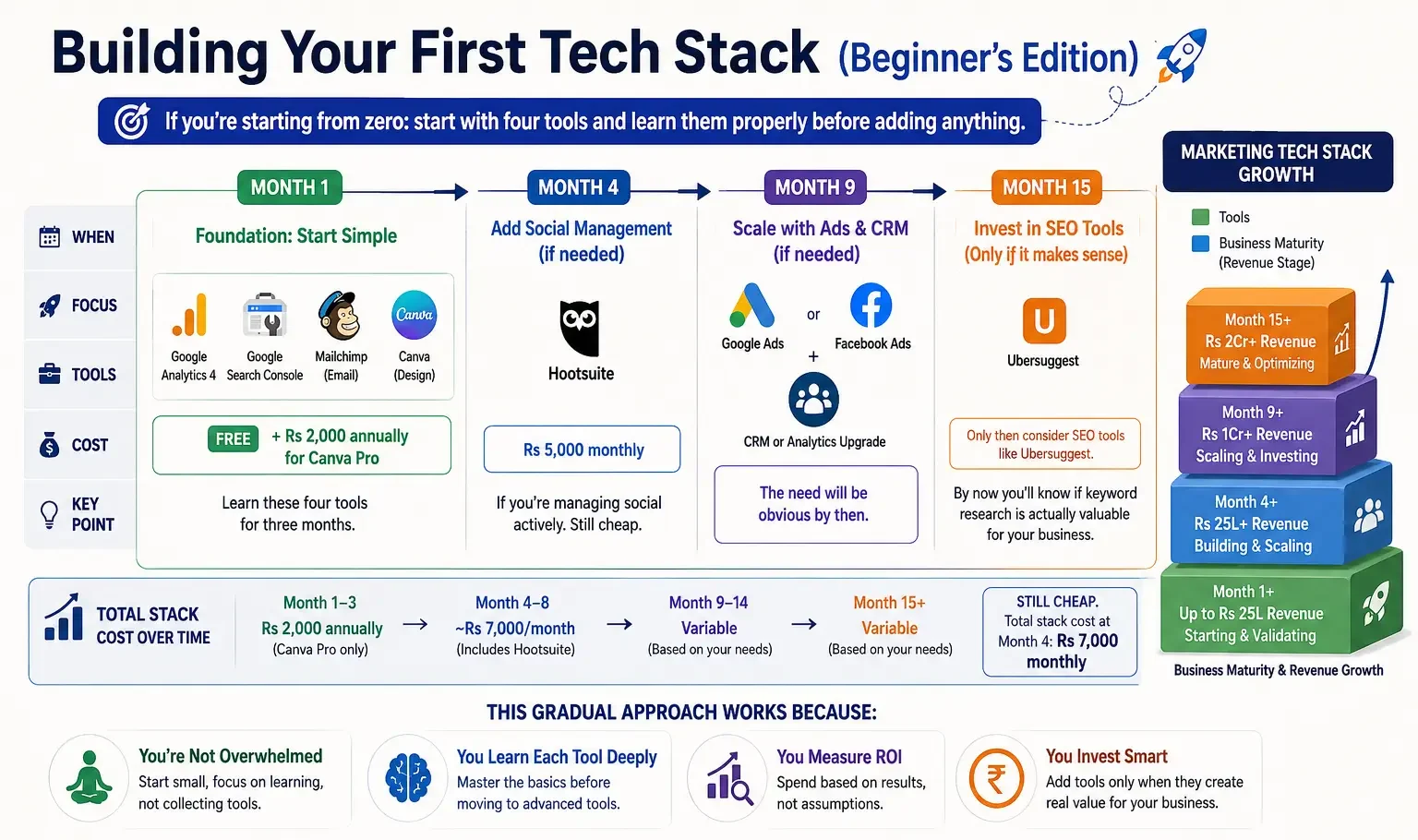
Building Your First Tech Stack (Beginner’s Edition)
If you’re starting from zero: start with four tools and learn them properly before adding anything.
Month 1: Set up Google Analytics 4, Google Search Console, Mailchimp (email), Canva (design). Cost: free + Rs 2,000 annually for Canva Pro. That’s it. Learn these four for three months.
Month 4: Add Hootsuite if you’re managing social actively. Cost: Rs 5,000 monthly. Still cheap. Total stack cost: Rs 7,000 monthly.
Month 9: If you’re doing paid ads (Google Ads or Facebook), add a CRM or analytics upgrade. The need will be obvious by then.
Month 15: Only then consider SEO tools like Ubersuggest. By now you’ll know if keyword research is actually valuable for your business.
This gradual approach works because: you’re not overwhelmed, you learn each tool deeply, you measure ROI before adding expensive stuff. Don’t build a Rs 2 lakh/month tech stack when you’re doing Rs 50 lakhs annual revenue. That’s not investing. That’s ego.
The Tools We Recommend You Skip (But Everyone Buys)
HubSpot. It’s solid software, genuinely good. But for most Indian businesses doing under Rs 5 crores annual revenue, it’s overkill. The free tier is limited, and paying Rs 8,000-20,000 monthly when you could do the same thing in Pipedrive for Rs 3,000… doesn’t make financial sense.
Most AI writing tools (Copy.ai, Jasper, Sudowrite). They’re novelties. I’ve seen brands spend months setting these up for campaigns that underperform because the AI writing lacks actual strategy. Tool doesn’t replace thinking.
Expensive project management tools (Monday.com’s highest tier, Jira for small teams). Asana’s free tier + a $100/month paid seat works fine. Don’t over-engineer your ops.
Multiple email tools. Pick ONE. Using Mailchimp + Klaviyo + Active Campaign simultaneously means your data is fragmented, your audiences are duplicated, you’re spending money on three of something you only need one of.
ROI-First Approach To Tools
Every tool purchase should come with a question: “What will this help me measure or do that I can’t measure now?”
Adding Ahrefs? Answer: “I’ll see competitor keywords and backlinks, which tells me where SEO opportunities are.” Measurable. Worth it.
Adding Mixpanel? Answer: “I’ll track event sequences in my SaaS app, which helps me understand drop-off points.” Measurable. Worth it if you’re a SaaS company.
Adding some fancy marketing automation platform? Answer: “Ummm… it looks nice?” Not measurable. Skip it.
This is how we approach tool recommendations internally. Vinnay and I will spend a lot of time debating whether a new tool is worth the cost. Usually, we find we can do the same thing with existing tools + better discipline. Discipline is cheaper than software.
If you’re building a digital marketing strategy and tools are part of it, we help think through this. Not selling you subscriptions — actually weighing whether each tool serves your ROI goals.
| Approach | Best for | Watch out for |
|---|---|---|
| DIY | Small teams, tight budgets | Slow ramp-up, trial-and-error |
| Freelancer | Specific project bursts | Inconsistency, limited ownership |
| Agency | Ongoing work, senior input | Higher retainer, less control |
Quick checklist before you start:
- Define the one thing you want: leads, sales, awareness — pick one.
- Baseline your numbers: write down where you are today.
- Pick a 90-day window: nothing moves in 2 weeks.
- Agree on success metrics: with whoever is paying the bill.
- Set up proper tracking: GA4, UTMs, call tracking.
- Review monthly: kill what doesn’t work, double down on what does.
The Bottom Line
If you take one thing from this: best digital marketing tools for indian businesses 2026 rewards patience and specificity, not volume or clever tricks. Start small, measure honestly, fix what breaks, and compound what works. The brands doing this well in India aren’t smarter — they’re just consistent. Need a hand with this for your business? Talk to us.
Want Help Building Your Marketing Tech Stack?
We help Indian businesses choose and implement tools that actually move the needle. Not overselling expensive software, just honest assessment of what fits your revenue and your ambition.
FAQs
-
What are the best free digital marketing tools?
Ans.Google Analytics, Google Search Console, MailerLite (up to 1,000 subs), Canva (basic design), Google Keyword Planner. These genuinely work for getting started. They would not replace paid tools, but they are real and useful. -
Which tools does PromotEdge use?
Ans.Ahrefs + Google Search Console (SEO). Google Analytics 4 + Mixpanel for SaaS (analytics). Klaviyo or Mailchimp (email). Hootsuite or Sprout Social (social). Asana (projects). Figma + Adobe Suite (design). Not one magic stack — different tools for different client needs and budgets. -
How many tools do I need?
Ans.Start with four: analytics, email, one social tool, one design tool. Most small businesses get paralysed trying to use seven tools badly instead of four tools well. Add complexity as you grow and your ROI justifies it.
Author Details

Latest Posts
-
 24 / Sep
GMB Optimisation Google Business Profile Optimization Guide 2026
24 / Sep
GMB Optimisation Google Business Profile Optimization Guide 2026 -
 23 / Sep
Search Engine Optimization Programmatic SEO: Template + Data Model Explained
23 / Sep
Search Engine Optimization Programmatic SEO: Template + Data Model Explained -
 22 / Sep
Conversion Rate Optimization Conversion Rate Optimization: A Practical Guide
22 / Sep
Conversion Rate Optimization Conversion Rate Optimization: A Practical Guide -
 21 / Sep
Whatsapp Marketing WhatsApp Marketing for Indian SMBs
21 / Sep
Whatsapp Marketing WhatsApp Marketing for Indian SMBs -
 19 / Sep
Related Knowledge