-
Author: Anindita Barik
-
Updated Date: Jun-18-2026
-
Views: 2 Min Read
AI in digital marketing refers to systems that learn patterns from your data to make decisions and predictions automatically — from email send-time optimization and ad bidding to lead scoring and content drafting. This blog covers how AI is actually being used across email, paid ads, content creation, and customer insights; which tools genuinely use machine learning vs. marketing hype; where AI fails (small data, attribution delays, bias); and a practical 3-step framework to integrate it without scaling your mistakes. The core argument: AI removes repetitive execution work so marketers can focus on strategy, judgment, and creativity — but only works if your tracking is clean, your KPIs are clear, and a human stays in the loop to ask “does this make sense?”
Artificial intelligence has transformed digital marketing in ways that actually matter to businesses of all sizes. It looks at what your audience is searching for, what they click on, and what makes them buy — then helps you show up at exactly the right moment with exactly the right message. Tasks that used to eat up entire workdays, like sorting audiences, testing ad copy, or personalizing emails, now happen in the background without anyone lifting a finger.
What makes it truly valuable though isn’t the automation — it’s the clarity it gives you. Marketers today aren’t just guessing what might work and hoping for the best. They’re making decisions backed by real data, spotting trends before they peak, and understanding their customers on a level that just wasn’t possible a few years ago. AI handles the grunt work so the people behind the campaigns can focus on what actually takes human thinking — the ideas, the storytelling, and the strategy that makes a brand worth paying attention to.
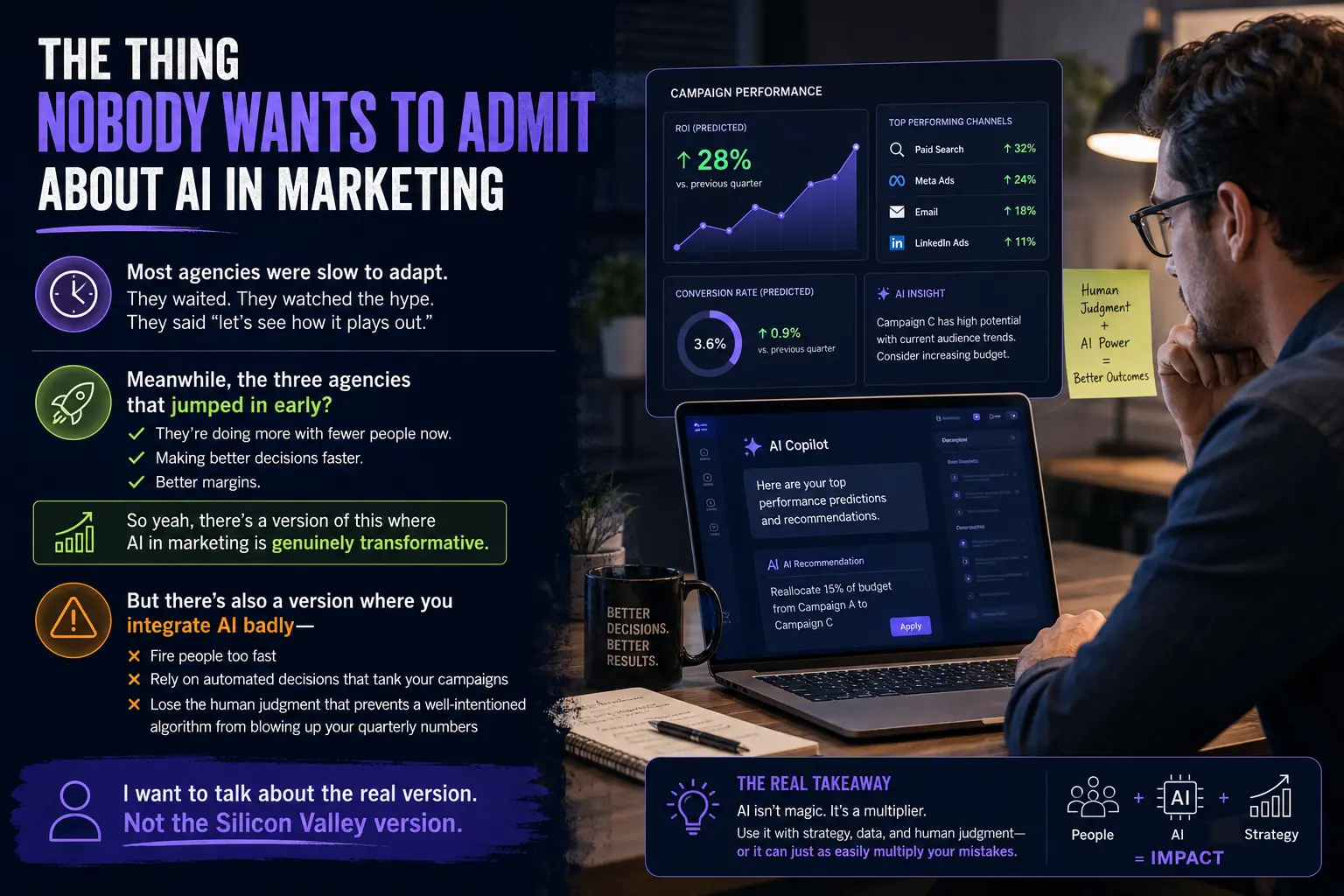
The Thing Nobody Wants to Admit About AI in Marketing
Most agencies were slow to adapt. They waited. They watched the hype. They said “let’s see how it plays out.”
Meanwhile, the three agencies that jumped in early? They’re doing more with fewer people now. Making better decisions faster. Better margins. So yeah, there’s a version of this where AI in marketing is genuinely transformative.
But there’s also a version where you integrate AI badly — fire people too fast, rely on automated decisions that tank your campaigns, lose the human judgment that prevents a well-intentioned algorithm from blowing up your quarterly numbers.
I want to talk about the real version. Not the Silicon Valley version.
What Is AI in Marketing (The Actual Definition)
Skip the textbook version. Here’s what it means in practice: AI is a system that learns patterns from your existing data and then makes decisions or predictions without being explicitly told how to do it.
Your email software learns who opens your emails and automatically sends future ones at the time that person is most likely to open. Advertising platform watches which ad variations perform best and starts putting more budget toward the winners. Customer database spots that people fitting profile X have a 70% chance of becoming repeat customers, so you should target people like that.
That’s AI. It’s not magical. It’s pattern recognition on steroids.
How AI Is Actually Being Used in Digital Marketing Right Now
Let me break down the areas where AI makes a real difference versus where agencies slap an “AI-powered” label on something that’s basically automated.
-
Email & Customer Communication
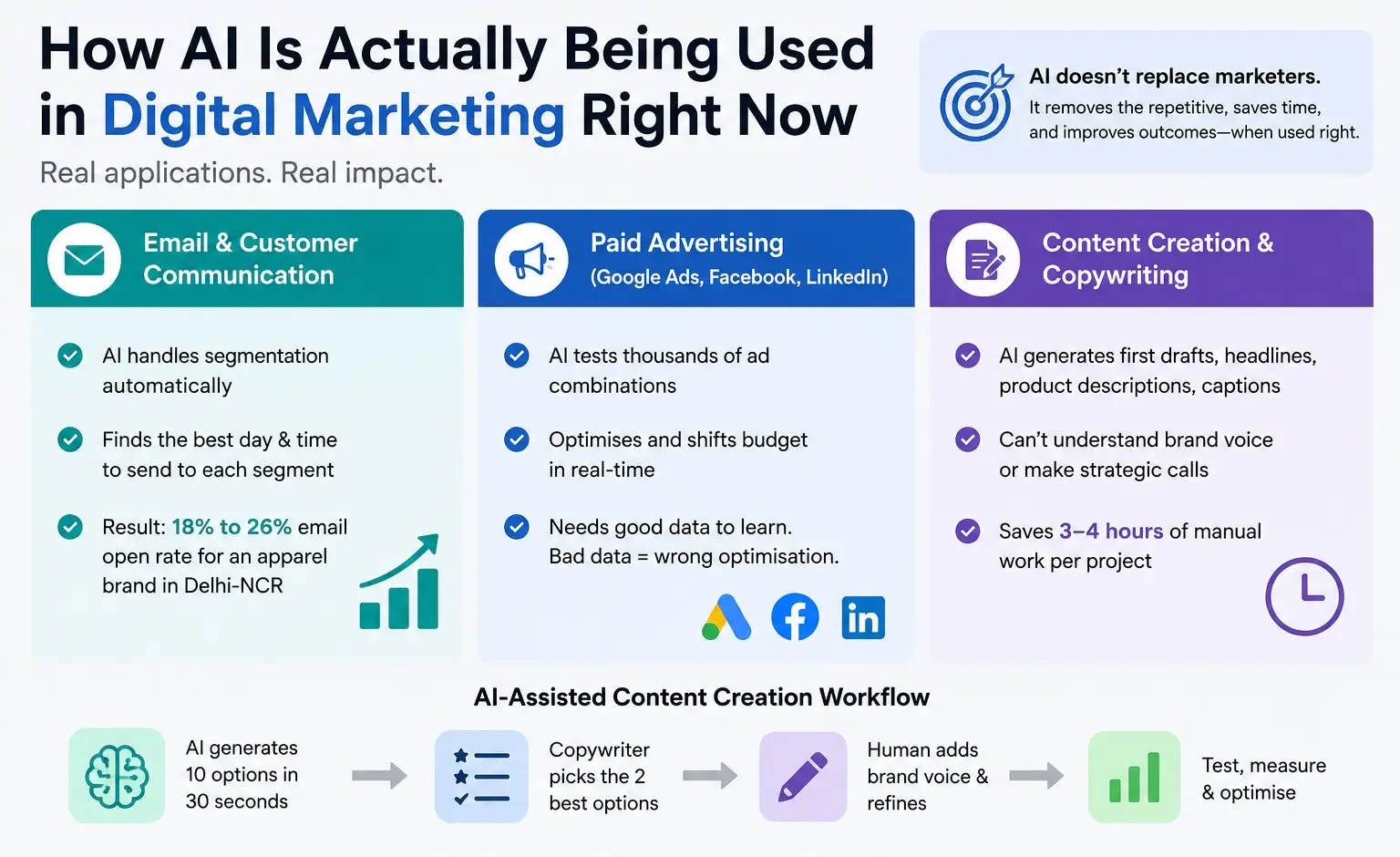
This is the easiest win. AI handles segmentation automatically. Instead of manually dividing your 50,000 email subscribers into 15 segments based on purchase history and behaviour, the algorithm does it for you. Then it figures out the best day and time to send to each segment.
A client of ours — an apparel brand selling sarees in Delhi-NCR — got their email open rate from 18% to 26% just by letting the platform handle optimal send times. Nothing changed about the content. Timing changed. And because everything else stayed the same, we actually know what the lift came from.
-
Paid Advertising (Google Ads, Facebook, LinkedIn)
Google’s Performance Max, Facebook’s automated bidding, LinkedIn’s account-based targeting — these all use AI. What’s happening under the hood: the platform is testing thousands of ad combinations against your conversion data, figuring out what works, and shifting budget in real-time.
The tricky part? You have to give the algorithm good data to learn from. Feed it bad data, it optimises for the wrong thing. We worked with a food delivery startup last year where their conversion tracking was broken. The AI was brilliant — just optimising for the wrong metric. Took two weeks to fix the tracking, then suddenly the numbers made sense.
-
Content Creation & Copywriting
This is where everyone gets excited and also where it goes sideways the fastest. AI can generate first drafts. Headlines. Subject lines. Product descriptions. Social media captions.
What it can’t do? Understand your brand voice. Make strategic creative choices. Know when a safe option is worse than a bold one. That still requires a human who actually cares about the brand.
So the workflow now: AI generates 10 options in 30 seconds. Copywriter picks the two worth refining, adds brand personality, tests them. That saves maybe 3-4 hours of staring at a blank page. Real time saved. But it’s not “AI writes your marketing copy” — it’s “AI handles the boring part, humans handle the actual work.”
Customer Insights & Prediction
This one’s powerful. AI looks at your existing customers — who buys, how much they spend, how often they come back, what they buy next — and builds a model. Then it scores all your prospects against that model. “This person has an 82% chance of becoming a customer. This one? 12%.”
We used this for a B2B industrial client. Turned out their best customers matched a very specific profile: mid-sized manufacturers in Pune and Hyderabad who had recently expanded their product lines. Once we knew that, everything changed. Ad targeting. Sales outreach. Content strategy. All aligned to “are they in that winning profile?”
The AI didn’t solve the problem. But it made the problem visible. And that’s where value comes from.
The Tools That Actually Work (Not the Hyped Ones)
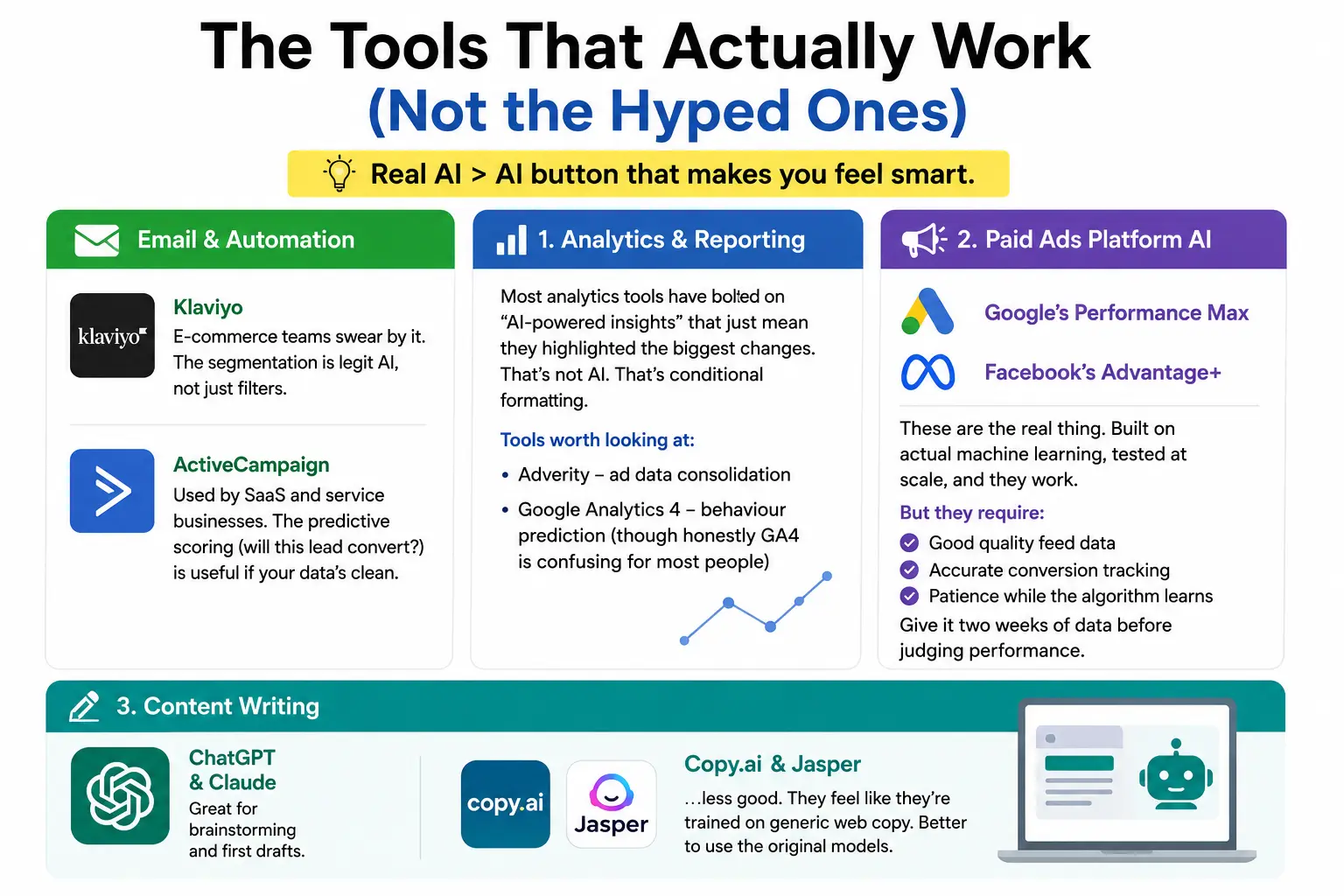
There’s a difference between tools with real AI and tools that just have an “AI” button that makes you feel smart.
Email & Automation
- Klaviyo — E-commerce teams swear by it. The segmentation is legit AI, not just filters.
- ActiveCampaign — Used by SaaS and service businesses. The predictive scoring (will this lead convert?) is useful if your data’s clean.
1.Analytics & Reporting
Most analytics tools have bolted on “AI-powered insights” that just mean they highlighted the biggest changes. That’s not AI. That’s conditional formatting.
Tools worth looking at: Adverity for ad data consolidation, Google Analytics 4 for behaviour prediction (though honestly GA4 is confusing for most people).
2. Paid Ads Platform AI
Google’s Performance Max, Facebook’s Advantage+ — these are the real thing. Both are built on actual machine learning, tested at scale, and they work. But they require: good quality feed data, accurate conversion tracking, and patience while the algorithm learns. Give it two weeks of data before judging performance.
3. Content Writing
ChatGPT and Claude for brainstorming and first drafts. Copy.ai and Jasper are… less good. They feel like they’re trained on generic web copy. Better to use the original models.
Where AI Actually Fails (And Why Agencies Won’t Tell You)
Because admitting failure is bad for business. But here’s the honest version.
- AI is bad at originality : It will never generate the idea that makes your brand stand out. It’ll generate the idea that worked well for everyone else — which means your ad looks like 15 other ads in the same space.
- AI is bad with small data : If you’re a startup with 200 customers, the algorithm is still in kindergarten. It needs thousands of data points to make good decisions.
- AI is bad at cause and effect when there’s delay : If someone sees your ad on Monday and buys on Friday, does the AI correctly credit the ad? Usually not. It’ll usually underestimate channel value because it doesn’t account for the time delay. This is a massive blind spot in attribution that nobody talks about.
- AI can be discriminatory by accident: If your historical customer data is skewed (say, 90% of your customers are from tier-1 cities), the algorithm will bias heavily toward tier-1 prospects. Is that efficient or unfair? That’s a business decision. But you need to know it’s happening.
The Real Impact: What Changes and What Doesn’t
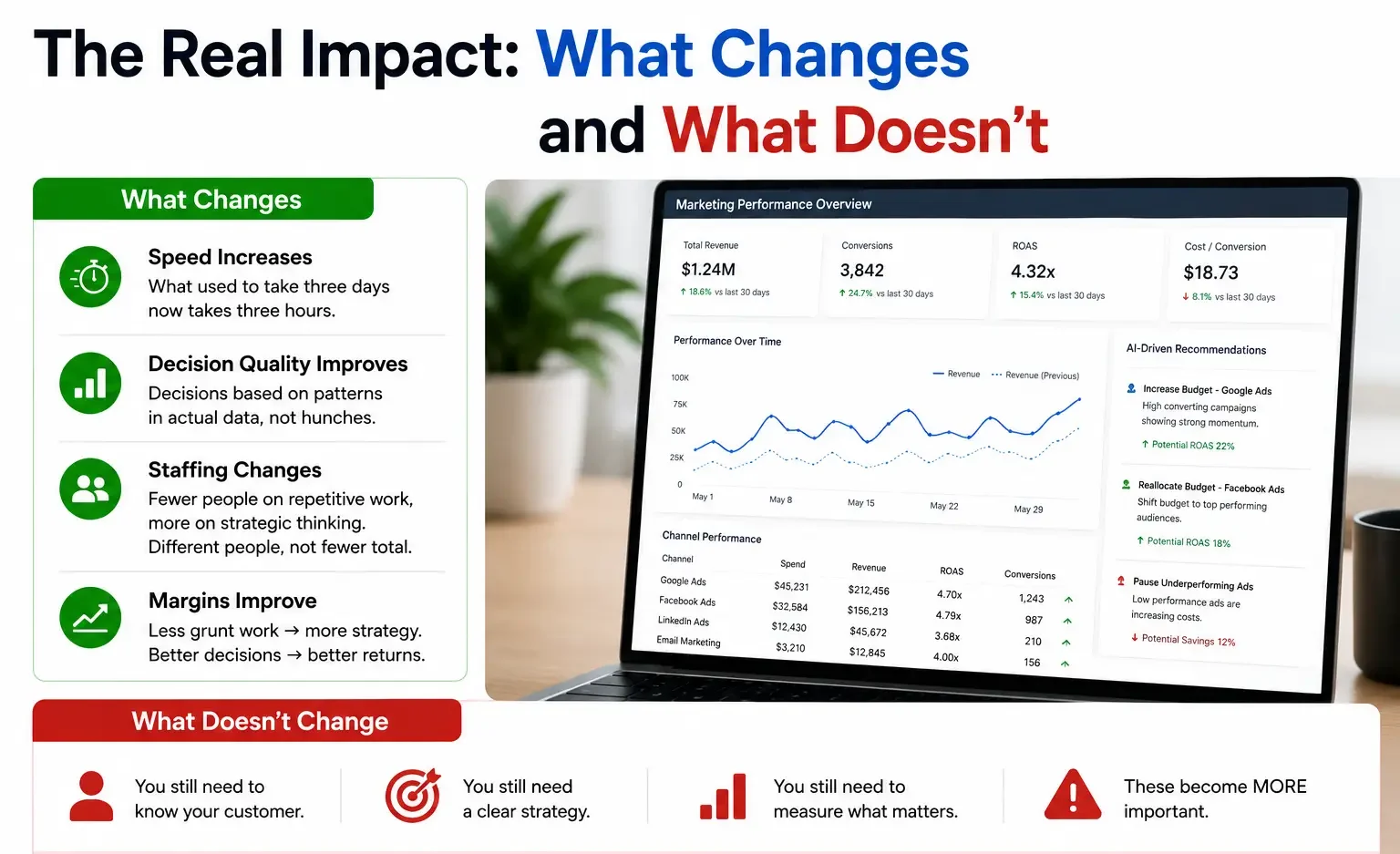
Speed increases. What used to take three days now takes three hours.
Decision quality improves. You’re making decisions based on patterns in actual data, not hunches.
Staffing changes. You need fewer people doing repetitive execution work, more people thinking strategically. Not fewer people total. Different people.
Margins improve. Fewer hours on grunt work means more time on strategy. More time on strategy means better decisions. Better decisions mean better returns.
What doesn’t change? You still need to know your customer. You still need a clear strategy. You still need to measure what matters. In fact, these become MORE important because bad strategy + AI execution = bad strategy at scale.
Should You Use AI in Your Marketing Right Now?
The answer depends on one question: Are you currently doing the basics well?
Basics = clean customer data, accurate tracking, clear KPIs, consistent messaging, regular testing.
If you’re not doing the basics, AI will make you faster at doing the wrong thing. You’ll scale your mistakes.
If you ARE doing the basics, then yes. Find the one area where you’re spending most manual time — could be email segmentation, could be ad setup, could be report writing — and introduce AI there first. Small win. Learn from it. Expand.
Most teams take 2-3 months to properly integrate one new AI tool. During that time, productivity dips. You’re learning. Then it clicks and you get your time back, plus efficiency gains.
That’s the unglamorous version. No overnight transformation. But real improvement if you approach it methodically.
Getting Started: 3 Steps That Actually Work
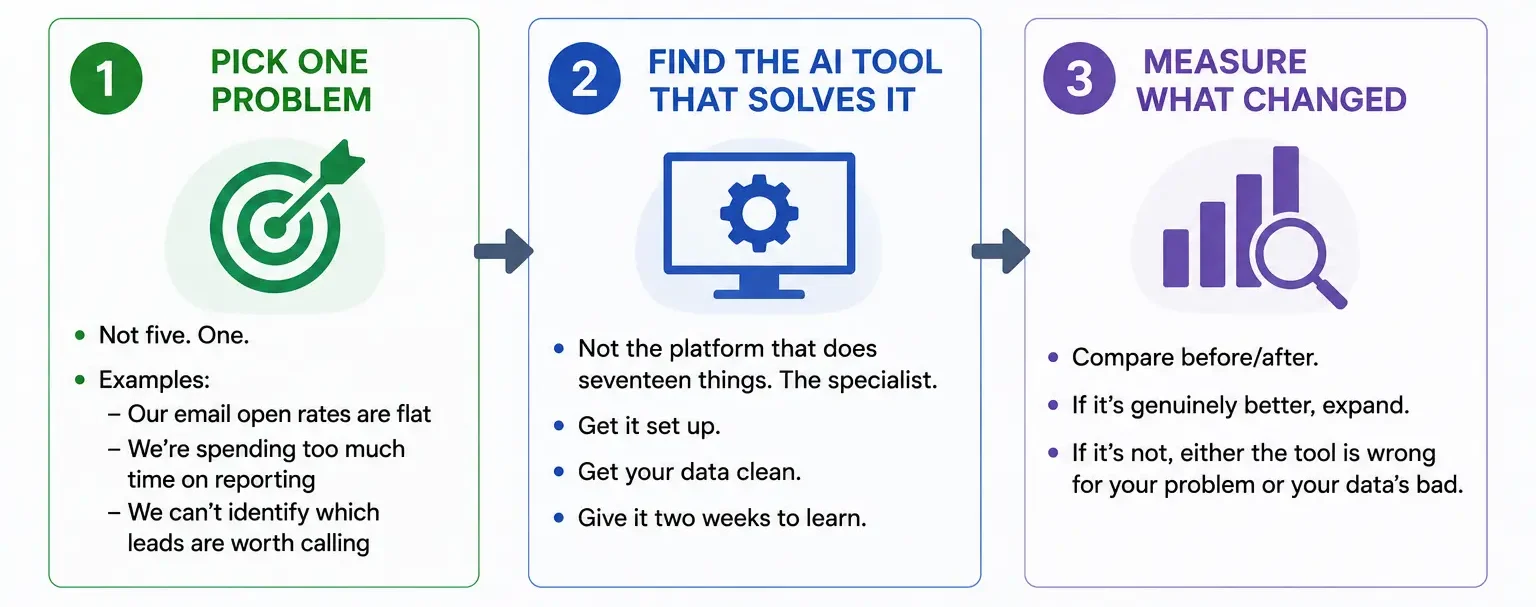
First : Pick ONE problem. Not five. One. “Our email open rates are flat” or “We’re spending too much time on reporting” or “We can’t identify which leads are worth calling.”
Second : Find the AI tool that solves that one problem. Not the platform that does seventeen things. The specialist. Get it set up, get your data clean, give it two weeks to learn.
Third : Measure what changed. Compare before/after. If it’s genuinely better, expand. If it’s not, either the tool is wrong for your problem or your data’s bad.
Then repeat. Next problem. Next tool. Build your stack slowly, deliberately. This is how you avoid the “we bought five platforms, nobody knows how to use them” situation.
One More Thing: The Human Element Still Matters
Last month, our team caught something weird in the performance data. A keyword we thought was worthless was actually driving quality leads — the conversion metric just wasn’t capturing it because of how the sale was structured. The algorithm would’ve killed that keyword.
That’s the thing nobody talks about. AI optimizes for what you measure. If you measure wrong, AI fails. If you don’t have someone asking “wait, does this make sense?”, you end up with great numbers and terrible business results.
So AI in marketing isn’t about replacing humans. It’s about removing the stuff humans are bad at (repetition, pattern recognition on large datasets, testing thousands of variables) so humans can focus on what they’re good at (judgment, creativity, asking “why”).
The best marketing teams we know? They’re not fully automated. They’re not anti-AI either. They’re using AI as a tool and staying skeptical. Questioning the recommendations. Testing assumptions. That’s the version that actually wins.
| Approach | Best for | Watch out for |
|---|---|---|
| DIY | Small teams, tight budgets | Slow ramp-up, trial-and-error |
| Freelancer | Specific project bursts | Inconsistency, limited ownership |
| Agency | Ongoing work, senior input | Higher retainer, less control |
Quick checklist before you start:
- Define the one thing you want: leads, sales, awareness — pick one.
- Baseline your numbers: write down where you are today.
- Pick a 90-day window: nothing moves in 2 weeks.
- Agree on success metrics: with whoever is paying the bill.
- Set up proper tracking: GA4, UTMs, call tracking.
- Review monthly: kill what doesn’t work, double down on what does.
The Bottom Line
If you take one thing from this: AI in digital marketing is changing the way brands grow, but it rewards patience and specificity, not volume or clever tricks. Start small, measure honestly, fix what breaks, and compound what works. The brands doing this well in India aren’t smarter — they’re just consistent. Need a hand with this for your business? Explore our digital marketing services or talk to us.
Ready to Transform Your Marketing?
We’ve been integrating AI into client strategies across 250+ brands for two years now. Let’s talk about where AI could actually help your business.
FAQs
-
How is AI used in digital marketing?
Ans.AI handles the stuff that used to take people days. Email segmentation, ad audience targeting, content recommendations, chatbots answering customer questions at 2am. The bigger thing? Prediction. AI looks at past customer behaviour and tells you who's likely to buy, who's about to churn, what message will make them respond. The accuracy is honestly better than most human guesses. -
Will AI replace digital marketers?
Ans.Not in the way people think. The marketer who knows how to USE AI effectively? Not getting replaced. The marketer who just posts captions and hopes something sticks? Yeah, that job is changing. What won't change is strategy, creativity, customer empathy. AI is a tool. Like Excel didn't replace accountants — it just made bad accountants obsolete. -
What are the best AI marketing tools?
Ans.Depends what you need to do. For email: Klaviyo, ActiveCampaign. For ads and prediction: Adverity, Optmyzr. For content: Claude, ChatGPT (with human review). For insights: Salesforce Einstein, HubSpot's AI features. The ones that actually work are built for ONE job.
Author Details

Latest Posts
-
 24 / Sep
GMB Optimisation Google Business Profile Optimization Guide 2026
24 / Sep
GMB Optimisation Google Business Profile Optimization Guide 2026 -
 23 / Sep
Search Engine Optimization Programmatic SEO: Template + Data Model Explained
23 / Sep
Search Engine Optimization Programmatic SEO: Template + Data Model Explained -
 22 / Sep
Conversion Rate Optimization Conversion Rate Optimization: A Practical Guide
22 / Sep
Conversion Rate Optimization Conversion Rate Optimization: A Practical Guide -
 21 / Sep
Whatsapp Marketing WhatsApp Marketing for Indian SMBs
21 / Sep
Whatsapp Marketing WhatsApp Marketing for Indian SMBs -
 19 / Sep
Related Knowledge