-
Author: Anindita Barik
-
Updated Date: Jul-10-2026
-
Views: 2 Min Read
Ethical link building strategies separate sustainable SEO growth from risky shortcuts that invite Google penalties. For Indian websites, this means creating linkable content, pursuing digital PR outreach, and securing listings from trade associations like FICCI. Drawing on real client stories—including a penalty recovery that took eight months—this guide explains why relevance, authority, and placement matter more than link volume, and how consistent, patient execution builds long-term ranking power.
Ethical link building strategies for Indian websites rely on earning links through value, not manipulation. Key tactics: guest posting on reputable Indian blogs/publications, creating original research or region-specific data, broken link building, getting listed on trusted local directories (Google Business Profile, Justdial), and journalist/influencer outreach for genuine mentions.
Avoid black-hat shortcuts like buying links, link farms, or comment spam — these risk Google penalties. The best link building strategies focus on quality over quantity: a few high-authority, relevant Indian backlinks beat hundreds of low-quality ones, protecting long-term rankings and domain trust. This is the foundation of sustainable search engine optimisation — authority built slowly and honestly compounds in ways that shortcuts never can.
The Link That Changed Everything (And Almost Cost Us a Client)
2023. A manufacturing client of ours — industrial equipment, legitimate company, good products. They’d been struggling to rank for competitive keywords. We’d done everything: technical SEO, content, keyword research. Still stuck at position 8-10 for their main money keywords.
Then a previous agency they’d worked with — someone they’d fired years earlier — contacted them with an offer: “Get 50 backlinks in 30 days, guaranteed ranking improvement, Rs 40,000.” Our client called me panicking. “Why would they do this if it doesn’t work?”
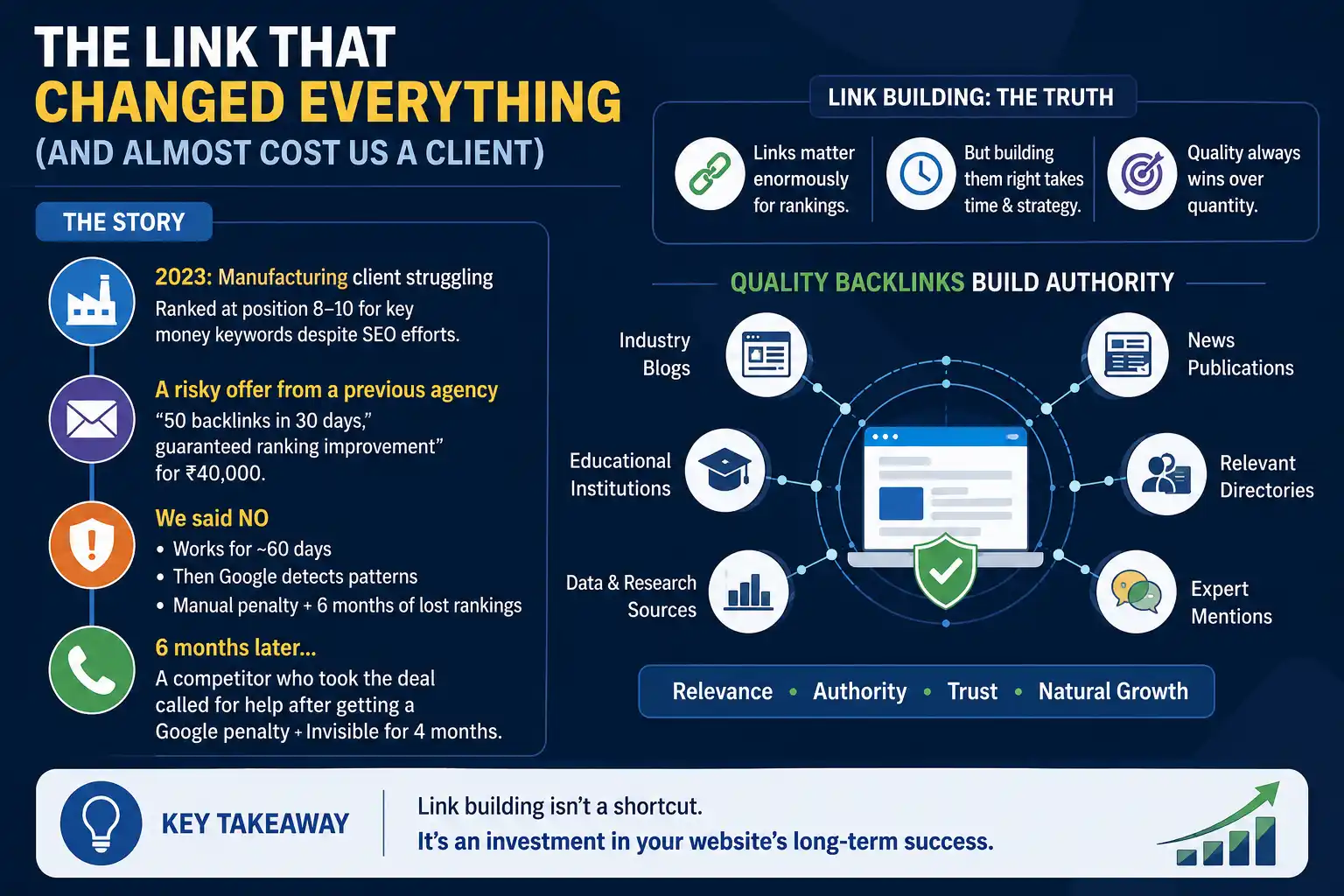
I told him: it works. For about 60 days. Then Google notices the pattern, triggers a manual penalty, and your entire domain drops out of rankings for six months. We showed him examples. He didn’t take the deal. Six months later, a competitor who did take a similar offer called asking for help recovering from a Google penalty. They’d been invisible for four months.
That story is why I’m writing this. Because link building is one of the most misunderstood parts of SEO. Agencies promise “50 links in a month” knowing it’s nonsense. Business owners think links are either a scam or a magic bullet. The truth is somewhere in between: links matter enormously, but building them right takes time and strategy.
What Links Actually Do
In the early days of Google, there were no links. Then someone realised: if Site A links to Site B, that’s a vote for Site B. Site A is saying “this other site is good, worth reading.” Link = vote.
That insight built Google. And it’s still true. A link from another website to yours is a signal that your content is worth linking to. From Google’s perspective, it’s third-party validation. You can say you’re the best widget manufacturer in India. But if the Economic Times writes about you and links to your site, that’s external validation. That matters.
The key word is external. A link from your own site to yourself doesn’t count. Only links from other people’s sites count. And only if those other sites have authority themselves. A link from a site nobody visits is basically worthless. A link from a site that gets a million visitors a month is gold.
Google also looks at anchor text — the words used for the link. If a hundred sites link to you using the anchor “best dentist in Bangalore,” Google thinks “okay, this site is relevant for that keyword.” But if it looks artificial — if the pattern of anchor text seems unnatural — Google gets suspicious. Which is why a lot of cheap link-building tactics get penalised. Understanding how links fit into the full picture of off-page SEO builds real authority clarifies why anchor text diversity and source quality matter far more than raw link volume.
Ethical vs Black Hat Link Building
Let me be direct about the shortcuts because I know some people are tempted.
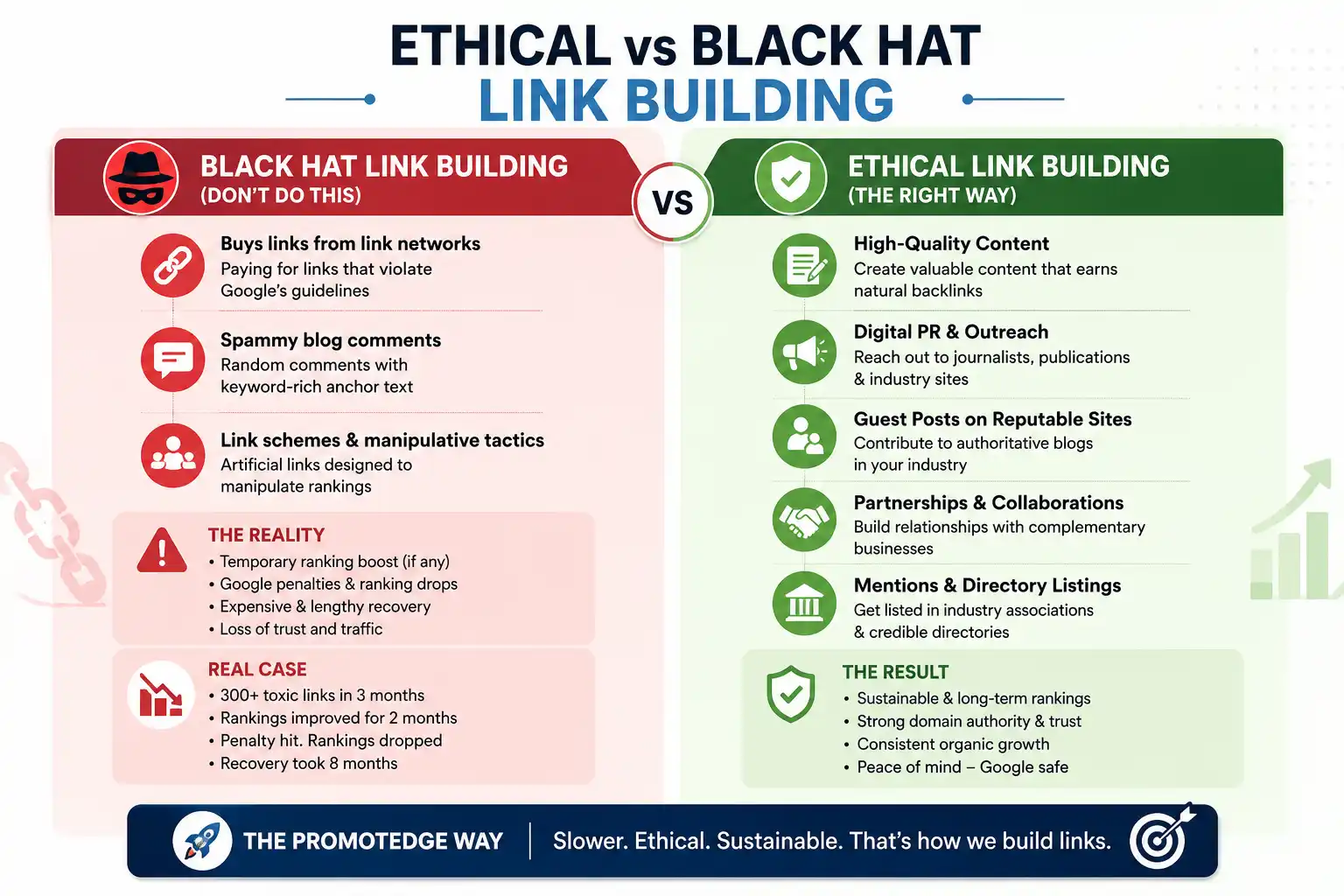
Black Hat (Don’t Do This) involves buying links from link networks, paying for links on sites that sell them, commenting on random blogs with keyword-rich anchor text, or using link schemes. The promise is always the same: “fast rankings.” The reality is: Google penalties, dropped rankings, months of recovery. We’ve cleaned up after these. It’s expensive and demoralising for the client.
We once had to fix a penalty for a manufacturing export company. A previous agency had built 300+ links in three months from obvious link networks. The company saw ranking improvements for two months, got excited, doubled down. Then the penalty hit. Their domain dropped out of rankings for major keywords. Recovery took eight months and involved disavowing hundreds of toxic links one by one.
Ethical link building is slower. But it’s permanent. It involves creating content good enough that people naturally want to link to it. Digital PR outreach where you contact journalists and publications. Guest articles on reputable blogs. Partnerships with complementary businesses. Industry mentions and association listings.
The PromotEdge way is the ethical way. It takes longer. But clients aren’t constantly looking over their shoulder wondering when Google will penalise them.
The Strategy: Building Links That Actually Count
Link building starts with understanding your competitive landscape. What sites are linking to your competitors? Which publications cover your industry? What keywords are worth competing for? This research tells you where your links should come from.
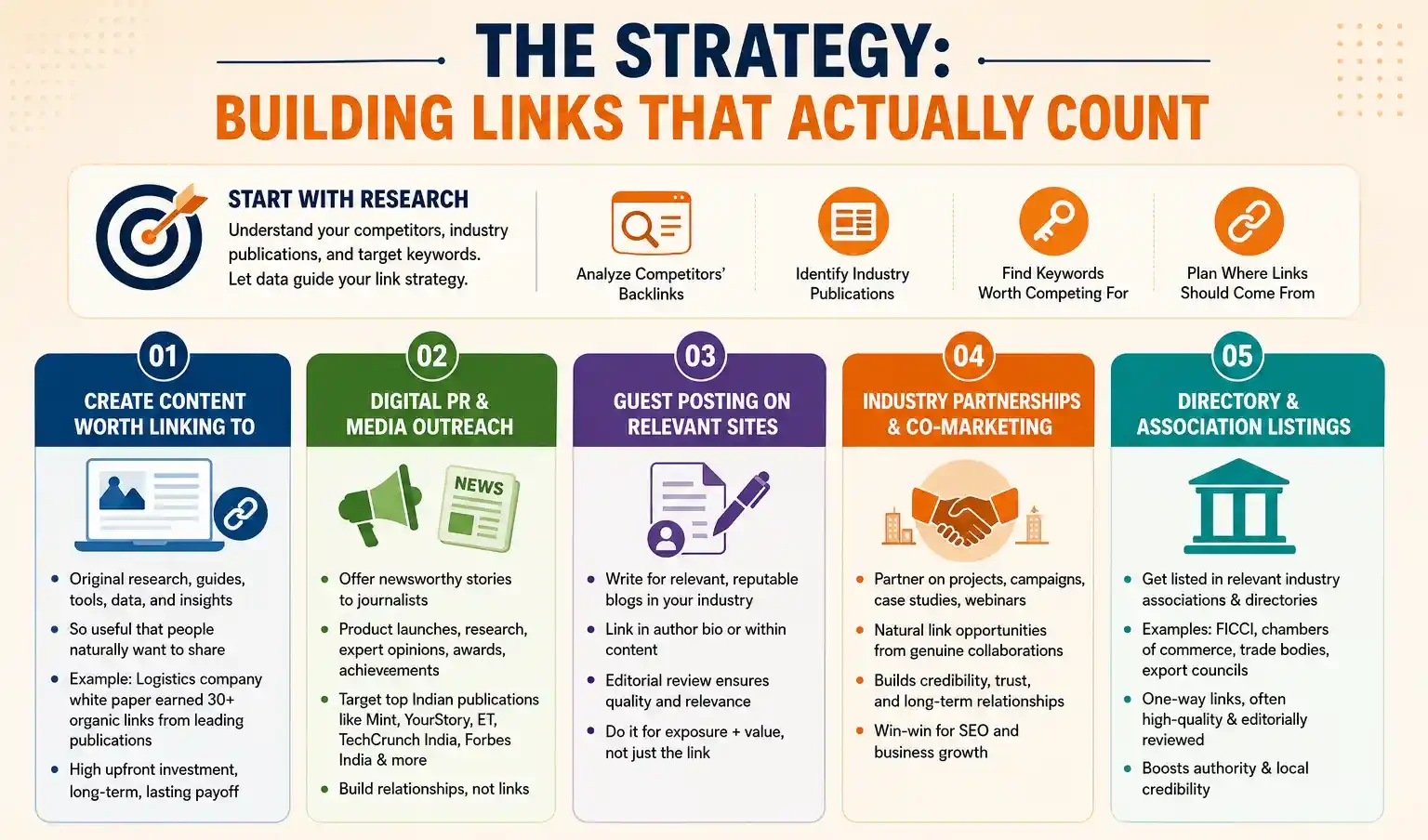
Strategy 1: Create Content Worth Linking To
The best long-term link strategy is simple: make something so useful, so detailed, so unique that people naturally want to share it. An original research report. A comprehensive guide. A tool that solves a problem. Industry data nobody else has compiled.
We worked with a logistics company that published a white paper on supply chain inefficiencies in Indian manufacturing. The report was based on their actual data and was detailed enough to be genuinely useful. They sent it to industry publications. Thirty of them covered it. Each coverage included a link to the report. That was 30 high-quality links from authoritative sites, all organic, no money exchanged, no schemes.
This requires investment upfront — time or money to create the asset. But the payoff is real and lasting.
Strategy 2: Digital PR and Media Outreach
Journalists and publications need stories. If you have something newsworthy, they’ll cover it and link to your site. This is where relationships matter. You’re not buying a link — you’re offering a story to a journalist who thinks their readers would care.
What’s newsworthy? Product launches. Funding announcements. Market research. Expert opinions on industry trends. Awards. Achievements. In India, there are dozens of publications always looking for stories — Mint, YourStory, Economic Times, TechCrunch India, Forbes India, Business Insider India, and dozens of vertical-specific publications.
We have a team member dedicated to media relationships. Her job is knowing which journalists cover what topics and being the first to pitch relevant stories. The links that come from this aren’t just valuable for SEO — they’re good for brand visibility too.
Strategy 3: Guest Posting on Relevant Sites
Write an article for someone else’s blog, get a link back to your site in the author bio or within the content. But — and this is critical — the site has to be relevant. A content marketing agency writing a guest post on a financial blog about content strategy works. A weight loss product writing on an unrelated tech blog does not.
Quality guest posting sites in India: industry blogs, association websites, thought leadership platforms. The best ones don’t pay you (you do it for the link and exposure) but they also don’t let just anyone post. There’s editorial review. That editorial review is what makes the link valuable.
Strategy 4: Industry Partnerships and Co-Marketing
If you partner with another business on a project, campaign, or initiative, they’ll naturally link to you. If you collaborate with a brand for a case study or joint webinar, that’s a link opportunity. These links are valuable because they come from genuine business relationships.
Strategy 5: Directory and Association Listings
Get your business listed in relevant Indian industry associations, chambers of commerce, and directory sites. These are one-way links and they’re often higher quality than you’d think because they’re editorially reviewed. If you’re in manufacturing, get listed with FICCI or industry-specific associations. If you’re in exports, get listed with trade bodies. These links also help with local authority.
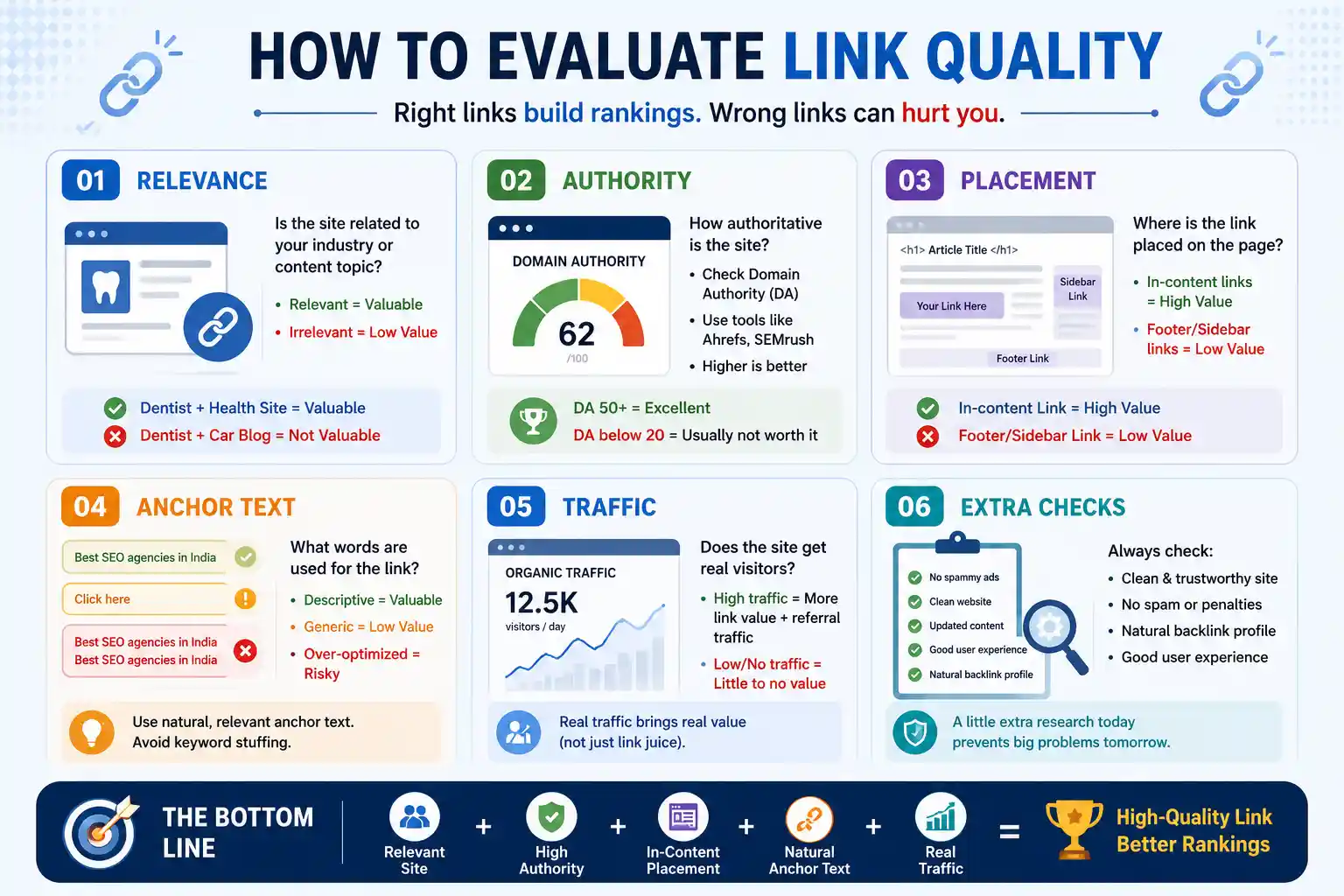
How to Evaluate Link Quality
Not all links are equal. A link from Economic Times is worth more than a link from a random blog. But how do you tell the difference?
Relevance: Is the site related to your industry or content topic? A dentist getting a link from a health website is valuable. A dentist getting a link from a car blog is not.
Authority: How much traffic does the site get? How many other quality sites link to it? Tools like Ahrefs or SEMrush will show “domain rating” or “authority score.” Higher is better. A site with domain authority of 50+ is gold. Below 20 is usually not worth pursuing.
Placement: Is the link in the actual content or in the footer/sidebar? Content links are much more valuable. Footer links are basically worthless.
Anchor text: What words are used for the link? “Click here” is worthless. “Best SEO agencies in India” is valuable. Overly keyword-stuffed anchor text looks unnatural and can actually hurt you.
Traffic: Does the site actually get real visitors? A site with thousands of daily visitors linking to you sends not just link juice but also referral traffic. A dead site linking to you is essentially useless.
The Link That Almost Killed Us (And How We Fixed It)
2024. We were contacted by an e-commerce brand that had bought links from a link network without telling us. They got a Google manual penalty and their rankings disappeared. Overnight. The brand thought it was a technical issue. It wasn’t.
Fixing it required: identifying all the toxic links, disavowing them through Google Search Console, cleaning up the site, and proving to Google we’d fixed the issue. This process took four months. During those four months, the brand lost significant traffic and revenue.
The lesson we learnt (reinforced): there are no shortcuts. We now have contracts with clients explicitly stating we don’t do black hat link building. And we advise against it, strongly.
How Many Links Do You Actually Need?
This is the question we get asked constantly. The honest answer: it depends.
We’ve seen sites rank with 20 high-quality links from authoritative sources. We’ve also seen sites with 500 low-quality links that don’t rank. Google cares about quality far more than quantity. A site linking to you from a publication like Economic Times is worth more than 100 random blog links.
As a rough guideline: for a competitive keyword in a crowded industry, you’ll probably need 50-100+ high-quality links from diverse sources. For a less competitive niche keyword, 10-20 good links might be enough. But this varies wildly by industry and competition level.
The better approach than counting links is thinking about relevance and consistency. Build links gradually, from relevant sources, in your industry. Monitor what competitors are getting links from. Try to get links from those same sources but with better content or angles.
Link Building as Part of Content Marketing
Here’s what most people miss: the best link building happens when you combine it with content marketing. You create genuinely useful content — guides, research, tools, templates. Then you promote that content to journalists, industry peers, and relevant websites. They link because the content is good, not because you’re “building links.”
This is the long-term approach. It’s also the one that compounds. Create 10 pieces of linkable content and promote each properly, you’ll get dozens of links. Create 100 such pieces over two years, and your domain will have the authority of someone who’s been doing this for a decade. For more on how content and links work together, our guide on crafting a solid SEO strategy covers exactly this — content and link building aren’t separate workstreams, they’re part of the same authority-building system.
For more on how content and links work together, check our content marketing strategy guide. They’re not separate. They’re part of the same system.
Practical Checklist: How to Start Link Building Today
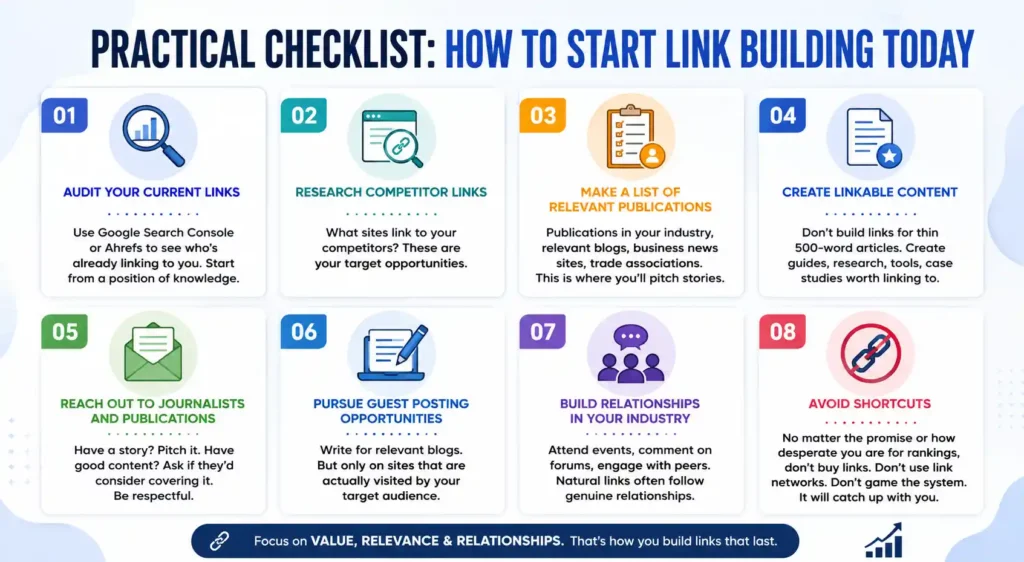
- Audit your current links : Use Google Search Console or Ahrefs to see who’s already linking to you. Start from a position of knowledge.
- Research competitor links : What sites link to your competitors? These are your target opportunities.
- Make a list of relevant publications : Publications in your industry, relevant blogs, business news sites, trade associations. This is where you’ll pitch stories.
- Create linkable content : Don’t build links for thin 500-word articles. Create guides, research, tools, case studies worth linking to.
- Reach out to journalists and publications : Have a story? Pitch it. Have good content? Ask if they’d consider covering it. Be respectful.
- Pursue guest posting opportunities : Write for relevant blogs. But only on sites that are actually visited by your target audience.
- Build relationships in your industry : Attend events, comment on forums, engage with peers. Natural links often follow genuine relationships.
- Avoid shortcuts : No matter the promise or how desperate you are for rankings, don’t buy links. Don’t use link networks. Don’t game the system. It will catch up with you.
Why This Matters More Than You Think
I know link building sounds unsexy. You’re not buying ads, you’re not creating viral content, you’re not running a campaign. You’re just quietly building authority by getting other sites to vouch for you.
But here’s the thing: links are one of Google’s oldest and most reliable ranking signals. In 11 years of running an agency, I’ve seen link building separate successful SEO campaigns from failures. Businesses that invested in it properly are now getting hundreds of organic leads a month. Businesses that skipped it are still buying ads.
The businesses that tried shortcuts? Most had to deal with penalties. Some recovered. Some didn’t.
Do it right. Do it patiently. Do it ethically. That’s the strategy that actually works in India, whether you’re a B2B manufacturer trying to rank for competitive keywords or a D2C brand building authority. The link building you do today is the authority you’ll have two years from now.
| Approach | Best for | Watch out for |
|---|---|---|
| DIY | Small teams, tight budgets | Slow ramp-up, trial-and-error |
| Freelancer | Specific project bursts | Inconsistency, limited ownership |
| Agency | Ongoing work, senior input | Higher retainer, less control |
Quick checklist before you start:
- Define the one thing you want: leads, sales, awareness — pick one.
- Baseline your numbers: write down where you are today.
- Pick a 90-day window: nothing moves in 2 weeks.
- Agree on success metrics: with whoever is paying the bill.
- Set up proper tracking: GA4, UTMs, call tracking.
- Review monthly: kill what doesn’t work, double down on what does.
The Bottom Line
If you take one thing from this: link building strategies ethical techniques for indian website rewards patience and specificity, not volume or clever tricks. Start small, measure honestly, fix what breaks, and compound what works. The brands doing this well in India aren’t smarter — they’re just consistent. Need a hand with this for your business? Talk to us.
Ready to Build Real Authority?
PromotEdge has built link profiles for 250+ brands across India. From digital PR to content promotion, we know how to get your site linked to from sites that matter.
FAQs
-
How many backlinks do I need to rank well?
Ans.There is no magic number. We have seen sites rank with 20 high-quality links from authoritative sources. We have also seen sites with 500 low-quality links that do not rank at all. Google cares about quality over quantity. One link from Economic Times or YourStory is worth more than 100 links from random directories. Focus on getting links from relevant, reputable sources in your industry rather than chasing a number. -
Is link building still important for SEO?
Ans.Absolutely. It is still one of Google's top ranking factors. The difference from a few years ago is that Google is much better at detecting artificial, unnatural link patterns. Your competitors are doing it. If you are not, you are at a disadvantage. But do it ethically — through genuine relationships, valuable content, and digital PR — not through shortcuts that will get you penalised. -
What makes a good backlink?
Ans.A good backlink comes from a reputable, relevant source with actual authority. It is placed naturally within content (not in a footer or sidebar). The anchor text (the clickable words) is relevant to what the page is about. And it is from a website that gets real traffic from real people. Links from respected Indian publications — Mint, Economic Times, TechCrunch India, YourStory — are gold. Links from random blog networks or link farms are worthless and can hurt you.
Author Details

Latest Posts
-
 26 / Aug
Search Engine Optimization Video SEO: How to Rank Your Videos in Google & YouTube
26 / Aug
Search Engine Optimization Video SEO: How to Rank Your Videos in Google & YouTube -
 25 / Aug
Video Production Corporate Video Production: A Practical Guide for Indian Brands
25 / Aug
Video Production Corporate Video Production: A Practical Guide for Indian Brands -
 24 / Aug
-
21 / Aug
Catalogue Design Catalogue Design: How to Create Catalogues That Actually Sell
-
 20 / Aug



Related Knowledge