-
Author: Anindita Barik
-
Updated Date: Jun-12-2026
-
Views: 2 Min Read
Social media advertising means paying platforms like Facebook, Instagram, and LinkedIn to show your content to targeted audiences beyond your followers. Beginners should start with image ads, set a clear conversion goal, and budget around ₹500–1,000/day. Success depends on four essentials: a strong product, a converting landing page, a follow-up system, and conversion tracking. Avoid common mistakes like running ads to your homepage or skipping retargeting. Start small, measure cost per acquisition, and scale what works.
Social media advertising is really just paying to get your content seen by the right people. Think about it — you post something organically and maybe your existing followers see it. But with a paid ad, you can reach someone who’s never heard of you but would probably click “buy” the moment they saw your product. That’s the real power of it.
Getting started isn’t as scary as it sounds. Pick whichever platform your audience actually uses — if you’re selling to teens, go TikTok; if it’s professionals, try LinkedIn. Set a goal, even something simple like “I want more people to visit my website,” put in a small budget you’re comfortable losing while you learn, and just launch something. You’ll make mistakes early on, everyone does, but the dashboard will show you the numbers and slowly it starts to click. Before long you’re tweaking headlines, testing different images, and actually enjoying the process.
The Instagram Ad That Cost Us Rs 30,000 With Zero Sales
Three years back. A new D2C brand. Pretty products, solid margins, zero audience. The founder was confident: “Instagram is where young people are. Let’s just… put some ads up.”
We ran a campaign. Targeting looked decent — women, 25-40, income bracket 2+ lakhs annually, interested in skincare. The creative was actually good. The ad got 14,000 impressions, 320 clicks.
Zero purchases.
Rs 30,000 burned. And the founder’s confidence was gone.
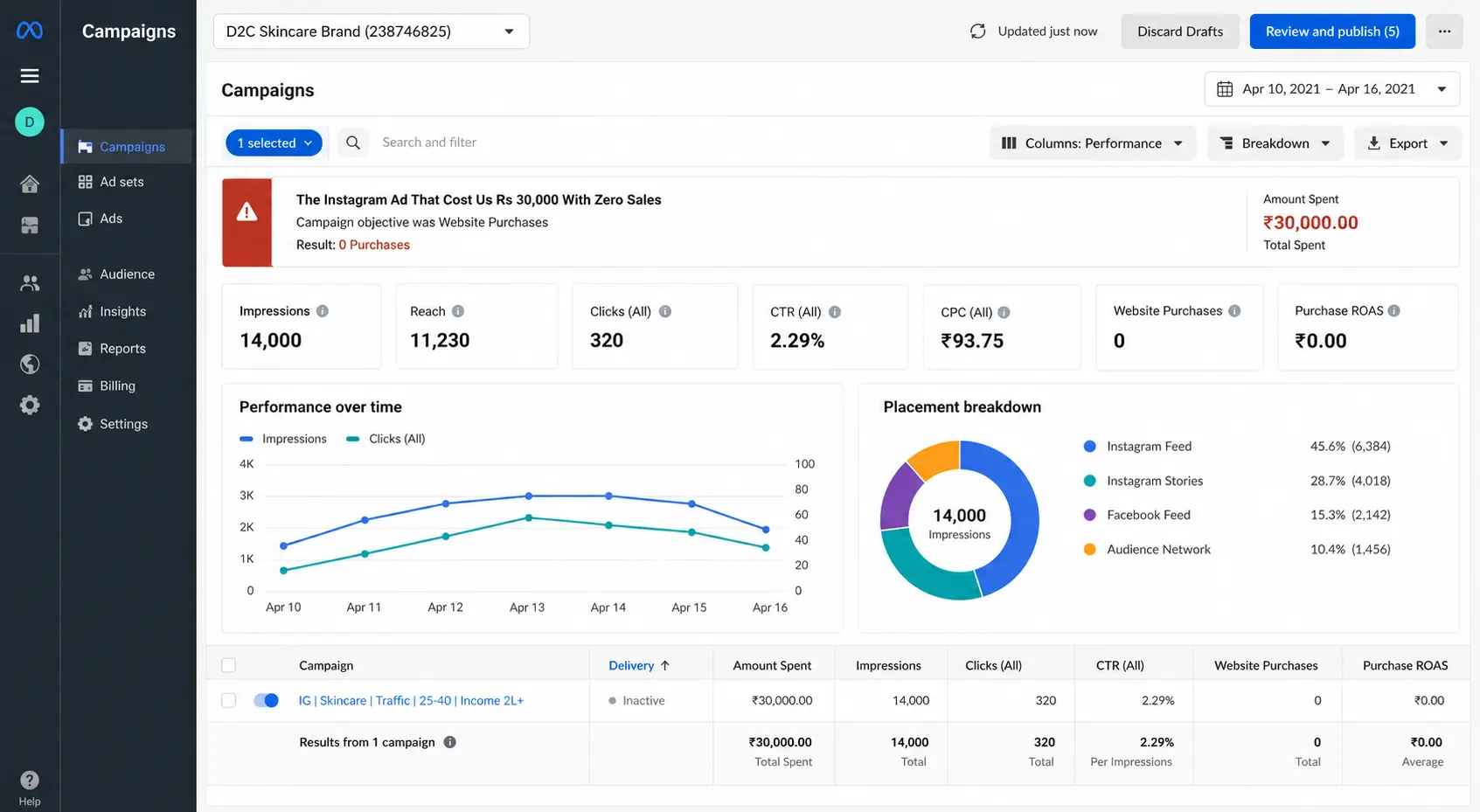
We had a proper debrief after that. The issue wasn’t the platform — Instagram was right. It wasn’t the targeting either. It was the funnel. Nobody knew this brand existed. One Instagram ad doesn’t create trust for something people are buying for the first time. It’s not how humans work.
The fix? We switched approach. Same budget. Facebook ads to get traffic to a landing page (not directly to purchase). Email sequence to build trust. Retargeting when people came back. Suddenly the same budget pulled in conversions.
This is what paid social actually is. It’s not magic. It’s not even complicated. It’s just a system. And most beginners skip half the system.
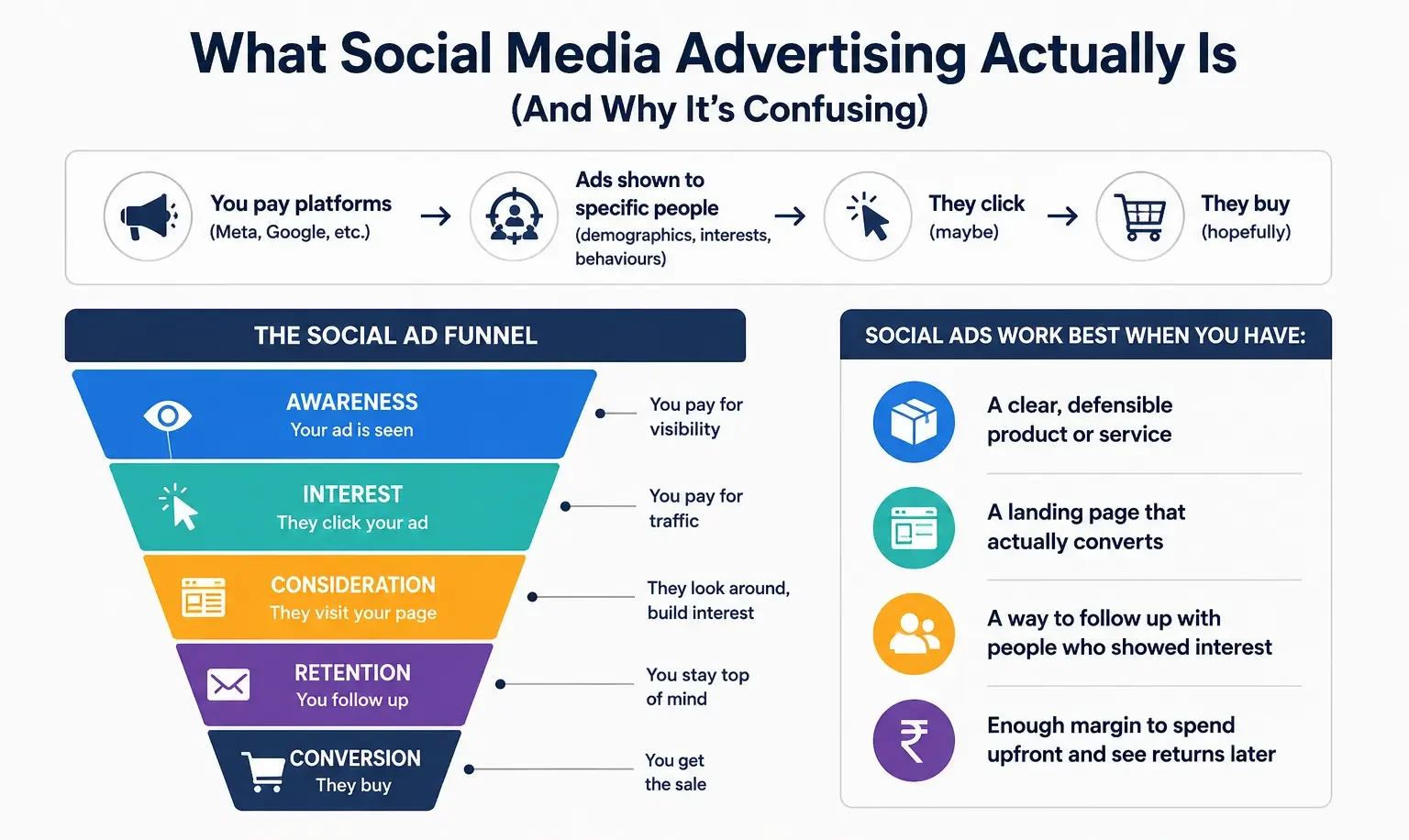
What Social Media Advertising Actually Is (And Why It’s Confusing)
Social media advertising is paying for visibility on platforms like Facebook, Instagram, LinkedIn, YouTube, and Twitter — so your content reaches people who haven’t followed you yet.
That’s the definition. But here’s what actually happens: you pay Meta (or Google, or Twitter) to show your ad to specific people, based on their demographics, interests, and behaviours. And then you hope they click. And then you hope they buy.
The hope is the problem. Most brands do this backwards. They create an ad, pay for traffic, and then wonder why nobody converts. They blame the platform. They blame the creative. They blame targeting.
But the issue is usually the whole setup. Social ads work best when you already have:
- A clear, defensible product or service
- A landing page that actually converts (most don’t)
- A way to follow up with people who showed interest
- Enough margin to spend money upfront and see returns later
Without those four things, paid social becomes a very expensive way to collect clicks. If you’re unsure whether your landing page is up to scratch, our guide on how to create a landing page in WordPress walks you through the fundamentals.
Why Paid Social Matters (And When It Doesn’t)
Organic reach is dead. Anyone who says otherwise is either posting 3x a day or selling a course on social media.
If you want to reach NEW people on Facebook, Instagram, LinkedIn, or YouTube, you’re paying. Full stop.
That said — paid social is not the right channel for everyone.
It works great for: D2C brands, FMCG, real estate, education, healthcare services, fashion, food delivery — basically anything consumer-facing where the purchasing decision happens fast or in consideration of social proof.
It’s expensive and slow for: B2B industrial products, niche services with very small audiences, anything where the sales cycle is 6+ months, highly specialised professional services.
We had a manufacturing client once selling industrial pumps. They wanted to run Facebook ads. We said no. “Why would a purchasing director be on Facebook?” we asked. Well, they are, but not scrolling for pumps. We pointed them toward LinkedIn instead and it worked way better.
So first question: does your customer actually spend time on the platform you want to advertise on, AND are they in a frame of mind to consider what you’re selling?
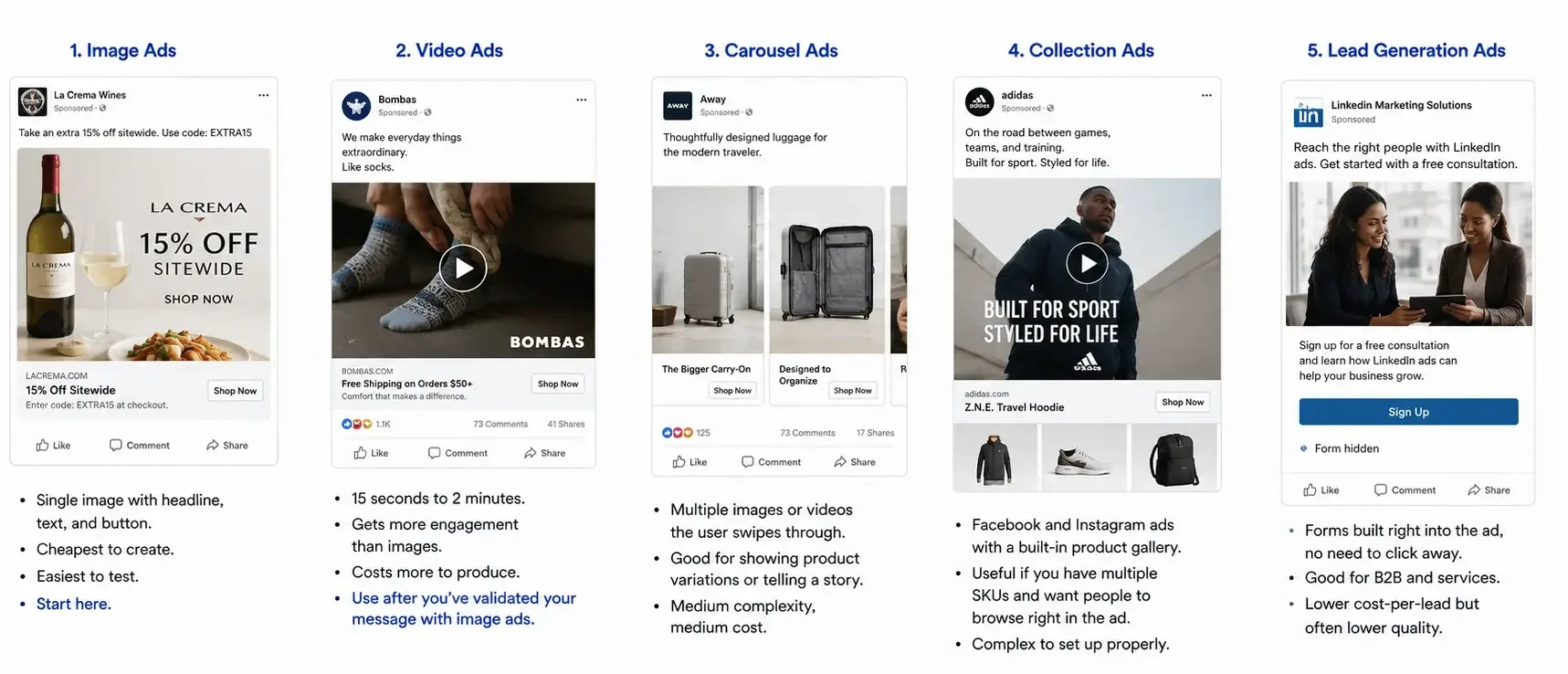
Types of Social Media Ads — And Which One To Start With
1. Image Ads
A single image with headline, text, and a button. Cheapest to create. Easiest to test. Start here.
2. Video Ads
15 seconds to 2 minutes. Gets more engagement than images. Costs more to produce. Use after you’ve validated your message with image ads. If you’re exploring video as a format, our overview of video marketing trends can help shape your strategy.
3. Carousel Ads
Multiple images or videos the user swipes through. Good for showing product variations or telling a story. Medium complexity, medium cost.
4. Collection Ads
Facebook and Instagram ads with a built-in product gallery. Useful if you have multiple SKUs and want people to browse right in the ad. Complex to set up properly.
5. Lead Generation Ads
Forms built right into the ad, no need to click away. Good for B2B and services. Lower cost-per-lead but often lower quality.
Our strategy? Start with image ads on Instagram and Facebook. They’re cheap to test. If you get a decent click-through rate and some conversions, then invest in video. Don’t go backwards.
How To Set Up Your First Campaign (The Basics)
-
Pick Your Platform
Facebook and Instagram usually together (they’re the same ads manager now). LinkedIn for B2B. YouTube for video-first audiences.
-
Define Your Objective
Awareness, traffic, conversions, or leads. Pick conversions if you’re just starting out. It means you care about actual business outcomes, not vanity metrics.
-
Create Your Audience
You can target by age, location, interests, behaviours, lookalike audiences (people similar to your customers). Start broad-ish, narrow based on what converts.
-
Set Your Budget and Duration
Start with Rs 500-1,000/day. Run for at least 7 days. Let the algorithm learn.
-
Create Your Ad
One image or video. One headline. 2-3 lines of body text. One CTA button. That’s it. More isn’t better. Simpler converts.
-
Link to a Landing Page
Not your homepage. A specific page about the thing you’re advertising.
-
Set Up Conversion Tracking
Install Meta Pixel on your website so you can see which ads actually led to purchases. This is non-negotiable. If you don’t do this, you’re flying blind.
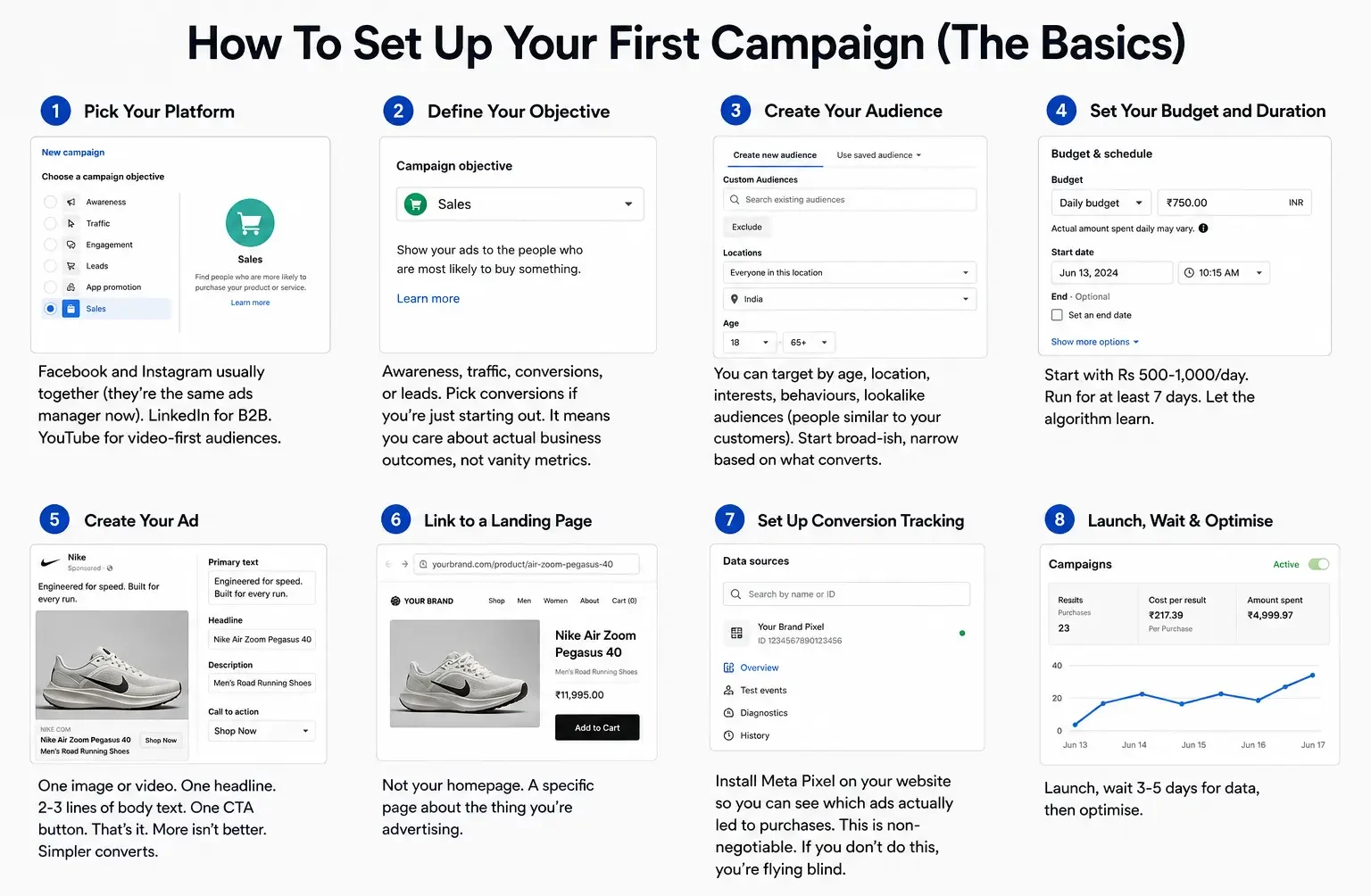
Launch, wait 3-5 days for data, then optimise.
Budgeting: Stop Guessing, Start Testing
Everyone asks the same question: “How much should I spend?”
Wrong question.
Right question: “How much revenue do I need to make this profitable?”
Let’s say you’re selling a course for Rs 5,000. Your profit margin is 80%. So each sale makes you Rs 4,000. If you spend Rs 500 to get a customer (cost per acquisition), and they’re worth Rs 4,000, you’re making Rs 3,500 profit on that customer. Good business.
If you spend Rs 1,500 per customer and they’re worth Rs 4,000, you’re still profitable but less exciting. Spend Rs 3,000 per customer and you’re barely breaking even.
So budget backwards. Figure out: how much can I afford to spend to acquire one customer? Then set your daily budget to that number.
For most e-commerce and D2C brands, we see CPA (cost per acquisition) ranging from Rs 200 to Rs 2,000+. Depends on the product, the market, the season, whether you’re selling a luxury item or a necessity.
Start lean. Rs 500/day for a week. If you get sales, keep it going. If you don’t, pause and fix the funnel before spending more.
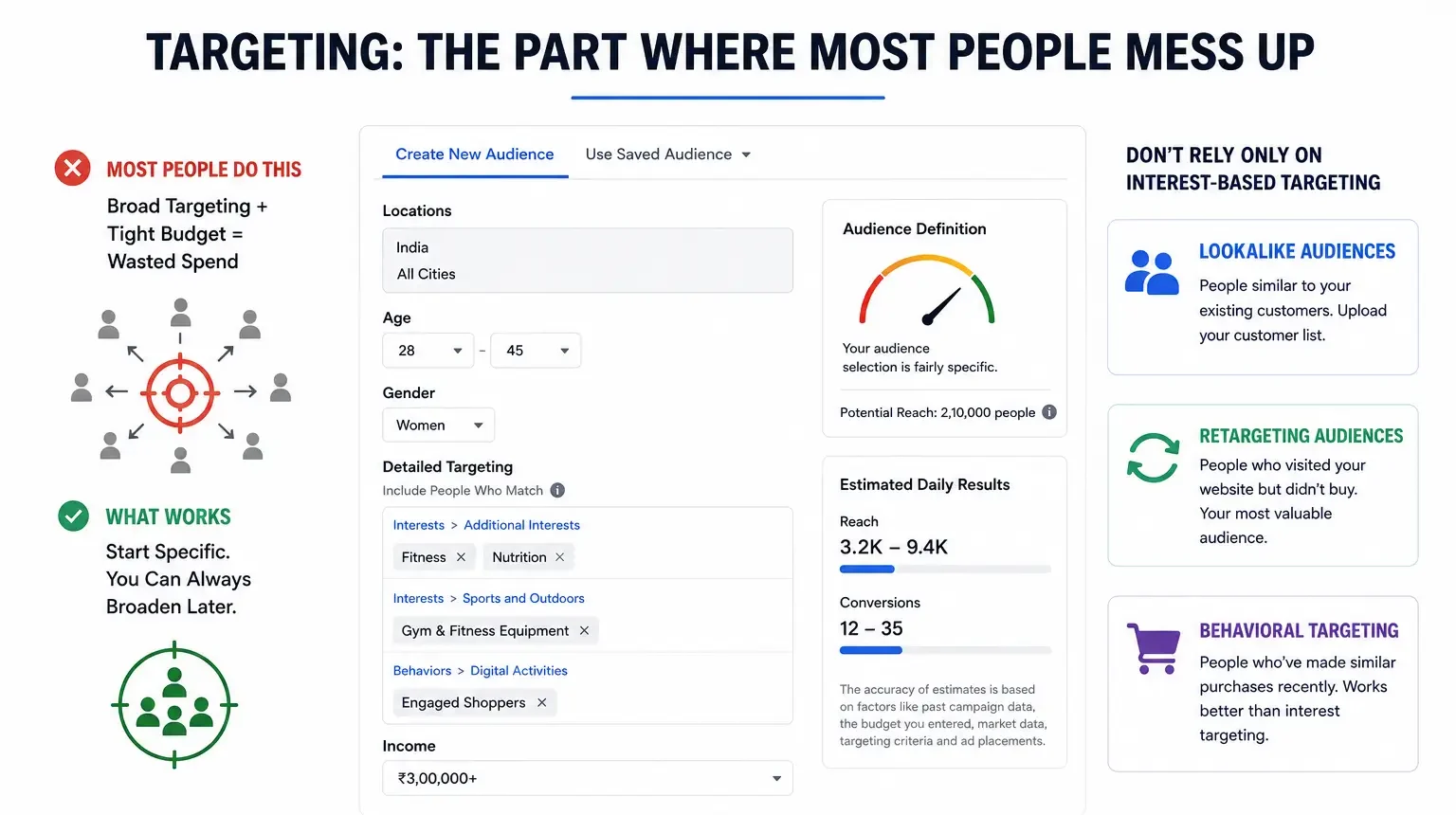
Targeting: The Part Where Most People Mess Up
Platform: “You can target people interested in Decathlon, CrossFit, gym equipment…”
Beginner: “Great, let me target all of those!”
Wrong.
Broad targeting, tight budget = wasted spend on people who’ll never buy.
We worked with a nutrition brand once. They wanted to reach “health-conscious people.” That’s 40% of the internet. We narrowed it down: women aged 28-45, living in tier-1 cities, interested in fitness and nutrition, income 3+ lakhs annually. Suddenly the CPA dropped 40%.
Start specific. You can always broaden later.
Also — and this is important — don’t rely only on interest-based targeting. Also target:
- Lookalike audiences: People similar to your existing customers. Meta can find these if you upload your customer email list.
- Retargeting audiences: People who visited your website but didn’t buy. This is your most valuable audience. Don’t skip it.
- Behavioural targeting: People who’ve made similar purchases recently. Works better than interest targeting.
Honestly? We usually turn off interest targeting after month 1 once we have enough retargeting and lookalike audiences built up.
Measuring Results: Stop Celebrating Meaningless Numbers
Click-through rate is meaningless. Engagement rate is vanity. Impressions don’t buy anything.
The metrics that matter:
Cost Per Click (CPC): How much you’re paying per person to click your ad. Lower is better, but only if they convert.
Cost Per Lead (CPL): If you’re generating leads, how much each one costs. Target: Rs 100-500 depending on industry.
Cost Per Acquisition (CPA): How much you spend to get a customer. This is THE number. Everything else is diagnostic.
Return On Ad Spend (ROAS): Revenue generated divided by spend. A 3:1 ROAS is healthy. 5:1 is excellent. Below 2:1 and you’re not scaling.
Customer Lifetime Value (CLV): How much a customer is worth over their entire relationship with you. If CLV is 10x your CPA, you can spend way more on ads. If it’s 1.5x, you need to be very careful.
Set up Meta Pixel, Google Analytics 4, and (if you’re serious) a CRM. Hook them all together. Track revenue back to the ad.
Most small businesses don’t do this. So most small businesses waste money on ads.
The Stuff Most Beginners Get Wrong
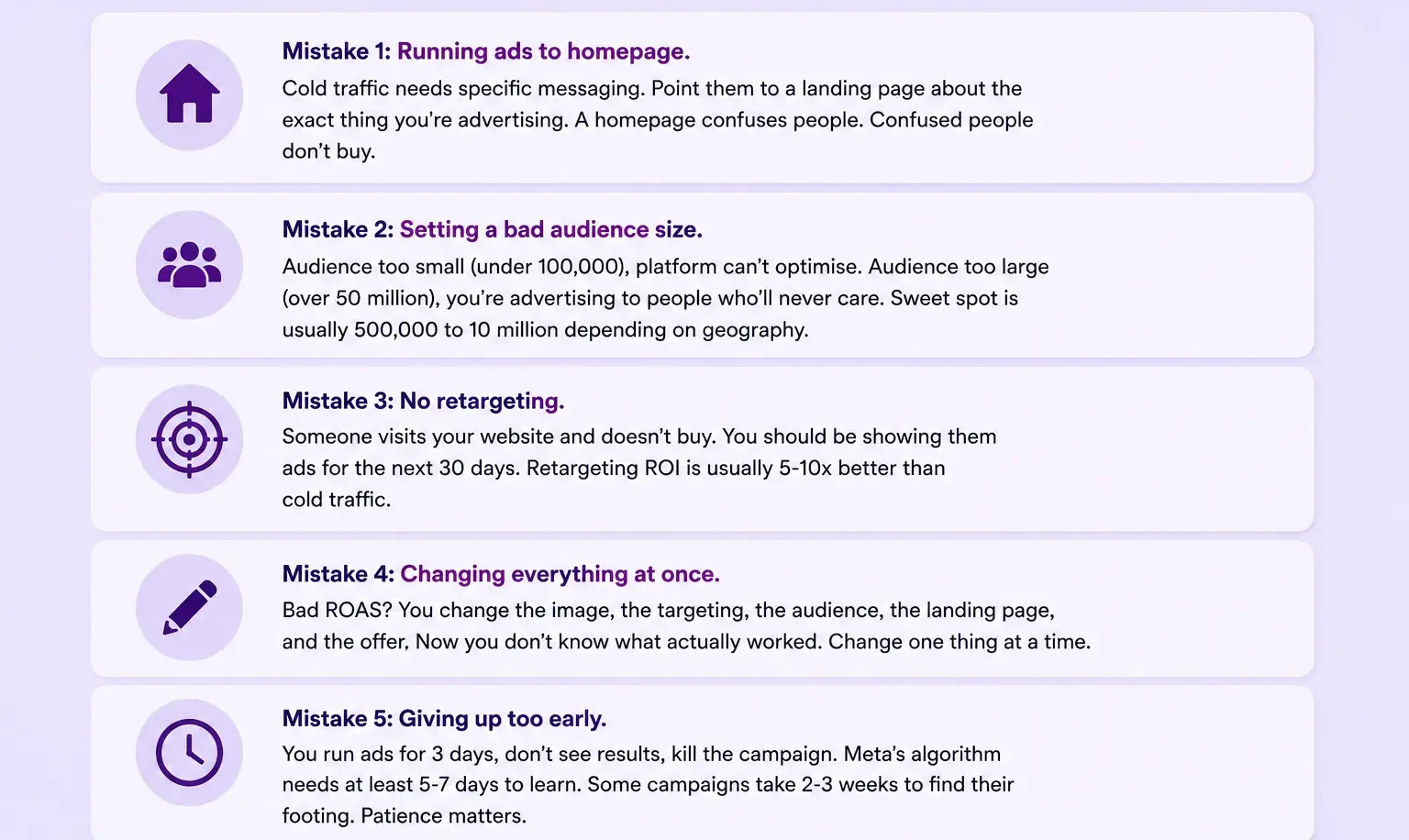
Mistake 1: Running ads to homepage. Cold traffic needs specific messaging. Point them to a landing page about the exact thing you’re advertising. A homepage confuses people. Confused people don’t buy.
Mistake 2: Setting a bad audience size. Audience too small (under 100,000), platform can’t optimise. Audience too large (over 50 million), you’re advertising to people who’ll never care. Sweet spot is usually 500,000 to 10 million depending on geography.
Mistake 3: No retargeting. Someone visits your website and doesn’t buy. You should be showing them ads for the next 30 days. Retargeting ROI is usually 5-10x better than cold traffic.
Mistake 4: Changing everything at once. Bad ROAS? You change the image, the targeting, the audience, the landing page, and the offer. Now you don’t know what actually worked. Change one thing at a time.
Mistake 5: Giving up too early. You run ads for 3 days, don’t see results, kill the campaign. Meta’s algorithm needs at least 5-7 days to learn. Some campaigns take 2-3 weeks to find their footing. Patience matters.
When Should You Actually Start Running Ads?
Not immediately. If you have zero customers, no testimonials, no case studies, and an untested value proposition, ads will just amplify your problems.
Get 10-20 customers first. Organically. Validate that people actually want what you’re selling. Then use ads to scale.
Otherwise you’re paying to learn what should’ve been free learning.
Also — and I learned this the hard way — paid social works best when it’s part of a broader digital marketing strategy. SEO to get organic traffic, social ads for immediate reach, email to nurture, retargeting to close. Each channel has a job.
Trying to grow using only paid social is like building a house and only focusing on the roof.
The Real ROI Conversation
Here’s what we tell clients when they ask if paid social is worth it:
If your product has healthy margins (40%+), you’re willing to spend money upfront to get customers later, and you can track revenue back to your ads — yes. Definitely worth it.
If your margins are thin, your business model depends on cheap traffic, or you can’t track revenue — probably not.
And honestly? A lot of businesses fall into the second category and still try to run ads anyway.
Vinnay and I had a debate about this last month. He’s all-in on paid social. I said it’s overrated for businesses that should be using Facebook organically or performance marketing first. We didn’t quite solve it, but the point is: paid social is a tool. A powerful one. But not the right tool for every situation.
Quick Wins To Start With Tomorrow
- Retarget your existing visitors. Even with a Rs 1,000/week budget, retargeting old website traffic can generate sales.
- Create a lookalike audience from your customer list and test it with a small budget (Rs 500/day). Usually outperforms cold targeting.
- Audit your landing pages. Most convert at under 2%. Fix that before spending money on more traffic.
- Set up conversion tracking properly. Without it, you’re guessing.
- A/B test one thing at a time. Image, headline, audience, or offer — pick one, test it, see results, then move to the next.
The best social media campaign isn’t the most creative. It’s the one that turns the lowest cost into the highest revenue.
| Approach | Best for | Watch out for |
|---|---|---|
| DIY | Small teams, tight budgets | Slow ramp-up, trial-and-error |
| Freelancer | Specific project bursts | Inconsistency, limited ownership |
| Agency | Ongoing work, senior input | Higher retainer, less control |
Quick checklist before you start:
- Define the one thing you want: leads, sales, awareness — pick one.
- Baseline your numbers: write down where you are today.
- Pick a 90-day window: nothing moves in 2 weeks.
- Agree on success metrics: with whoever is paying the bill.
- Set up proper tracking: GA4, UTMs, call tracking.
- Review monthly: kill what doesn’t work, double down on what does.
The Bottom Line
If you take one thing from this: social media advertising a beginners guide to paid social rewards patience and specificity, not volume or clever tricks. Start small, measure honestly, fix what breaks, and compound what works. The brands doing this well in India aren’t smarter — they’re just consistent. Need a hand with this for your business? Talk to us.
Need Help Setting Up Your First Paid Social Campaign?
We’ve run paid social campaigns for 100+ brands across FMCG, D2C, real estate, and e-commerce. We’ll help you avoid the expensive mistakes and get real ROI from day one.
FAQs
-
How much should I spend on social media ads?
Ans.Depends entirely on your business model and goals. We have seen D2C brands get profitable at Rs 8,000/month spend and others needing Rs 2+ lakhs to make real revenue. The math is simple though: whatever you spend should bring back at least 3x that amount. If your product margin is tight, ads might not work. If you are selling luxury items with healthy margins, even high ad spend makes sense. Start small, test, scale what works. -
Which platform is best for advertising?
Ans.Facebook if you want reach and conversion. Instagram if you are selling lifestyle or beauty products. LinkedIn for B2B. YouTube for video. But honestly — test them all. Spend Rs 500 on each for a week and see which one delivers cheaper leads for YOUR specific business. What works for a clothing brand might be a complete waste for a B2B SaaS product. -
How do I know if my ads are actually working?
Ans.Track three numbers only: how much you spent, how many conversions you got, how much revenue those conversions generated. If you spend Rs 5,000 and get Rs 15,000 in revenue, it is working. If you get 50 clicks and nobody converts, it is not working regardless of how many impressions your ad got. Stop looking at vanity metrics like impressions. Focus on revenue per rupee spent.
Author Details

Latest Posts
-
 26 / Aug
Search Engine Optimization Video SEO: How to Rank Your Videos in Google & YouTube
26 / Aug
Search Engine Optimization Video SEO: How to Rank Your Videos in Google & YouTube -
 25 / Aug
Video Production Corporate Video Production: A Practical Guide for Indian Brands
25 / Aug
Video Production Corporate Video Production: A Practical Guide for Indian Brands -
 24 / Aug
-
21 / Aug
Catalogue Design Catalogue Design: How to Create Catalogues That Actually Sell
-
 20 / Aug