
-
Author: Anindita Barik
-
Updated Date: Jul-27-2026
-
Views: 2 Min Read
Professional content writing helps businesses attract qualified traffic, build trust, and generate consistent leads through search. Unlike generic copy, strategic content answers customer questions, targets search intent, and supports every stage of the buying journey. A strong content strategy combines SEO, research, topic clusters, and performance tracking to deliver long-term results. Businesses that create valuable, optimized content and measure its impact often achieve higher organic visibility, better conversions, and sustainable growth than those relying only on paid advertising.
Content writing for business is the process of creating strategic, audience-focused content that helps attract potential customers, improve search engine rankings, build trust, and increase conversions. It includes website copy, product pages, blog articles, case studies, email campaigns, and SEO content designed to answer customer questions and support business goals.
Professional content writing drives growth by matching content with user search intent, providing valuable information, and guiding prospects through the buying journey. Businesses that publish well-researched, SEO-optimized content consistently generate more organic traffic, qualified leads, and long-term revenue than those relying only on paid advertising or generic website copy.
The Valve Manufacturer With a Beautiful Website and Zero Enquiries
This was 2023. A company from Pune called us. They’d spent Rs 4 lakhs on website redesign. Perfect design. Loading speed was excellent. Responsive. Mobile-friendly. The works.
And they had exactly zero enquiries coming in from Google. Zero.
The site had roughly 30 pages. Not one of them had real content. Generic descriptions everywhere. “We manufacture industrial valves of premium quality” repeated across every category. Copy-paste work. No strategy behind it.
Google had literally no idea what they actually made or why someone should contact them.
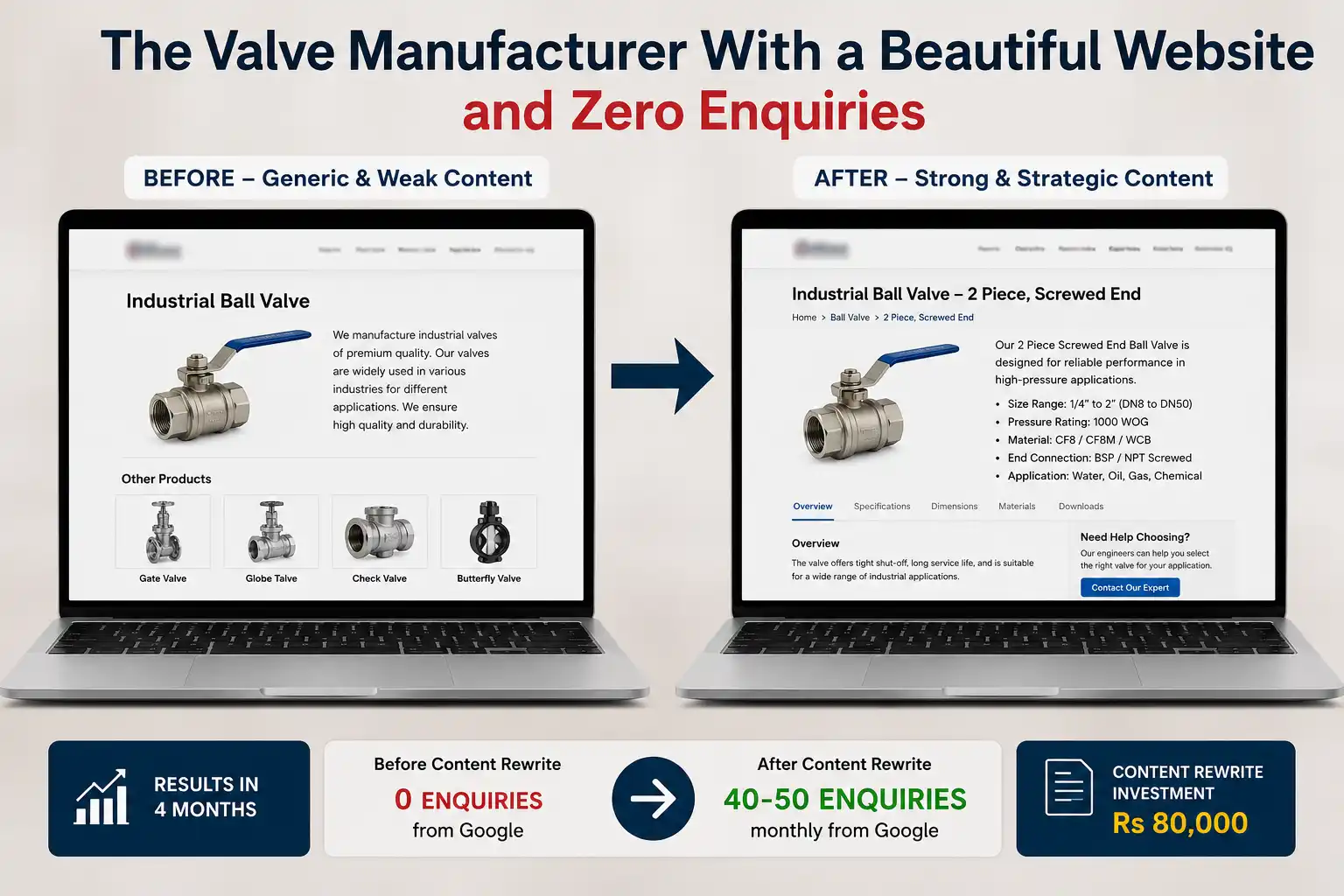
We brought in a writer. Complete content rewrite. Product pages with actual technical specs. Blog with proper guides on valve types and industry standards. FAQ content that answered questions their engineers actually heard. Comparison pieces. Real substance.
Cost was about Rs 80,000.
Result? Within four months they got 40-50 qualified enquiries monthly. From zero. Nothing else changed on the site. Same design. Same functionality. Different words.
That’s the power of content. And it’s exactly the gap we describe in our breakdown of 8 deadly SEO content writing mistakes to avoid — generic, unstrategy copy doesn’t just underperform, it makes Google treat your site as if it doesn’t exist.
Why Businesses Ignore This Despite the Evidence
Companies spend lakhs on ads. Crores on product development. Content? Rs 5,000-10,000 per blog post from whoever’s cheapest.
It’s a priority problem, honestly. If your CEO doesn’t get it, it won’t get budget.
But consider the math. Someone searching “how do I choose the right valve for my application” isn’t looking for your ad. They’re looking for knowledge. If your content answers that question, you’re not really selling — you’re becoming trustworthy. That’s the sale.
Google loves this. It’s why organic search converts better than ads. No clicking away as soon as the ad disappears. Your content keeps working while you sleep.
We track this across clients. A B2B SaaS firm getting 70% of qualified leads from organic. A fintech startup getting 3x more demos from blog traffic than from ads. A manufacturer getting 15-20 solid leads monthly — all from content.
The compounding is real. With ads, you stop paying and traffic drops immediately. With content… it just keeps flowing.
What Types of Business Content Actually Move the Needle
Not all content is the same. Most businesses think “content” means blogs. It’s much bigger.
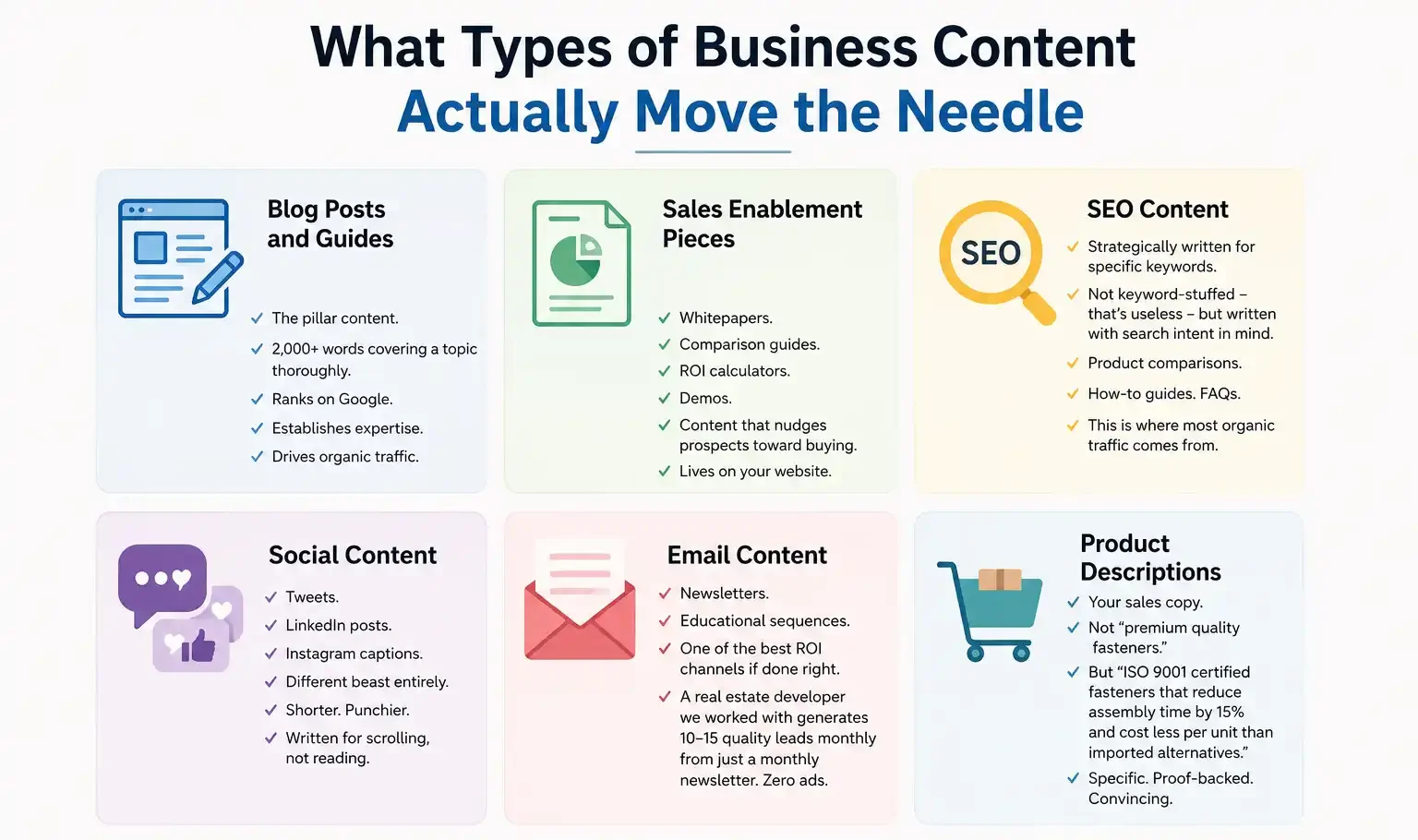
- Blog posts and guides : The pillar content. 2,000+ words covering a topic thoroughly. Ranks on Google. Establishes expertise. Drives organic traffic.
- Sales enablement pieces : Whitepapers. Comparison guides. ROI calculators. Demos. Content that nudges prospects toward buying. Lives on your website.
- SEO content : Strategically written for specific keywords. Not keyword-stuffed — that’s useless — but written with search intent in mind. Product comparisons. How-to guides. FAQs. This is where most organic traffic comes from.
- Social content : Tweets. LinkedIn posts. Instagram captions. Different beast entirely. Shorter. Punchier. Written for scrolling, not reading. This format is what our social media content creation strategy guide is built around — the principles of good content apply across channels, but execution changes dramatically by platform.
- Email content : Newsletters. Educational sequences. One of the best ROI channels if done right. A real estate developer we worked with generates 10-15 quality leads monthly from just a monthly newsletter. Zero ads.
- Product descriptions : Your sales copy. Not “premium quality fasteners.” But “ISO 9001 certified fasteners that reduce assembly time by 15% and cost less per unit than imported alternatives.” Specific. Proof-backed. Convincing.
Most businesses handle one or two types. Winners handle all of them with different people writing different formats.
What Separates Good Content From Expensive Waste
Businesses think good content means well-written. Grammatical. No typos. Reads smoothly.
That’s baseline. Not good content.
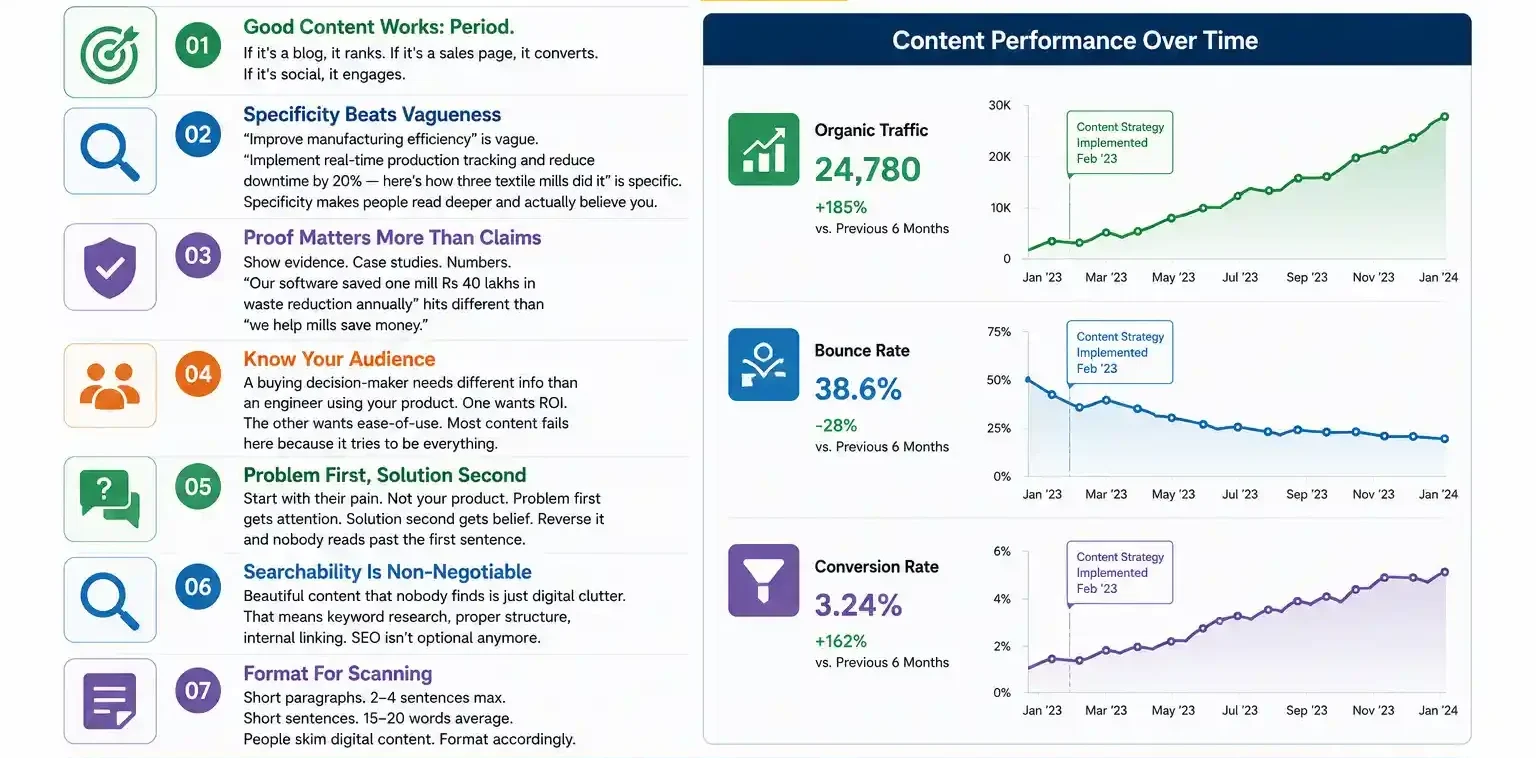
- Good content works : Period. If it’s a blog, it ranks. If it’s a sales page, it converts. If it’s social, it engages.
- Specificity beats vagueness : “Improve manufacturing efficiency” is vague. “Implement real-time production tracking and reduce downtime by 20% — here’s how three textile mills did it” is specific. Specificity makes people read deeper and actually believe you.
- Proof matters more than claims : Show evidence. Case studies. Numbers. “Our software saved one mill Rs 40 lakhs in waste reduction annually” hits different than “we help mills save money.”
- Know your audience : A buying decision-maker needs different info than an engineer using your product. One wants ROI. The other wants ease-of-use. Most content fails here because it tries to be everything.
- Problem first, solution second : Start with their pain. Not your product. Problem first gets attention. Solution second gets belief. Reverse it and nobody reads past the first sentence.
- Searchability is non-negotiable : Beautiful content that nobody finds is just digital clutter. That means keyword research, proper structure, internal linking. SEO isn’t optional anymore.
- Format for scanning. Short paragraphs. 2-4 sentences max. Short sentences. 15-20 words average. People skim digital content. Format accordingly.
Building Content Strategy
This is where most businesses mess up. They think strategy is an Excel sheet with blog titles for next quarter. It’s not.
Real strategy starts with research. What do your customers actually search for? What do they ask your sales team? What problems do they have? Keyword research tools help. So does asking your sales team what they hear constantly.
One industrial client had 50+ product categories. Could have written 50 blogs. Waste. We dug deeper and found 80% of questions came down to five core problems: “Which material do I need?”, “How long will this last?”, “Does it meet standards?”, “How does price compare to imports?”, “How do I install this?”
We built content around those five themes. Multiple content pieces per theme. Guides. Comparisons. Technical docs. Installation videos. One strategy. Multiple pieces.
Second, cluster your content. One pillar page (comprehensive guide) plus 3-4 supporting articles that link back. This builds topical authority with Google. Your “Manufacturing 101” guide isn’t one post — it’s an ecosystem of 5-6 pieces all connected.
Third, map to the customer journey. Early-stage prospect needs are different from decision-stage needs. Different again from existing customer needs. Your content roadmap should reflect reality, not just random topics.
Fourth, consistency matters. One quality article weekly beats three rushed ones. Google notices patterns. Your audience learns when to expect you. Pick a rhythm you can sustain.
How to Find (And Actually Keep) Good Writers
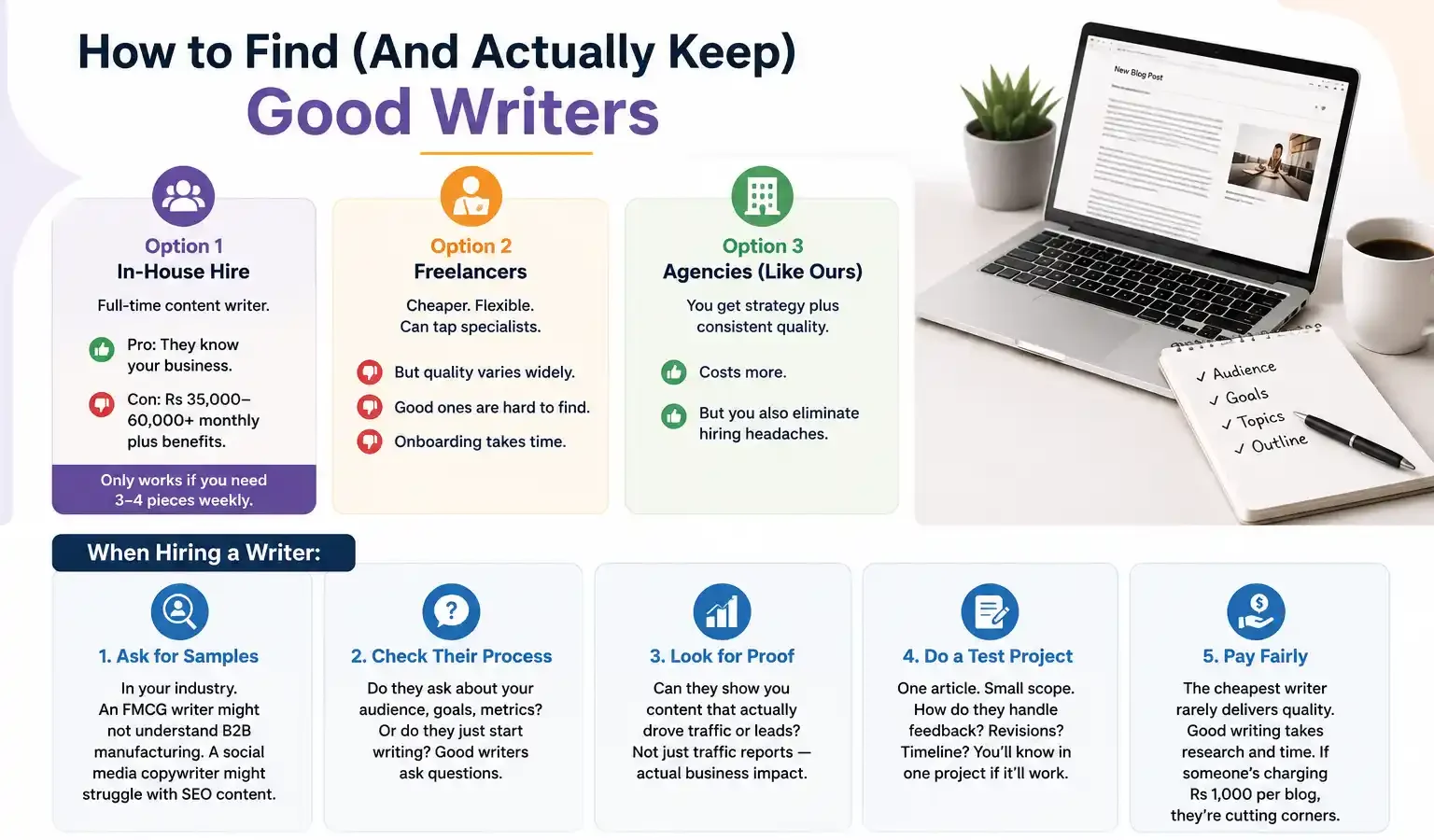
Option one: In-house hire. Full-time content writer. Pro: they know your business. Con: Rs 35,000-60,000+ monthly plus benefits. Only works if you need 3-4 pieces weekly.
Option two: Freelancers. Cheaper. Flexible. Can tap specialists. But quality varies wildly. Good ones are hard to find. Onboarding takes time.
Option three: Agencies like ours. You get strategy plus consistent quality. Costs more. But you also eliminate hiring headaches.
When hiring a writer:
Ask for samples in your industry. An FMCG writer might not understand B2B manufacturing. A social media copywriter might struggle with SEO content.
Check their process. Do they ask about your audience, goals, metrics? Or do they just start writing? Good writers ask questions.
Look for proof of results. Can they show you content that actually drove traffic or leads? Not just traffic reports — actual business impact.
Do a test project. One article. Small scope. How do they handle feedback? Revisions? Timeline? You’ll know in one project if it’ll work.
Pay fairly. The cheapest writer rarely delivers quality. Good writing takes research and time. If someone’s charging Rs 1,000 per blog, they’re cutting corners.
Actually Measuring If This Is Working
Most businesses have zero idea if content is working or not.
They publish pieces. Traffic goes up a little. But did content do it? Seasonal uptick? Did traffic convert? Did leads close?
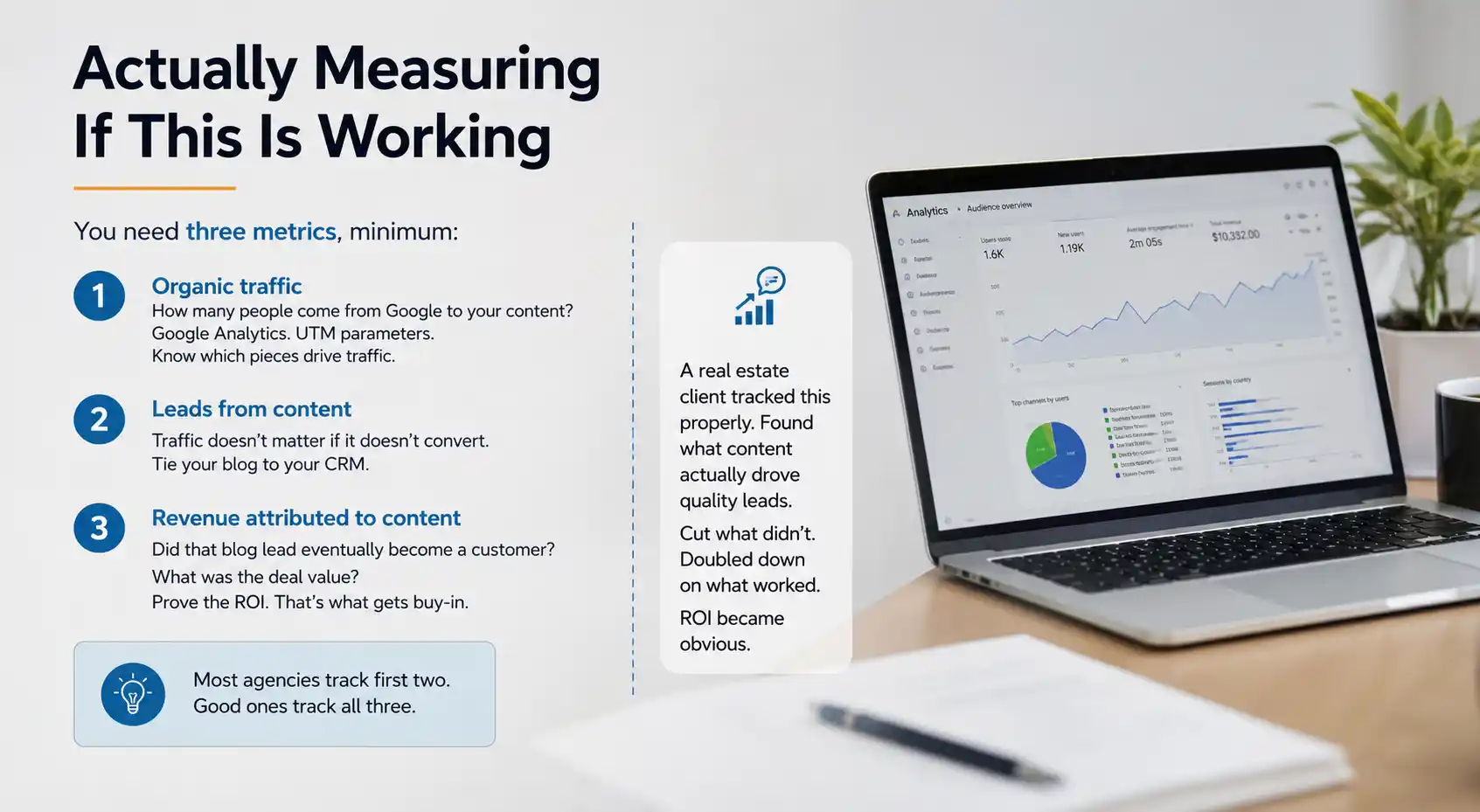
You need three metrics, minimum:
- Organic traffic : How many people come from Google to your content? Google Analytics. UTM parameters. Know which pieces drive traffic.
- Leads from content : Traffic doesn’t matter if it doesn’t convert. 1,000 visitors who don’t buy means nothing. 100 visitors where 5 become leads means everything. Tie your blog to your CRM.
- Revenue attributed to content : The hard metric. Did that blog lead eventually become a customer? What was the deal value? If you can prove content generated Rs 15 lakhs in revenue for Rs 1.5 lakh invested… everyone believes in content.
Most agencies track first two. Good ones track all three.
A real estate client we worked with tracked this properly. Discovered that “property investment tips” and “real estate market trends” drove the most qualified leads. Estate planning content? Traffic but poor conversion. They cut estate content. Doubled down on investment content. Lead quality went up. Conversion improved. ROI became obvious.
Without measurement, content is hope.
Content Mistakes That Kill Results
I could list 20. Here are the ones that actually matter:
- Writing for Google instead of people : Keyword stuffing. Awkward phrasing to hit targets. Prioritising SEO over readability. Google’s algorithm loves one thing: people engaging with content. Write for people first. Optimise for search second. They’re not competing goals.
- Ignoring what competitors publish : Look at what ranks for your keywords. Read it. Find the gaps. That gap is your opportunity. Everyone else is skimming this topic. Go deep. That’s how you win.
- Publishing and disappearing : Write a blog. Publish. Never update it. Never link to it. Never promote it. Content has a lifespan. It needs maintenance. A three-year-old blog with zero links won’t rank, no matter how good it is.
- Treating all content the same : You wouldn’t write a LinkedIn post the same way as a blog. Or Instagram the same as email. Different platforms. Different audiences. Different formats. Each one needs its own approach.
- Being too salesy too early : Lead with value. Solve problems first. Build trust. Then sell. A “5 Ways to Improve Manufacturing” piece followed by “here’s how our software does it” converts better than “buy now.”
Getting Started: Practical First Steps
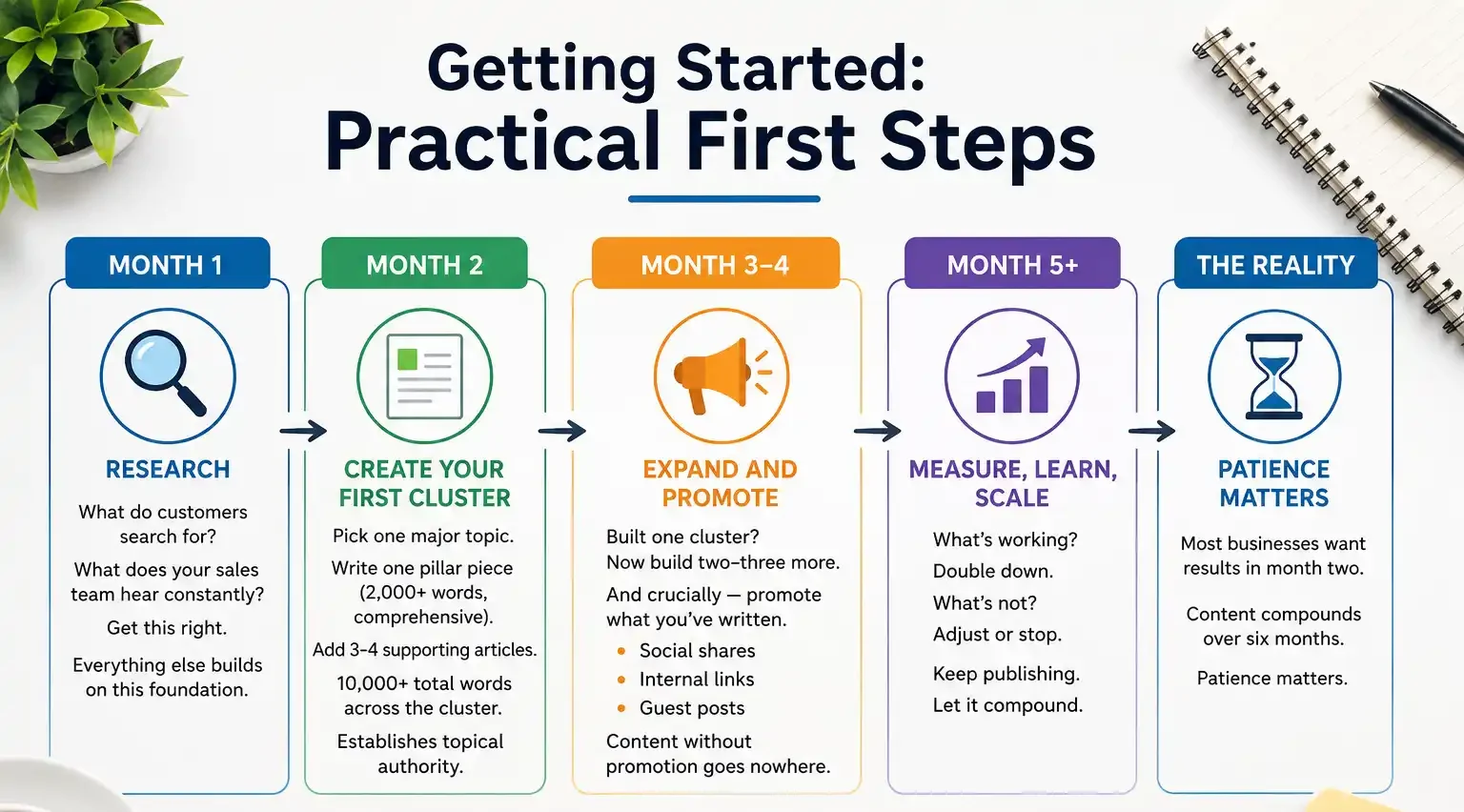
Month 1: Research. What do customers search for? What does your sales team hear constantly? Get this right. Everything else builds on this foundation.
Month 2: Create your first cluster. Pick one major topic. Write one pillar piece (2,000+ words, comprehensive). Add 3-4 supporting articles. 10,000+ total words across the cluster. Establishes topical authority.
Month 3-4: Expand and promote. Built one cluster? Now build two-three more. And crucially — promote what you’ve written. Social shares. Internal links. Guest posts. Content without promotion goes nowhere.
Month 5+: Measure, learn, scale. What’s working? Double down. What’s not? Adjust or stop. Keep publishing. Let it compound.
Most businesses want results in month two. Content compounds over six months. Patience matters.
Why We Actually Care About This
We’ve seen too many businesses try content, give up, and conclude “content doesn’t work for us.”
Content works. Bad content doesn’t. And most content is bad because there’s no strategy behind it. No research. No measurement. No promotion.
When we do this properly — and we’ve done it across 250+ brands — it’s consistently one of the best-performing channels. Better ROI than ads after six months. Better than social if you’re in B2B. Compound growth. Sustainable.
Your SEO content works while you sleep. That’s why we’re obsessed with this.
| Approach | Best for | Watch out for |
|---|---|---|
| DIY | Small teams, tight budgets | Slow ramp-up, trial-and-error |
| Freelancer | Specific project bursts | Inconsistency, limited ownership |
| Agency | Ongoing work, senior input | Higher retainer, less control |
Quick checklist before you start:
- Define the one thing you want: leads, sales, awareness — pick one.
- Baseline your numbers: write down where you are today.
- Pick a 90-day window: nothing moves in 2 weeks.
- Agree on success metrics: with whoever is paying the bill.
- Set up proper tracking: GA4, UTMs, call tracking.
- Review monthly: kill what doesn’t work, double down on what does.
The Bottom Line
If you take one thing from this: content writing for business how professional writing drives rewards patience and specificity, not volume or clever tricks. Start small, measure honestly, fix what breaks, and compound what works. The brands doing this well in India aren’t smarter — they’re just consistent. Need a hand with this for your business? Talk to us.
Ready to Build Content That Actually Works?
We’ve helped 250+ brands turn content into revenue. Let’s talk about your goals — no jargon, just strategy.
FAQs
-
How much does content writing cost?
Ans.Freelancers: Rs 3,000-8,000 per 1,500-word piece. Agencies: Rs 15,000-40,000+. Ongoing programmes: Rs 50,000-2 lakhs monthly depending on volume and research depth. Honestly though? Real question isn't price. It's ROI. Cheap content that doesn't convert is expensive. -
Should I write content myself or hire a writer?
Ans.DIY if you have 8-10 hours weekly and know your audience deeply. Hire if consistency matters more than your time. Most founders who try DIY either abandon it or produce mediocre work. Consistency suffers. Gaps appear. Hire when revenue matters more than autonomy. -
How often should I publish?
Ans.Weekly minimum if you want ranking traction. But consistency beats frequency always. One article weekly sustained for a year beats three articles weekly for three months then silence. Google notices patterns. Your audience learns when to expect you.
Author Details

Latest Posts
-
 28 / Jul
-
27 / Jul
-
 24 / Jul
Content Management System Headless CMS: What It Is and When Your Business Needs One
24 / Jul
Content Management System Headless CMS: What It Is and When Your Business Needs One -
23 / Jul
Website Security Website Security: Essential Guide to Protecting Your Business Site
-
21 / Jul




Related Knowledge