


-
Author: PromotEdge
-
Updated Date: Mar-19-2026
-
Views: 2 Min Read
Performance marketing in 2026 focuses on measurable outcomes like leads, conversions, and revenue rather than impressions. Modern frameworks integrate advertisers, publishers, networks, and agencies to create a data-driven system powered by AI and automation.
Performance marketing has become one of the most effective ways for businesses to generate measurable growth. Unlike traditional advertising, where companies pay for visibility or impressions, performance marketing focuses on real outcomes such as leads, conversions, and sales.
In 2026, performance marketing frameworks are designed in a way to help businesses track results more accurately while optimizing budgets. With the rise of AI automation and privacy-focused data regulations, companies are now building structured systems that help them scale campaigns more efficiently.
Many companies today prefer performance marketing because every campaign can be tracked from click to final purchase. This article helps you get an understanding about the advanced targeting strategies following which, companies can achieve long-term scalable growth.
Core Elements of Performance Marketing Frameworks
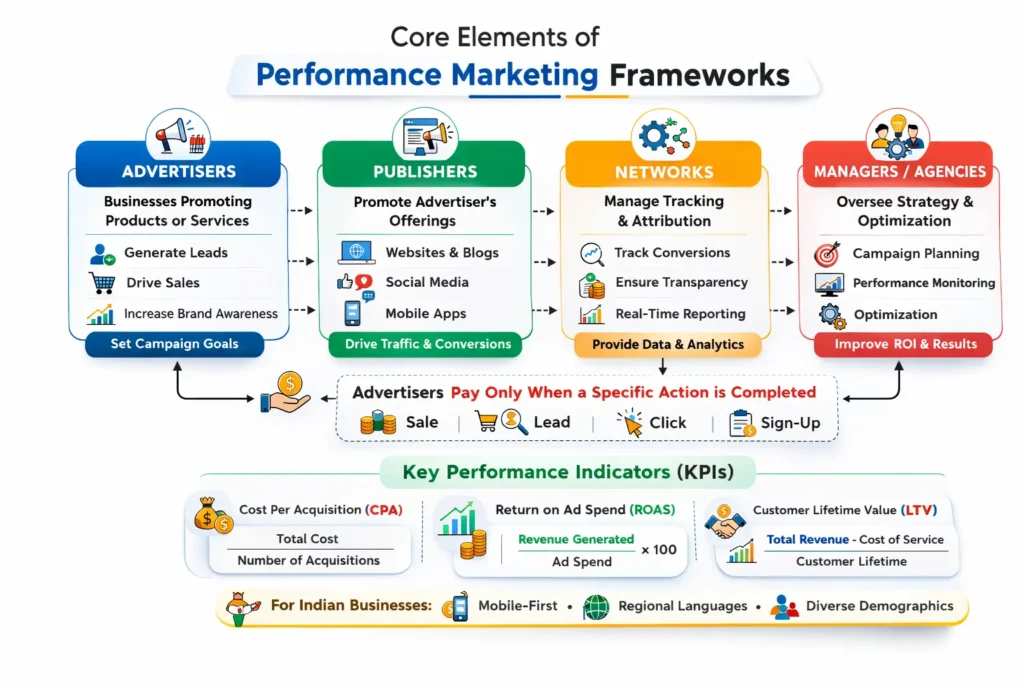
A performance marketing framework operates through four key participants that work together to generate measurable outcomes.
Advertisers
These are the businesses that want to promote their products or services and generate results such as leads or purchases.
Publishers
Publishers promote the advertiser’s offerings through platforms such as blogs, websites, social media channels, and mobile applications.
Networks
Networks such as Impact or CJ manage tracking systems that record conversions and provide transparent attribution across marketing channels.
Managers or Agencies
Marketing teams or agencies oversee campaign strategy, performance monitoring, and optimization.
In this system, advertisers only pay when a specific action is completed. This could be a sale, lead, or click depending on the chosen campaign model.
A strong performance marketing strategy also depends on clearly defined Key Performance Indicators (KPIs) such as:
- Cost Per Acquisition (CPA)
- Return on Ad Spend (ROAS)
- Customer Lifetime Value (LTV)
These metrics help businesses measure the real revenue impact of marketing activities rather than focusing only on clicks or impressions. For Indian businesses, effective frameworks also consider regional language preferences, mobile-first user behavior, and diverse customer demographics.
Building a Strong Performance Marketing Strategy
Before creating an effective performance marketing strategy, you need to start by understanding the target audience.
The first step is audience segmentation using first-party data collected from websites, mobile apps, and customer databases. AI-powered tools analyze this data to identify users with high purchase intent and predict their future behavior.
Next, marketers analyze campaign performance using platforms such as Google Analytics 4 and Meta Business Suite. Metrics like click-through rate (CTR) and cost per click (CPC) help determine whether ads are reaching the right audience.
For example, many e-commerce brands now use automated bidding on Google Ads combined with retargeting on Meta to recover abandoned carts.
These insights help marketers refine bidding strategies, improve ad creatives, and increase overall campaign efficiency. As a result, businesses can reduce Customer Acquisition Cost (CAC) while increasing their conversion rate.
A strong strategy also involves cross-channel marketing. Paid search, social media advertising, and display campaigns work together to create consistent brand visibility across multiple platforms.
Retargeting is another important component. Users who visit a website but leave without purchasing can be re-engaged through personalized ads or email reminders. This strategy helps recover abandoned carts and increase conversion rates.
At the same time, businesses also need to comply with privacy regulations such as GDPR and India’s Digital Personal Data Protection (DPDP) Act. Ethical data practices and consent-based tracking allow companies to scale campaigns while maintaining compliance.
Key Performance Marketing Models for 2026
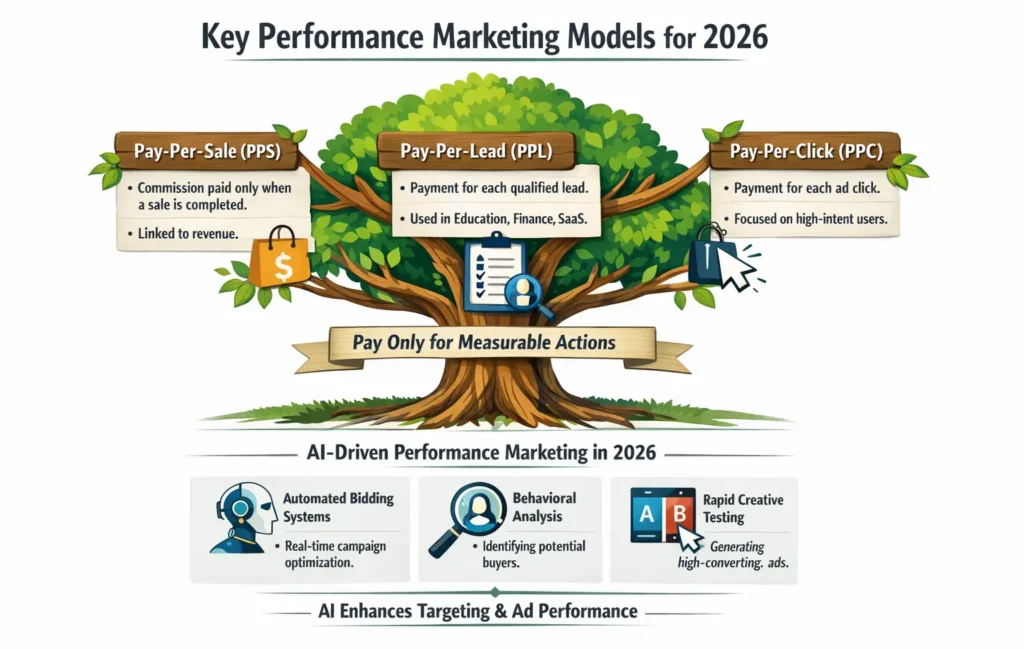
Performance marketing campaigns generally operate through three primary payment models.
Pay-Per-Sale (PPS)
Advertisers pay a commission only when a sale is completed. This model is commonly used in e-commerce because marketing costs are directly linked to revenue.
Pay-Per-Lead (PPL)
Businesses pay when a qualified lead is generated. This model is widely used in industries such as education, finance, and SaaS where leads require follow-up before conversion.
Pay-Per-Click (PPC)
Advertisers pay whenever a user clicks on their ad. Campaigns are optimized to ensure that clicks come from high-intent users who are more likely to convert.
These models reduce financial risk because businesses only pay for measurable actions.
In 2026, AI-driven performance marketing models are becoming increasingly important. Platforms like Google and Meta now use automated bidding systems that optimize campaigns in real time to maximize return on ad spend.
AI systems analyze user behavior signals such as browsing patterns, previous purchases, and engagement history to identify potential buyers. This allows marketers to focus their advertising budgets on audiences that are most likely to convert.
AI also enables rapid creative testing. Advanced tools are used which are capable of generating and testing multiple ad variations to identify which messages and visuals produce the highest conversion rates.
Optimizing the Performance Marketing Funnel
The performance marketing funnel represents the entire customer journey—from awareness to repeat purchases.
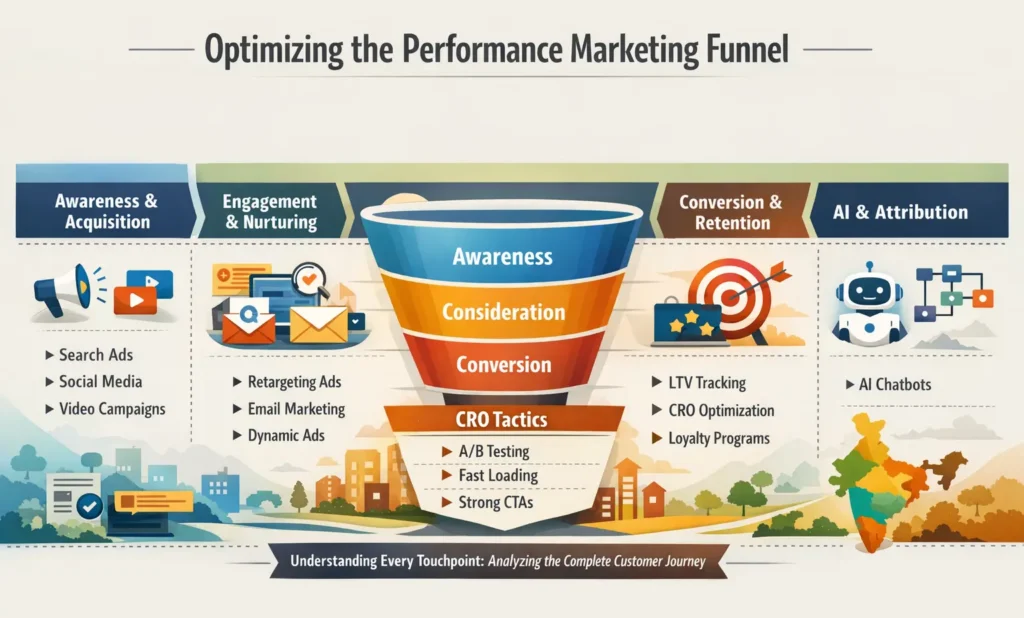
At the top of the funnel, businesses focus on generating visibility and attracting new users. Search engine marketing, social media advertising, and video campaigns help introduce the brand to a wider audience.
The middle of the funnel focuses on engagement and nurturing potential customers. Retargeting campaigns, personalized emails, and dynamic advertisements remind users about products they previously viewed.
The bottom of the funnel focuses on converting interested users into paying customers.
This is where Conversion Rate Optimization (CRO) becomes important. Techniques such as A/B testing landing pages, improving website loading speed, and using clear calls-to-action can significantly increase conversion rates.
Tracking Customer Lifetime Value (LTV) also helps businesses understand the long-term value of each customer. When companies focus on retaining customers rather than only acquiring new ones, overall marketing efficiency improves.
For businesses in India, localized communication strategies can further improve performance. Using regional languages and culturally relevant messaging increases engagement in diverse markets.
Many brands are also integrating AI chatbots into their marketing funnels. These tools provide instant responses to user queries and guide potential customers through the buying process.
Another important development is multi-touch attribution modeling. Instead of assigning credit only to the final interaction, this model analyzes every touchpoint that contributes to a conversion. This helps marketers understand which channels influence purchasing decisions.
Role of AI and Automation in Performance Marketing Strategies in 2026
Artificial Intelligence plays a major role in performance marketing strategies in 2026. Automation tools now manage bidding strategies, campaign optimization, and ad placement with minimal manual effort.
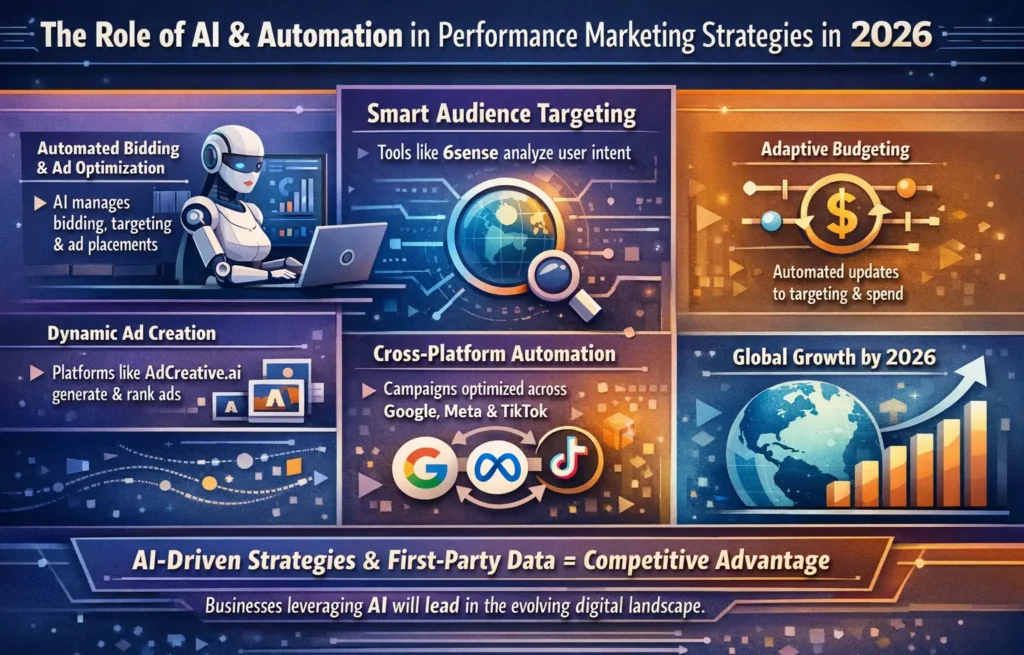
Platforms such as AdCreative.ai generate multiple versions of advertisements and rank them based on their predicted conversion performance. Tools like 6sense analyze user intent and help determine where and when ads should be displayed.
Automation systems continuously adjust campaigns across platforms like Google, Meta, and TikTok. As advertising algorithms evolve, these systems automatically update targeting and budget allocation.
This level of automation allows businesses to scale campaigns without significantly increasing manual effort. without significantly increasing acquisition costs.
Global digital advertising spending is expected to exceed $765 billion by 2026. Businesses that adopt AI-driven strategies and build strong first-party data systems will be better positioned to compete in this rapidly evolving environment.
CRO and Creative Strategies
Creative content plays a critical role in performance marketing success.
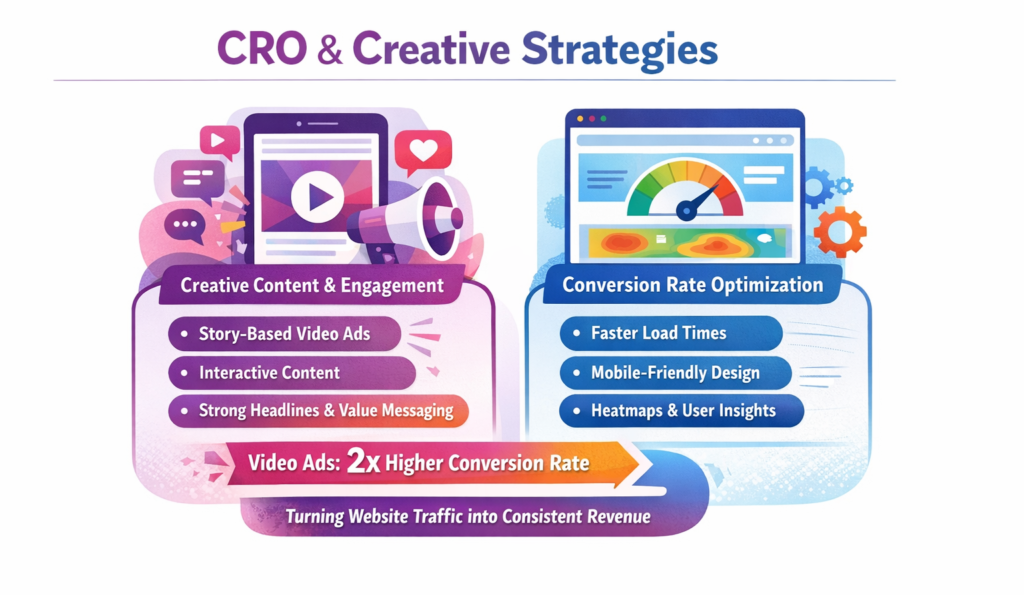
Story-based video advertisements and interactive content help capture user attention in competitive digital spaces. Strong headlines that clearly communicate value encourage users to click and explore further.
Video advertising, particularly on social media platforms, often delivers significantly higher engagement than static display ads. In many cases, video campaigns achieve nearly twice the conversion rate.
Conversion Rate Optimization focuses on improving the user experience after visitors reach the website. Faster page loading speeds, mobile-friendly design, and simple navigation make it easier for users to complete purchases.
Marketing teams also use tools such as heat maps to identify where users drop off during the buying process. These insights help improve website design and remove friction from the customer journey.
By combining strong creative content with CRO techniques, businesses can turn website traffic into consistent revenue.
Final Thoughts
Performance marketing frameworks in 2026 allow businesses to scale revenue through data-driven strategies.
From audience segmentation to conversion optimization, each stage of the performance marketing funnel contributes to long-term growth. Businesses that focus on key metrics such as ROAS, CPA, and customer lifetime value can continuously refine their strategies and maximize returns.
PromotEdge specializes in building such customized performance marketing strategies that help brands achieve sustainable growth. Our goal is to help brands turn marketing investments into predictable and scalable revenue.
FAQs
-
What are performance marketing frameworks?
Ans.Performance marketing frameworks are systems used to plan, run, and measure marketing campaigns based on results such as clicks, leads, or sales. -
What is a performance marketing funnel?
Ans.A performance marketing funnel shows the journey of a customer from discovering a brand to finally making a purchase. -
What is a performance marketing strategy?
Ans.A performance marketing strategy uses data and online advertising to generate leads, conversions, and revenue from digital marketing campaigns.
Latest Posts
-
19 / Mar
-
 18 / Feb
Web Solution 12 Website Redesign Mistakes to Avoid Losing SEO
18 / Feb
Web Solution 12 Website Redesign Mistakes to Avoid Losing SEO -
11 / Feb
Digital Marketing What is 7P and 7C of Digital Marketing?
-
22 / Jan
-
22 / Dec
Digital Marketing Google December 2025 Core Update


FAQs

-
What are performance marketing frameworks?
Ans.Performance marketing frameworks are systems used to plan, run, and measure marketing campaigns based on results such as clicks, leads, or sales. -
What is a performance marketing funnel?
Ans.A performance marketing funnel shows the journey of a customer from discovering a brand to finally making a purchase. -
What is a performance marketing strategy?
Ans.A performance marketing strategy uses data and online advertising to generate leads, conversions, and revenue from digital marketing campaigns.


