-
Author: Anindita Barik
-
Updated Date: Aug-26-2026
-
Views: 2 Min Read
Video SEO can help brands turn existing video content into a consistent source of organic search traffic. By matching videos with search intent and optimizing titles, descriptions, tags, captions, thumbnails, timestamps, schema markup, and video sitemaps, businesses can improve visibility across Google and YouTube. This guide provides a practical Video SEO framework covering keyword research, publishing, performance tracking, engagement optimization, common mistakes, and long-term strategies for sustainable video rankings.
Video SEO is the process of optimising videos to improve their visibility in Google and YouTube search results. It involves using relevant keywords in video titles, descriptions, tags, transcripts, and supporting content, while also improving thumbnails, engagement, watch time, and overall content quality.
To rank videos effectively, focus on matching search intent and answering specific audience questions clearly. Create useful, keyword-focused videos, optimise metadata, add accurate transcripts and captions, use descriptive thumbnails, and embed videos on relevant web pages. Consistent optimisation and strong viewer engagement can help your videos gain visibility across both Google and YouTube.
The Educational Channel That Couldn’t Get Discovered
Online education startup. Good content. Tier-2 city team. Their YouTube channel had 60+ videos covering engineering concepts. Well-shot. Actually helpful. The kind of thing students should be watching.
Total subscribers after one year? 340.
They called us frustrated. “Our content is good. Why isn’t it getting views?”
I watched three videos. Beautiful quality. Clear explanations. And then I checked: no keywords in the title. The description was basically empty — just “Thanks for watching!” The tags were random. The video wasn’t even claiming a topic in the way YouTube could understand it.
Google and YouTube had no idea what these videos were actually about.
We spent two weeks re-optimising 30 of their existing videos. Better titles. Actual descriptions (500+ words each). Timestamps for longer videos. Schema markup. Closed captions. Nothing changed about the video content itself.
Two months later? 8,000 monthly views. By month six, they were getting 50,000+ views a month. Most from search, not suggested videos. Same videos. Different metadata. That’s video SEO.
Not glamorous. Doesn’t feel like “strategy.” But it works. This same metadata discipline is exactly what our YouTube SEO tips guide is built around — the content quality is necessary but never sufficient on its own.
Why Video SEO Matters
Text content has been around since the beginning. Everyone knows SEO. Video is newer territory and — frankly — most creators ignore optimization completely.
Which means the competition is softer.
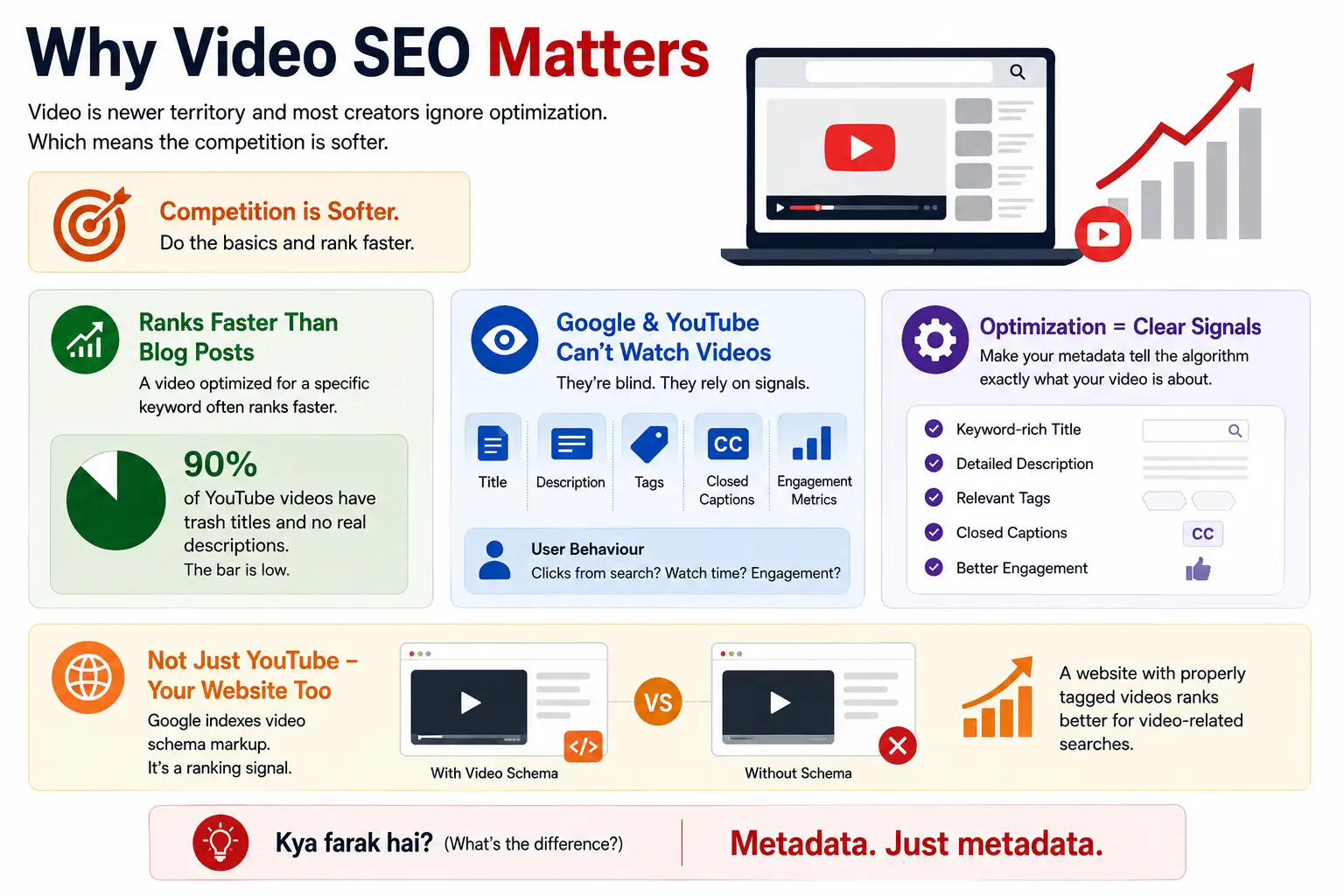
A video optimised for a specific keyword often ranks faster than a blog post about the same topic. Why? Because 90% of videos on YouTube have trash titles and no real descriptions. The bar is low. You just have to do the basics.
Google and YouTube can’t actually watch your videos. They’re blind. They see: your title, description, tags, closed captions, engagement metrics (watch time, likes, comments), and user behaviour (did people click the video from search results? How long did they stay?)
So optimising means: making sure that metadata tells the algorithm what your video is about in the clearest way possible.
This is true for YouTube videos, sure. But also videos embedded on your website. Google indexes video schema markup. It’s a ranking signal. A website with properly tagged videos ranks better for video-related searches than one with the same video uploaded but no schema. his technical layer is the same one covered in our technical SEO audit guide — schema markup for videos sits alongside page speed and crawlability as a foundational technical signal that most websites ignore until a competitor starts outranking them.
Kya farak hai? (What’s the difference?) Metadata. Just metadata.
YouTube Video SEO
A well-optimised YouTube video combines strong keyword targeting with clear, engaging metadata. Here’s what to focus on:
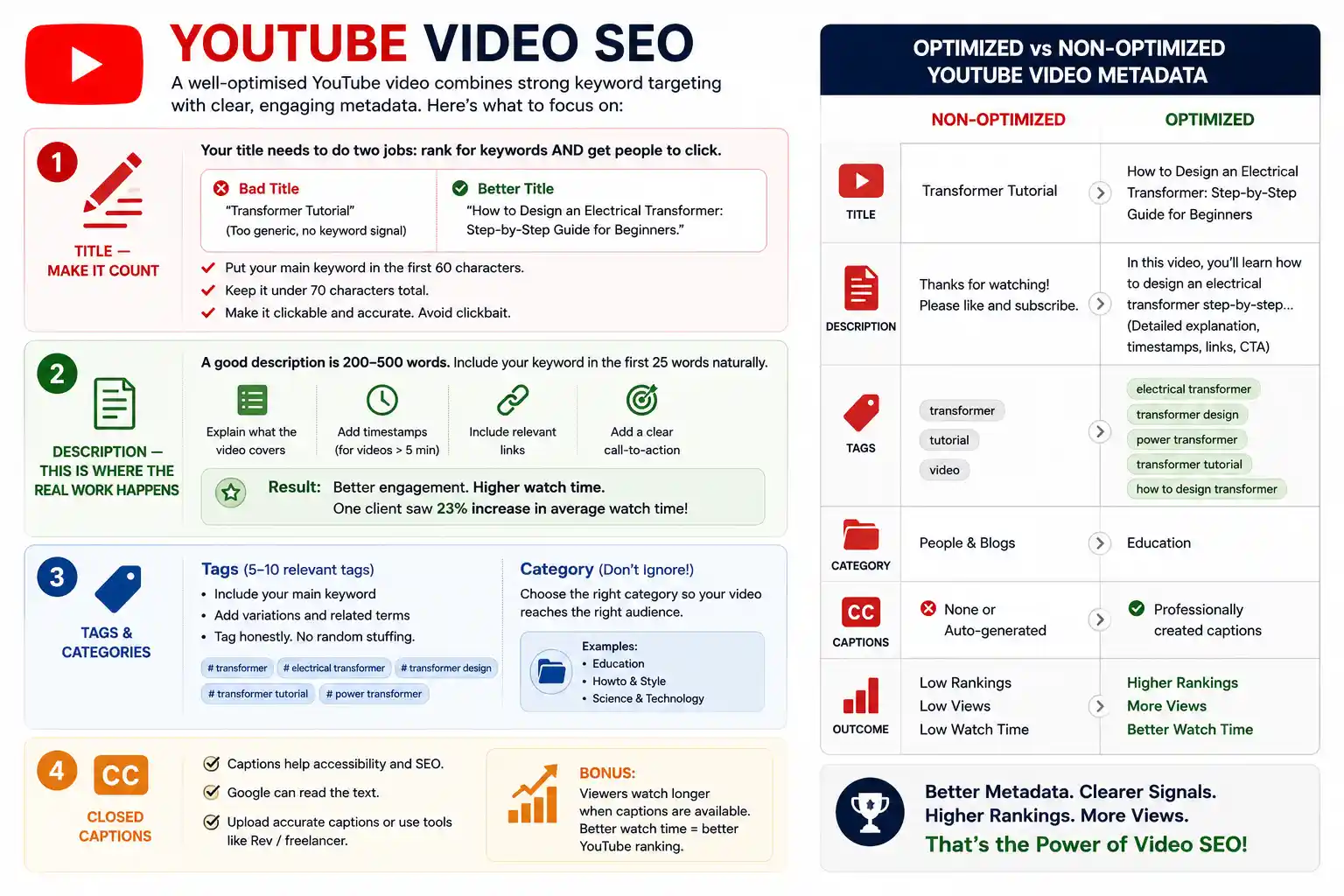
1. Title — Make It Count
Your title needs to do two jobs: rank for keywords AND get people to click. It’s a balance.
Bad title: “Transformer Tutorial” (way too generic, no keyword signal).
Better: “How to Design an Electrical Transformer: Step-by-Step Guide for Beginners.”
Why? “Transformer tutorial” is too broad. But “electrical transformer design step by step” signals specificity. It tells YouTube: this video is for people learning transformer design, not people looking for the Transformers movie.
Best practices: put your main keyword in the first 60 characters (before YouTube truncates the title). Keep it under 70 characters total. Make it clickable — people should want to actually click. Avoid clickbait that makes your CTR look good but watch time terrible.
We had a tech client once put “INSANE: This Feature Will BLOW YOUR MIND!” as a video title. Decent click-through rate. But 60% of viewers quit in the first 30 seconds because the title overpromised. YouTube’s algorithm noticed. The video tanked in the rankings eventually.
2. Description — This Is Where the Real Work Happens
Most creators write three sentences. Wrong.
A good description is 200-500 words. Include your keyword in the first 25 words naturally. Then explain what the video covers. If it’s a tutorial, list the steps. If it’s a review, explain what’s being reviewed. Add timestamps if your video is longer than 5 minutes.
Timestamps actually matter. They let viewers jump to sections. YouTube sees that as good UX. And each timestamp creates another page in the video that can be indexed.
Include relevant links: your website, related videos, social media. This helps with engagement signals — are people taking action after watching?
One manufacturing company we worked with made technical demo videos. Their descriptions were basically empty. We rewrote them to include: overview of what’s being demonstrated (2-3 sentences), timestamp breakdown of the demo, link to their product page, and a call-to-action. Their average watch time went up 23%. Seriously. This is the same principle behind strong on-page SEO — giving the algorithm clear, contextual signals about what the content covers always improves discoverability, whether it’s a web page or a video description.
3. Tags and Categories
Tags are secondary to title and description, but still matter. Add 5-10 relevant tags. Your main keyword should be one of them. Then add variations and related terms.
Don’t stuff tags with random words hoping to rank for everything. YouTube’s algorithm is smart enough to penalise that. Tag honestly.
Category selection is usually overlooked. Make sure your video is in the right category — “Education” for educational content, “Howto & Style” for tutorials, etc. Wrong category = wrong audience suggestions.
4. Closed Captions
This one’s underrated. Captions help accessibility, sure. But they also help SEO because Google can read the text.
Don’t rely on YouTube’s auto-generated captions. They’re helpful but often inaccurate. Best: upload a properly edited transcript or use a tool like Rev or a freelancer to caption your video professionally. If your video has 1,000 views, it’s worth the investment in proper captions.
The bonus: people watch longer when captions are available. Better watch time = better YouTube algorithm signal.
Google Video Search SEO
YouTube videos appear in YouTube. But they also appear in Google’s general search results — in the “Video” tab and sometimes in regular search results above the fold.
To rank in Google Video search, you need: a sitemap.xml that includes video URLs, schema markup (JSON-LD) that describes your video, and proper embed code on your website with metadata tags.
This is the technical bit most agencies skip.
Schema Markup for Videos
Google Search Console has a Video Indexing Report. Looks at your videos. Needs to understand what they’re about. You tell it by adding video schema.
Basic schema includes: video URL, title, description, thumbnail URL, and duration. This tells Google what to expect.
If you’re embedding a YouTube video on your website, the schema should point to YouTube. If you’re hosting on Vimeo or internally, same idea — make sure the schema matches the actual video location.
One e-commerce client had product videos embedded on their pages. No schema. Google wasn’t indexing those videos. We added schema markup to 50 product pages. Within a month, those videos started appearing in Google Image search results and video search results. Sudden traffic boost. Just schema.
Video Sitemaps
Create a video sitemap and submit it to Google Search Console. Tells Google where all your videos are. Format is similar to regular XML sitemap but with video-specific tags.
Include: video URL, title, description, thumbnail. Optionally: duration, upload date, expiration date (if relevant), rating, view count.
Most websites never do this. Most videographers never do this. Another low-competition opportunity.
The Metrics That Actually Matter for Video SEO
YouTube reports views, watch time, CTR, and engagement. Google reports impressions and CTR for video search. But which ones matter for SEO?
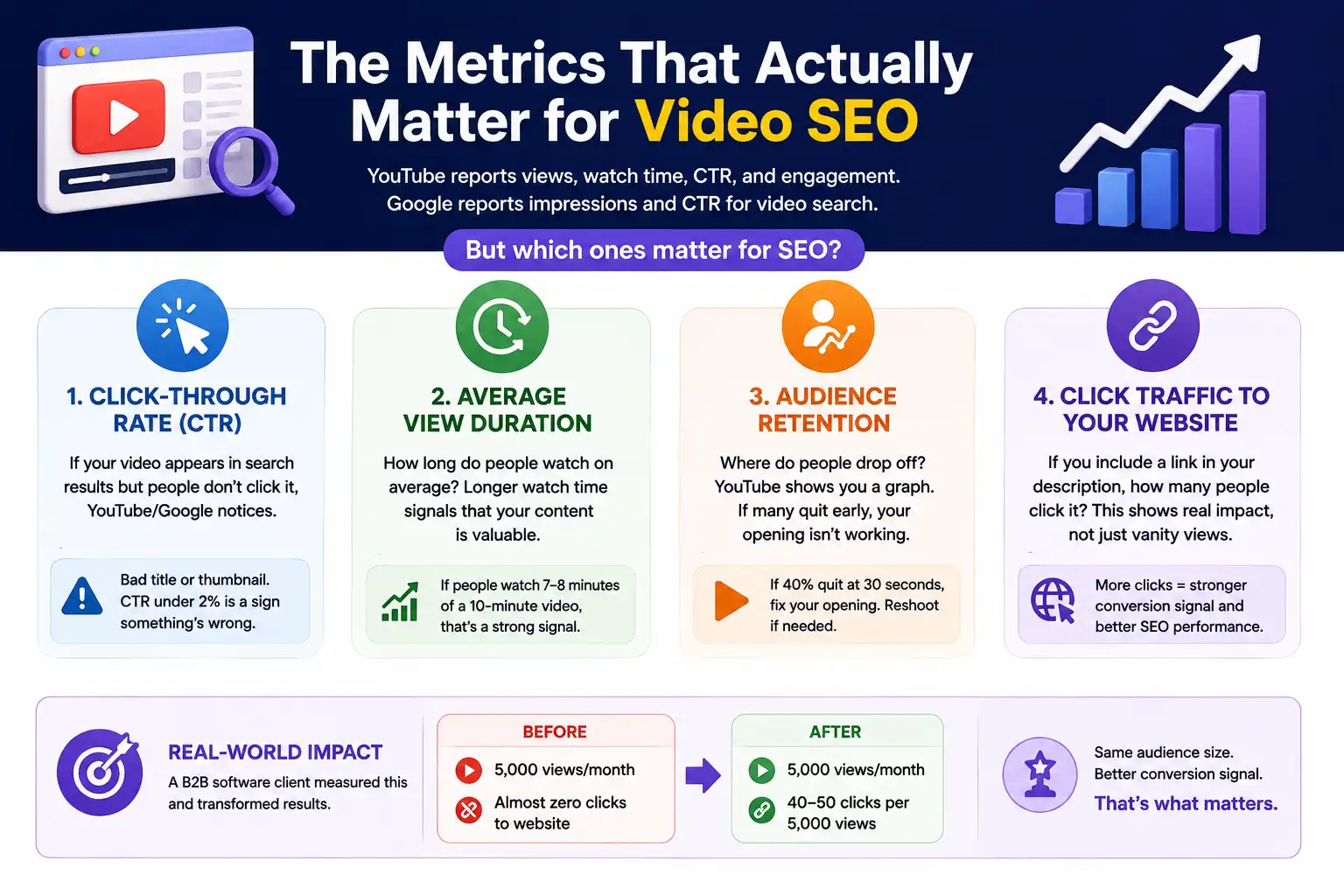
- Click-through rate (CTR) : If your video appears in search results but people don’t click it, YouTube/Google notices. Bad title or thumbnail. Fix it. CTR under 2% is a sign something’s wrong.
- Average view duration : How long do people watch on average? If you have a 10-minute video and people watch 2 minutes on average, the algorithm thinks your content is weak. If people watch 7-8 minutes, strong signal. Build your videos to keep people engaged.
- Audience retention : Where do people drop off? YouTube shows you a graph. If 40% of viewers quit at the 30-second mark, your opening is boring. Fix the first 30 seconds. Reshoot if needed.
- Click traffic to your website : If you include a link in your description, how many people click it? This tells you if your video is actually moving people toward a conversion goal or just getting vanity views.
We had a B2B software client measure this. Their videos were getting 5,000 views a month but almost zero clicks to their website. New video strategist came in, refined the description, added timestamps, improved the CTA. Suddenly 40-50 clicks per 5,000 views. Same audience size. Better conversion signal. That’s what matters.
Common Video SEO Mistakes
- Ignoring keywords. “Just make great content and people will find it.” No. Thousands of people make great content. The ones with optimised metadata rank higher. Know what keywords you’re targeting BEFORE you create the video. Then build the video around those keywords.
- Duplicate video titles. If you upload the same video to both YouTube and your website, use different titles. Same title = confusing signals to Google. One version should be optimised for YouTube algorithm, the other for Google search. They’re different beasts.
- Weak descriptions. “Check out this video! Subscribe!” is not a description. It’s lazy. YouTube doesn’t index “subscribe.” Write actual descriptions that explain what viewers will learn. This is where you include your keyword naturally, not forced.
- No captions for longer videos. You’re leaving SEO value on the table. Every word in your captions is crawlable text.
- Inconsistent upload schedule. YouTube’s algorithm favours consistency. Uploading one video, waiting three months, uploading another confuses the algorithm. It doesn’t know if your channel is active. Try for at least monthly uploads, ideally weekly. Consistency signals that your channel is live.
- Ignoring comments and engagement. Videos with higher engagement (likes, comments, shares) rank better. Encourage comments. Respond to comments. This is both a signal and a way to build community. Seedha baat (straight talk): comments matter for rankings.
Video SEO for Different Platforms
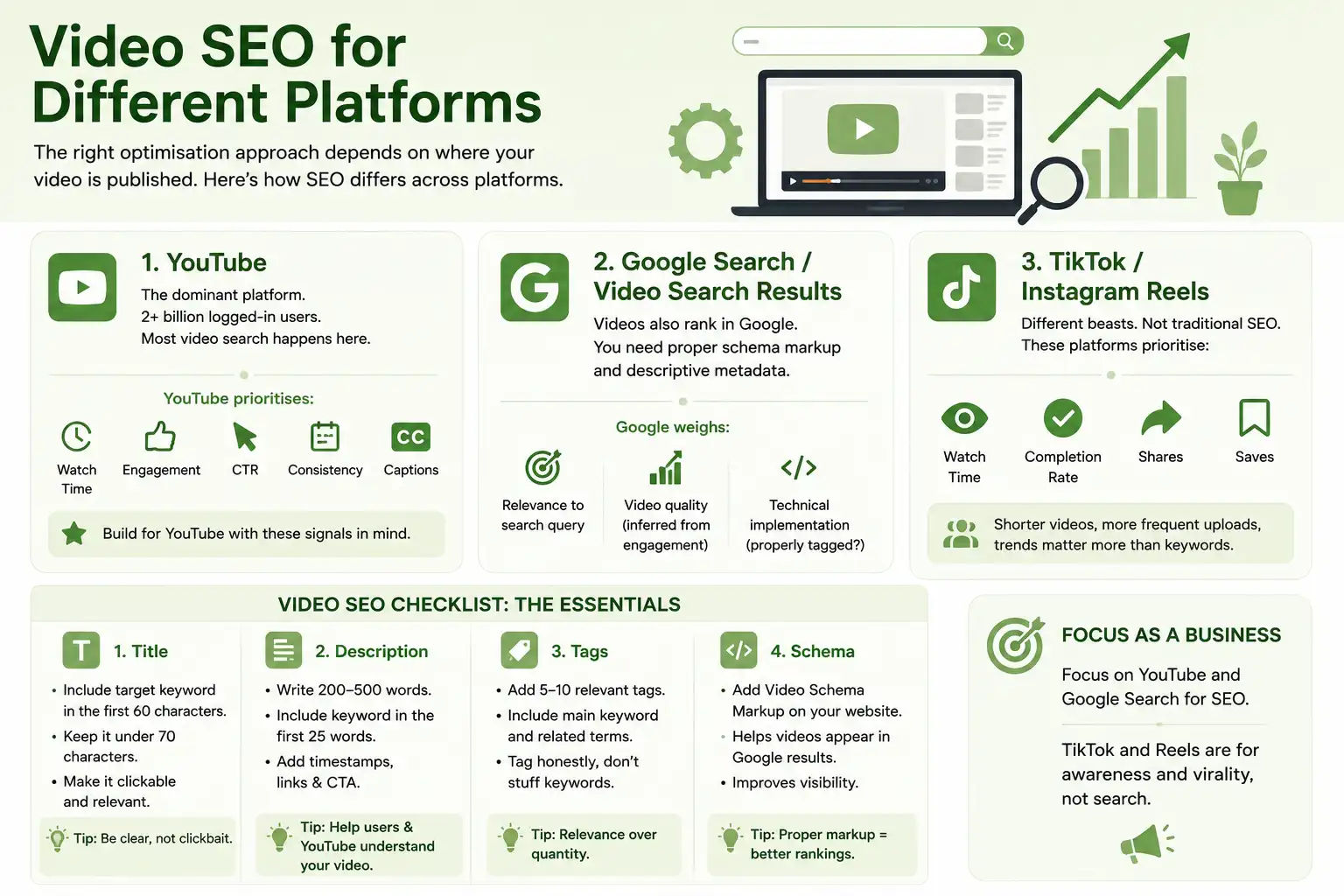
The right optimisation approach depends on where your video is published. Here’s how SEO differs across the major video platforms:
1. YouTube
The dominant platform. 2+ billion logged-in users. Most video search happens here. YouTube has its own algorithm. Prioritises: watch time, engagement, CTR, consistency, captions. Build for YouTube with those signals in mind.
2. Google Search / Video Search Results
Videos also rank in Google. You need proper schema markup and descriptive metadata. Google weighs: relevance to the search query, video quality (inferred from engagement), and technical implementation (is the video properly tagged?).
3. TikTok / Instagram Reels
Different beasts. Not traditional SEO. These platforms prioritise: watch time, completion rate, shares, saves. Shorter videos, more frequent uploads, trends matter more than keywords. Not optimised the same way as YouTube.
If you’re a business, focus on YouTube and Google search for SEO. TikTok and Reels are for awareness and virality, not search.
A Practical Video SEO Workflow
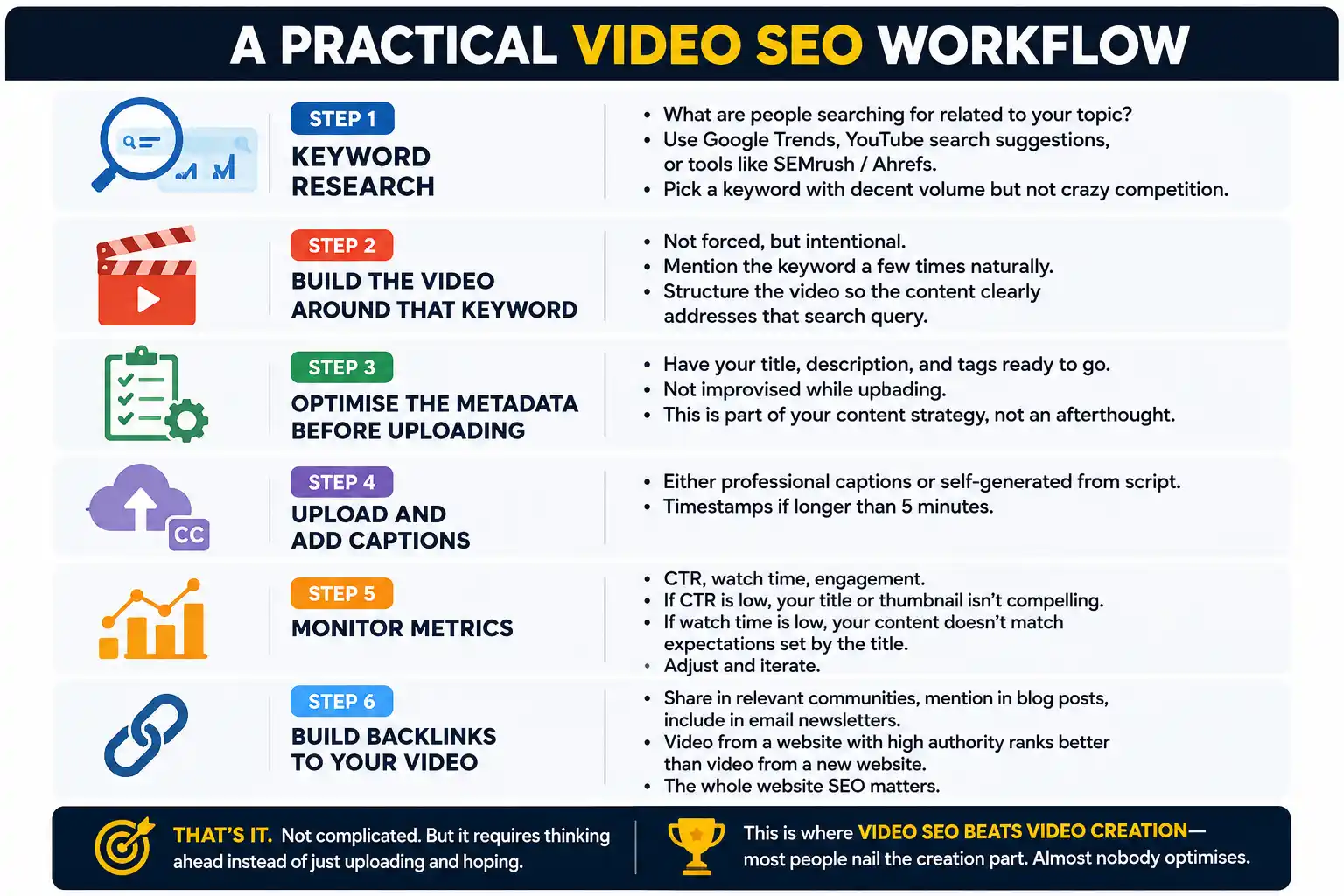
Step one: Keyword research. What are people searching for related to your topic? Use Google Trends, YouTube search suggestions, or tools like SEMrush / Ahrefs. Pick a keyword with decent volume but not crazy competition.
Step two: Build the video around that keyword. Not forced, but intentional. Mention the keyword a few times naturally. Structure the video so the content clearly addresses that search query.
Step three: Optimise the metadata BEFORE uploading. Have your title, description, and tags ready to go. Not improvised while uploading. This is part of your content strategy, not an afterthought.
Step four: Upload and add captions. Either professional captions or self-generated from script. Timestamps if longer than 5 minutes.
Step five: Monitor metrics. CTR, watch time, engagement. If CTR is low, your title or thumbnail isn’t compelling. If watch time is low, your content doesn’t match expectations set by the title. Adjust and iterate.
Step six: Build backlinks to your video. Share in relevant communities, mention in blog posts, include in email newsletters. Video from a website with high authority ranks better than video from a new website. The whole website SEO matters.
That’s it. Not complicated. But it requires thinking ahead instead of just uploading and hoping. This is where video SEO beats video creation — most people nail the creation part. Almost nobody optimises.
The Honest Truth About Video SEO Results
Optimised videos rank faster than text content. You can see ranking improvements within 4-6 weeks. But you won’t see traffic explosions. You’ll see gradual growth.
If you’re targeting “how to” keywords with lower competition, you might rank within 8-12 weeks. If you’re targeting competitive keywords, that stretches to 6 months+. Same as text SEO, honestly.
The real win is that video content typically has longer useful lifespan than text. A blog post about “top productivity tools 2026” might need updating every year. A video showing how to use a tool? Still relevant five years later if the tool hasn’t changed.
So video SEO is more of a long-term play. Not a “make this video and get 10,000 views next month” situation. But consistency compounds. Upload one video a week, properly optimised, for a year? You’re looking at a catalogue that feeds you traffic for years.
That’s the ROI conversation we’re still figuring out at PromotEdge. Kalakari (artistry) + data-driven strategy. Do the creative work, measure the results, improve. Build karo, show karo, grow karo (build, showcase, grow). That’s video SEO in practice.
| Approach | Best for | Watch out for |
|---|---|---|
| DIY | Small teams, tight budgets | Slow ramp-up, trial-and-error |
| Freelancer | Specific project bursts | Inconsistency, limited ownership |
| Agency | Ongoing work, senior input | Higher retainer, less control |
Quick checklist before you start:
- Define the one thing you want: leads, sales, awareness — pick one.
- Baseline your numbers: write down where you are today.
- Pick a 90-day window: nothing moves in 2 weeks.
- Agree on success metrics: with whoever is paying the bill.
- Set up proper tracking: GA4, UTMs, call tracking.
- Review monthly: kill what doesn’t work, double down on what does.
The Bottom Line
If you take one thing from this: video seo how to rank your videos in google youtube rewards patience and specificity, not volume or clever tricks. Start small, measure honestly, fix what breaks, and compound what works. The brands doing this well in India aren’t smarter — they’re just consistent. Need a hand with this for your business? Talk to us.
Ready to Optimise Your Videos for Search?
We’ve optimised 500+ videos for YouTube and Google search. Some got viral. Most got steady, reliable organic traffic. All started with proper metadata and strategy, not luck.
FAQs
-
Does video SEO actually work for ranking videos?
Ans.Yes. A properly optimised video ranks higher than the same video with no optimization. Will it rank for super competitive keywords? Probably not. But for niche keywords and long-tail searches, video SEO is faster than text SEO because fewer people are competing. -
What's more important — YouTube or Google search?
Ans.Depends. YouTube algorithm matters if you want subscribers and channel growth. Google search matters if you want to drive traffic to your website. Honest answer: they're intertwined. A video that ranks on YouTube shows up in Google Video search too. Optimise for both. -
How long should video descriptions be for SEO?
Ans.At least 200-300 words. Include your keyword naturally in the first 25 words. Add timestamps for longer videos. YouTube's algorithm considers description length as a quality signal. Too short looks spammy. Too long and nobody reads it — balance matters.
Author Details

Latest Posts
-
26 / Aug
Search Engine Optimization Video SEO: How to Rank Your Videos in Google & YouTube
-
 25 / Aug
Video Production Corporate Video Production: A Practical Guide for Indian Brands
25 / Aug
Video Production Corporate Video Production: A Practical Guide for Indian Brands -
 24 / Aug
-
21 / Aug
Catalogue Design Catalogue Design: How to Create Catalogues That Actually Sell
-
 20 / Aug



Related Knowledge