-
Author: Anindita Barik
-
Updated Date: Aug-20-2026
-
Views: 2 Min Read
Strong brand equity gives businesses an advantage that discounts and advertising alone cannot create. It helps customers recognise a brand, trust its promises, accept premium prices, return for future purchases, and recommend it to others. This article explains the four core layers of brand equity and shows how consistency, recognition, evidence, and patience contribute to long-term growth. It also covers practical metrics, common mistakes, financial impact, and the realistic timeline businesses should expect when building brand equity.
Brand equity is the value a brand gains from how customers recognize, trust, and perceive it. It reflects the impact of brand awareness, reputation, customer experiences, and perceived quality on purchasing decisions, helping a business stand out from competitors.
Businesses need strong brand equity because it can increase customer loyalty, support premium pricing, improve credibility, and drive long-term growth. A positive brand reputation also makes customers more likely to choose, recommend, and remain loyal to the brand. This is the long-term payoff of a well-executed brand strategy — not just differentiation today, but a compounding asset that generates price premium and customer loyalty for years.
The Thing You Can’t Put in a Balance Sheet But Somehow Drives Everything
2015. A phone call that changed how I think about marketing.
Client, manufacturing business — steel fabrication, tier-1 stuff. Revenue roughly Rs 5 crore. They were underpricing heavily because they thought they had to compete on cost. Their competitor — same product quality, similar scale — was charging 30% more and selling more volume.
I asked why nobody complained about the higher price.
The competitor’s sales guy said something that stuck: “People know we’ve been around for twenty years. They trust us. They’ll wait for our delivery instead of buying cheap.”
That’s brand equity.
My client had the same product, same quality, same delivery timeline. But no brand equity. So they were a commodity. Competing on price. Barely surviving on margins.
The competitor had built something invisible but worth at least Rs 1-2 crore annually in price premium alone.
What Brand Equity Actually Is
Most people think brand is logo. Logo matters, yeah. But brand equity is something else entirely.
Brand equity is the extra value that your brand adds to your product. It’s why people pay Rs 300 for a Bata shoe instead of Rs 150 for an identical shoe from an unknown brand. It’s why ITC’s Aashirvaad flour sells despite being slightly more expensive. It’s why Maruti outsells competitors with better technology.
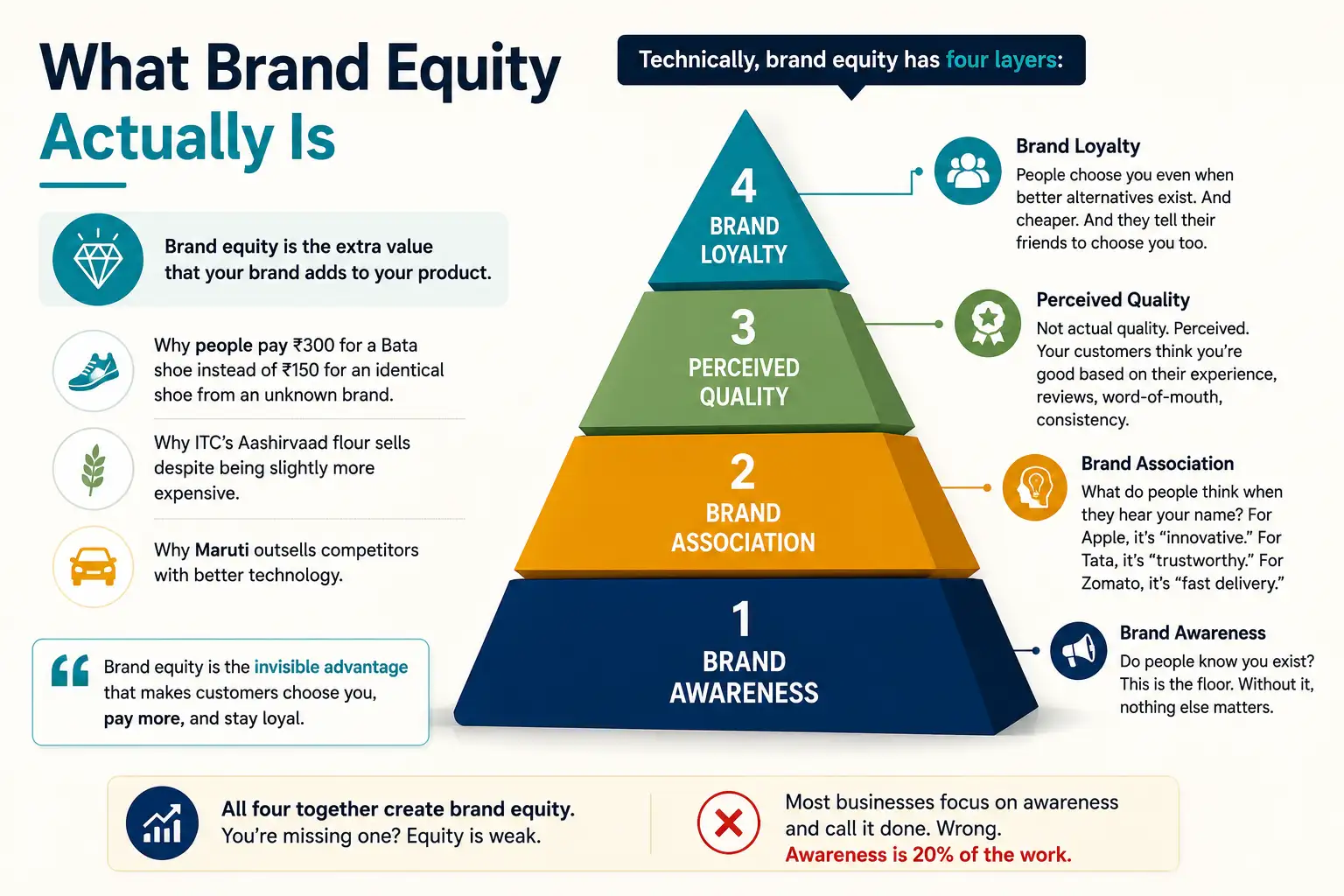
Technically, brand equity has four layers:
1. Brand Awareness — do people know you exist? This is the floor. Without it, nothing else matters.
2. Brand Association — what do people think when they hear your name? For Apple, it’s “innovative.” For Tata, it’s “trustworthy.” For Zomato, it’s “fast delivery.”
3. Perceived Quality — not actual quality. Perceived. Your customers think you’re good based on their experience, reviews, word-of-mouth, consistency.
4. Brand Loyalty — people choose you even when better alternatives exist. And cheaper. And they tell their friends to choose you too.
All four together create brand equity. You’re missing one? Equity is weak.
Most businesses focus on awareness and call it done. They run ads, people see them, think they’ve built a brand. Wrong. Awareness is 20% of the work. This is the same distinction we unpack in brand vs branding vs brand identity — confusing awareness for equity is the most common and most expensive mistake in brand-building.
The Money Question: How Much Is It Actually Worth?
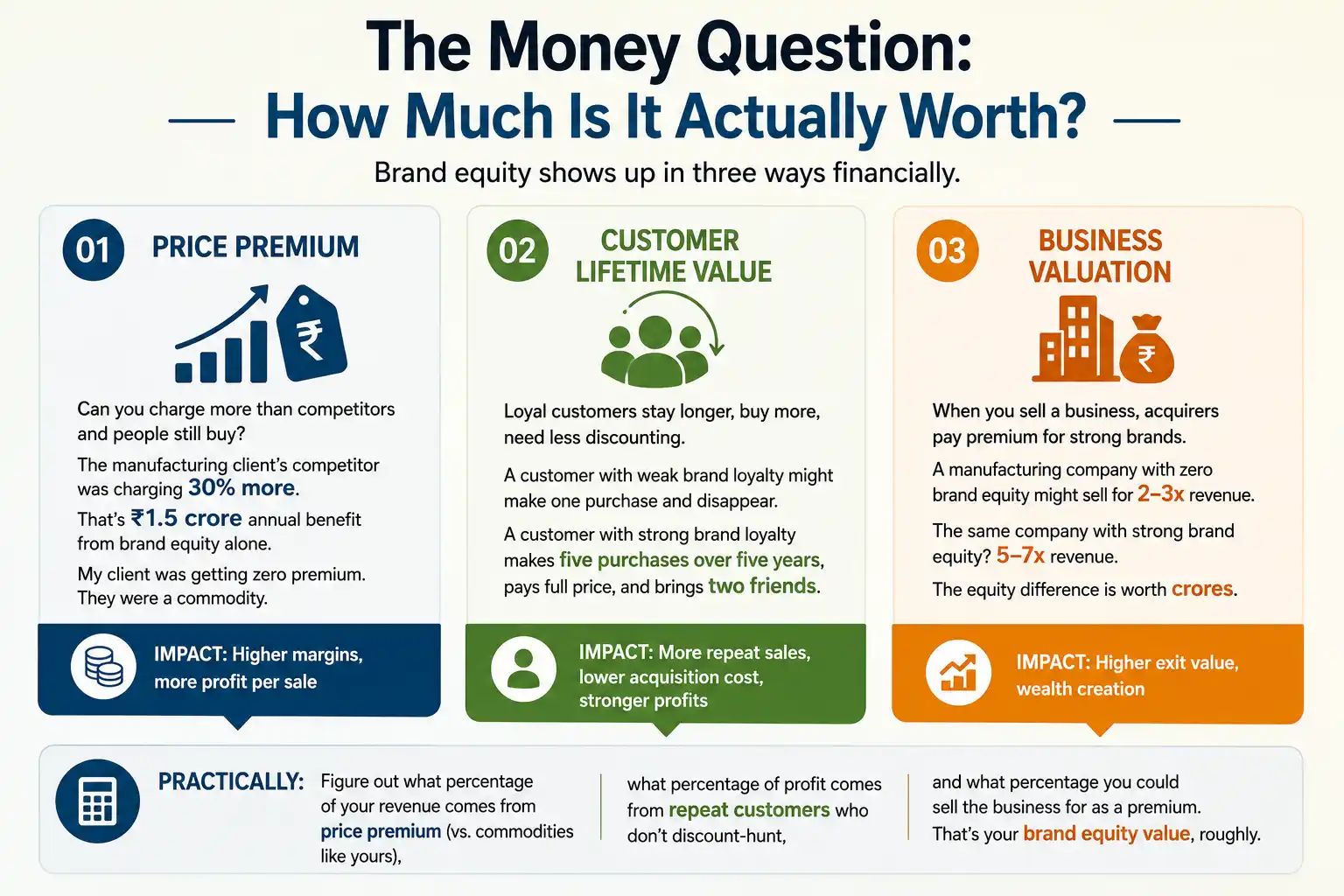
Brand equity shows up in three ways financially.
First — price premium : Can you charge more than competitors and people still buy? The manufacturing client’s competitor was charging 30% more. That’s Rs 1.5 crore annual benefit from brand equity alone. My client was getting zero premium. They were a commodity.
Second — customer lifetime value : Loyal customers stay longer, buy more, need less discounting. A customer with weak brand loyalty might make one purchase and disappear. A customer with strong brand loyalty makes five purchases over five years, pays full price, and brings two friends.
Third — business valuation : When you sell a business, acquirers pay premium for strong brands. A manufacturing company with zero brand equity might sell for 2-3x revenue. The same company with strong brand equity? 5-7x revenue. The equity difference is worth crores.
Practically : figure out what percentage of your revenue comes from price premium (vs. commodities like yours), what percentage of profit comes from repeat customers who don’t discount-hunt, and what percentage you could sell the business for as a premium. That’s your brand equity value, roughly.
How Strong Brand Equity Gets Built
There’s no shortcut. I wish I had one to sell.
You start with consistent experience — every customer touchpoint delivers what you promise. Website. Product. Support. It all works together. Most brands fail here because something’s always inconsistent. Website says “premium quality” but customer service ignores complaints. Marketing says “fast delivery” but delivery’s slow 20% of the time. Inconsistency destroys equity faster than anything.
Then you build recognition — people see you everywhere. Not necessarily ads. Could be word-of-mouth, could be social media, could be being cited in articles, could be partnerships. The manufacturing client’s competitor was known because they were mentioned in industry publications, mentioned in B2B directories, had referrals flowing. Not because of ads.
Then you deliver evidence — reviews, case studies, long customer relationships, employee testimonials, published work. Anything that proves you deliver. Jab koi third-party validate kare, tab brand equity badhta hai (when a third party validates you, brand equity increases). This is why user-generated content is one of the most powerful equity-building tools available — a real customer’s endorsement carries more credibility than anything the brand itself can say.
Then you maintain consistency over time — this is the hard part. Year 2, year 5, year 10 — same promise, same delivery. Companies that rebrand, that change positioning, that chase trends — they destroy equity. Companies that stay consistent for 5-10 years build real equity.
Then — and this is where most fail — you actually leverage it. Once you have equity, you charge premium prices. You expand into adjacent categories. You raise prices over time. You stop discounting. Most brands build equity and then don’t monetize it.
The Real-World Examples
Rupa — hosiery brand, been around since 1972, now market leader. Their equity is “trust.” Parents buy Rupa for their kids because Rupa didn’t fail in the 90s when everything else did. They charge premium over unbranded. They’ve expanded to multiple categories riding that equity.
Maruti — entered the market when Ambassador dominated. Maruti built equity around “reliability, resale value, service network.” It took 5 years. But once built, they became unstoppable. Competitors copied, offered cheaper cars. Maruti sold more. Why? Equity.
Chipotle in the US (yes, international) — went from zero to 1000-store chain in 15 years because they own “customizable, fast, responsible food.” That positioning created massive equity. They charge 40% more than similar competitors and have customer queues. Equity.
In the Indian context, look at any business doing well for 10+ years — they built equity. The FMCG brands, the financial services brands, the e-commerce platforms that survived. All of them invested in consistency and brand-building when cheaper options existed. That discipline created equity.
The Metrics
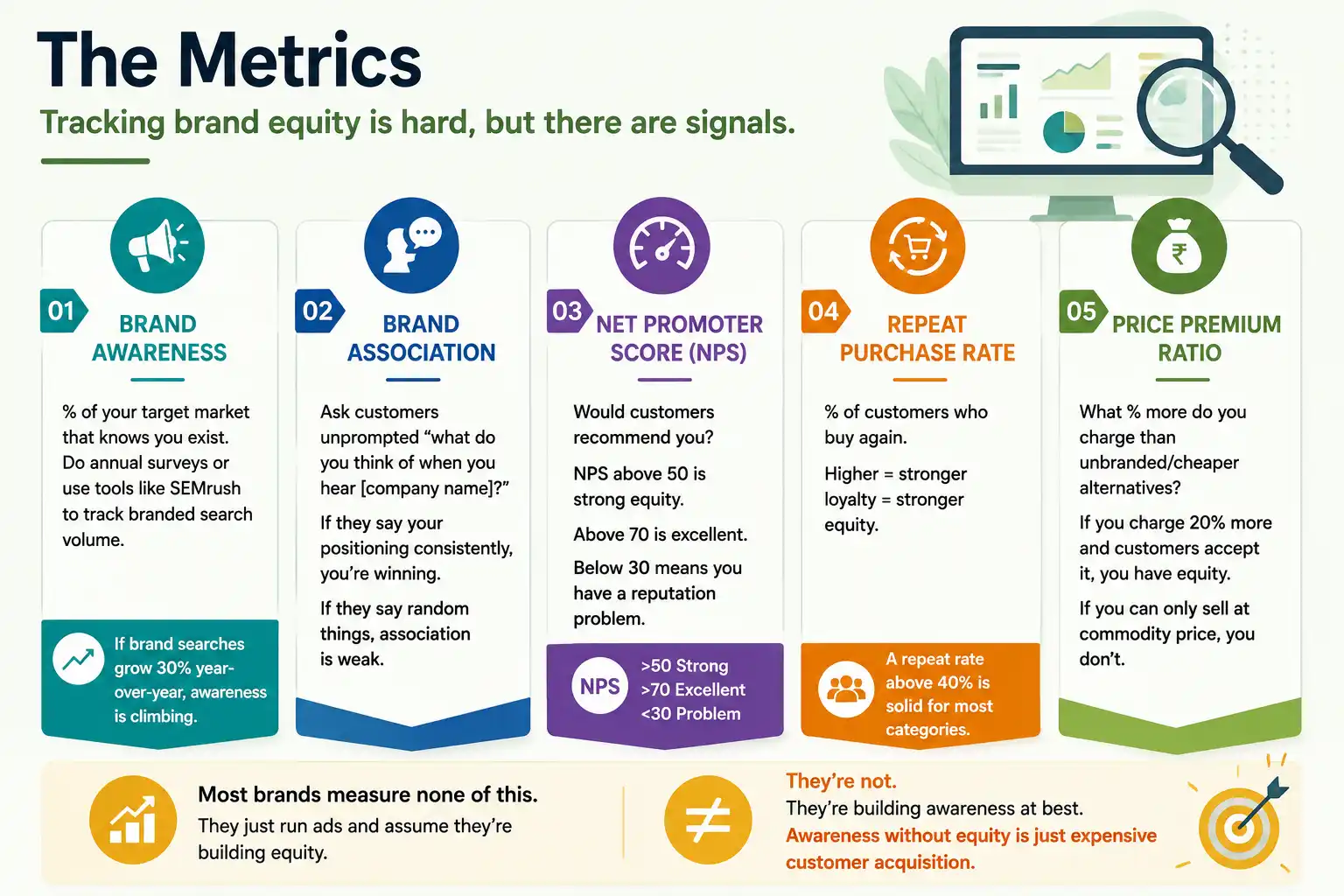
Tracking brand equity is hard, but there are signals.
Brand Awareness: % of your target market that knows you exist. Do annual surveys or use tools like SEMrush to track branded search volume. If brand searches grow 30% year-over-year, awareness is climbing.
Brand Association: Ask customers unprompted “what do you think of when you hear [company name]?” If they say your positioning consistently, you’re winning. If they say random things, association is weak.
Net Promoter Score (NPS): Would customers recommend you? NPS above 50 is strong equity. Above 70 is excellent. Below 30 means you have a reputation problem.
Repeat Purchase Rate: % of customers who buy again. Higher = stronger loyalty = stronger equity. A repeat rate above 40% is solid for most categories.
Price Premium Ratio: What % more do you charge than unbranded/cheaper alternatives? If you charge 20% more and customers accept it, you have equity. If you can only sell at commodity price, you don’t.
Most brands measure none of this. They just run ads and assume they’re building equity. They’re not. They’re building awareness at best. Awareness without equity is just expensive customer acquisition.
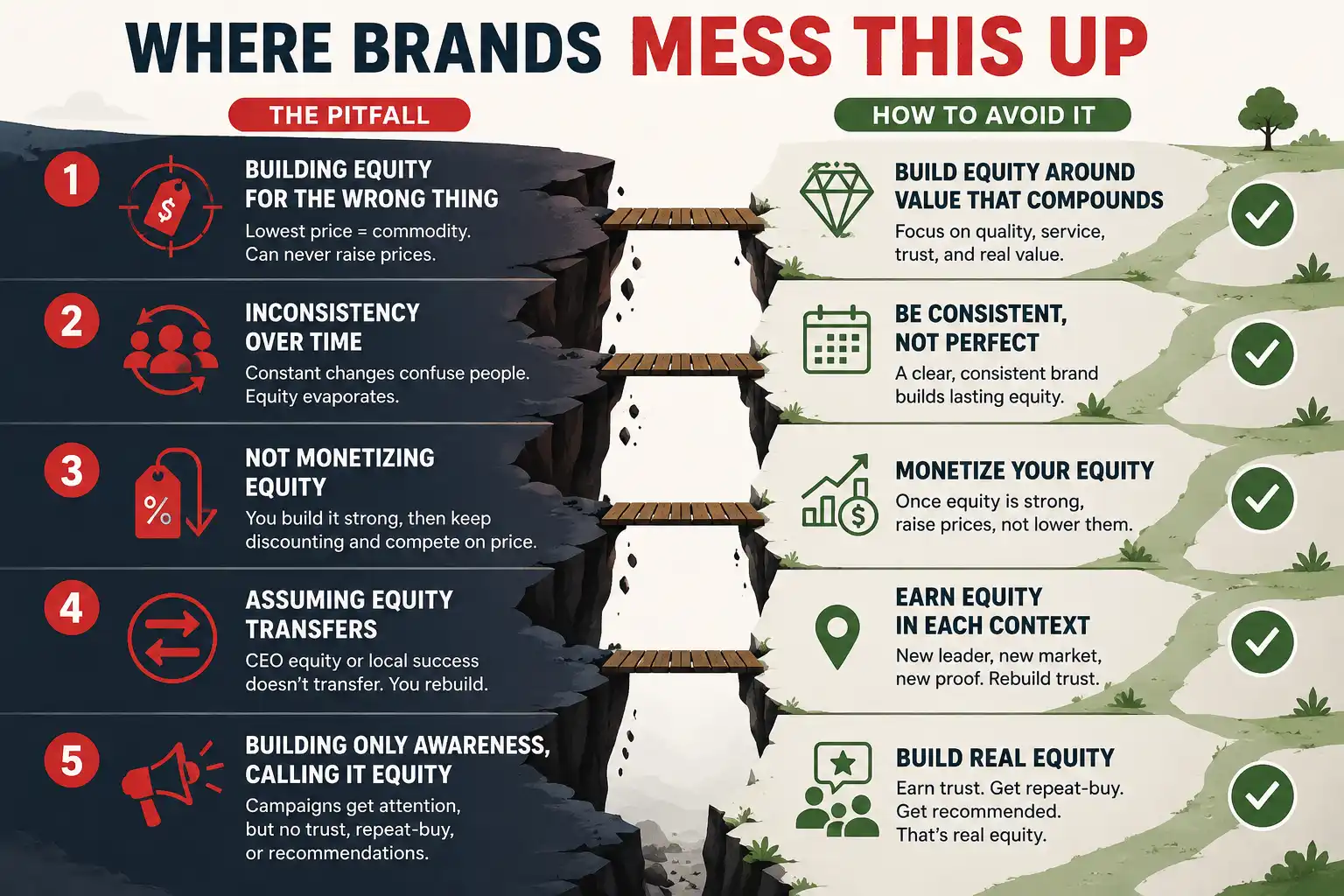
Where Brands Mess This Up
Mistake 1: Building equity for the wrong thing. You build brand equity around “lowest price” — congratulations, you’re now a commodity that can never raise prices. Better to build equity around value, quality, service, trust — things that actually compound.
Mistake 2: Inconsistency over time. You have 5 marketing managers in 10 years, each with different vision. Brand gets rebranded constantly. Equity evaporates because people don’t know what to expect. Consistency matters more than perfection.
Mistake 3: Not monetizing equity. You build strong equity, everyone loves you, but you keep discounting and competing on price. You’ve built an asset and destroyed its value. Once equity is strong, you raise prices, not lower them.
Mistake 4: Assuming equity transfers. You think your CEO’s personal equity transfers to the brand. It doesn’t. Or you think your geographic equity (strong in one city) transfers nationally. It doesn’t. You rebuild from scratch in new markets.
Mistake 5: Building only awareness, calling it brand equity. You run campaigns, win ads, get followers. But people don’t actually trust you, don’t repeat-buy, don’t recommend. That’s not equity. That’s noise.
How Long This Actually Takes
I’m going to be honest because I’m tired of people overselling this.
18-24 months: You can build basic awareness and initial associations if you do everything right and have budget. But that’s not equity yet.
3 years: With consistent execution, you’ll start seeing real price premium, repeat customers, word-of-mouth. You’ll notice margins improving. That’s equity starting to form.
5+ years: Now you have real equity. You can charge premium. You can expand categories. You can weather competitors. Customers actively choose you over cheaper options.
10+ years: Generational equity. Your brand is just “the good option.” Competitors need to massively outperform to steal share. Think Coca-Cola, think Tata, think ITC. That’s generational equity.
Most brands give up in year 2 or get distracted in year 3. The ones that stick it out to year 5 become the winners in their categories. Kalakari + strategy (artistry plus strategy).
Why We Still Believe in This
Because we’ve seen it work. My manufacturing client eventually rebuilt his positioning around “trusted for precision.” Took three years. Cost Rs 40 lakhs in marketing. But by year 4, his price premium came back. His margins improved. He stopped competing on cost.
His competitor had spent zero extra marketing in those three years. But they already had 20 years of equity. That’s the unfair advantage of strong brands. Once built, it generates returns for decades.
In a world where customer acquisition costs keep rising, where ad CPMs keep climbing, where discounting becomes the default — brand equity becomes your superpower. It’s the only moat that’s legal.
We work with brands to build this at every level — from brand positioning and strategy to identity design, website experience, brand films, and integrated marketing. The foundation is always the same: consistency, clear positioning, and enough patience to let it compound.
| Approach | Best for | Watch out for |
|---|---|---|
| DIY | Small teams, tight budgets | Slow ramp-up, trial-and-error |
| Freelancer | Specific project bursts | Inconsistency, limited ownership |
| Agency | Ongoing work, senior input | Higher retainer, less control |
Quick checklist before you start:
- Define the one thing you want: leads, sales, awareness — pick one.
- Baseline your numbers: write down where you are today.
- Pick a 90-day window: nothing moves in 2 weeks.
- Agree on success metrics: with whoever is paying the bill.
- Set up proper tracking: GA4, UTMs, call tracking.
- Review monthly: kill what doesn’t work, double down on what does.
The Bottom Line
If you take one thing from this: brand equity what it is and why your business needs it rewards patience and specificity, not volume or clever tricks. Start small, measure honestly, fix what breaks, and compound what works. The brands doing this well in India aren’t smarter — they’re just consistent. Need a hand with this for your business? Talk to us.
Let’s Build Brand Equity for Your Business
PromotEdge has guided 250+ brands through building real, lasting equity. From strategy to execution across all channels.
FAQs
-
Can you measure brand equity?
Ans.Sort of. You can measure components: awareness, loyalty, price premium, word-of-mouth. But overall equity is more a feeling — you know it's strong when customers choose you over cheaper options without thinking. You can measure indicators: NPS above 50, repeat purchase rate above 40%, price premium vs. competitors. But true equity is harder to put in a spreadsheet. You feel it. -
How many years does brand equity take?
Ans.18-24 months for initial awareness and associations. 3 years for real price premium and repeat customers. 5+ years for genuine competitive advantage. 10+ years for generational equity that competitors can't touch. Most brands give up before year 3. The ones that don't become category leaders. -
What's the difference between brand value and brand equity?
Ans.Equity is the asset — perception, trust, loyalty, quality association. Value is what you earn from that asset — price premium, repeat revenue, higher margins, acquisition cost advantage. A brand might have crores in equity but be earning only lakhs because they're underpricing or not monetizing well.
Author Details

Latest Posts
-
20 / Aug
-
 19 / Aug
Brand Identity Design How to Build a Brand from Scratch: The Real Playbook
19 / Aug
Brand Identity Design How to Build a Brand from Scratch: The Real Playbook -
 18 / Aug
Brand Identity Design Kapferer Brand Identity Prism: Build a Consistent Brand Identity That Resonates
18 / Aug
Brand Identity Design Kapferer Brand Identity Prism: Build a Consistent Brand Identity That Resonates -
 14 / Aug
-
 13 / Aug
Related Knowledge