-
Author: Anindita Barik
-
Updated Date: May-04-2026
-
Views: 2 Min Read
Email marketing strategy drives real revenue by sending the right message, to the right person, at the right time. Unlike basic email blasts, a proper strategy uses segmentation, automation, and value-driven content to convert subscribers into buyers — consistently delivering $36 ROI for every $1 spent.
The Email That Made Me Realise Everything Else Was Wrong
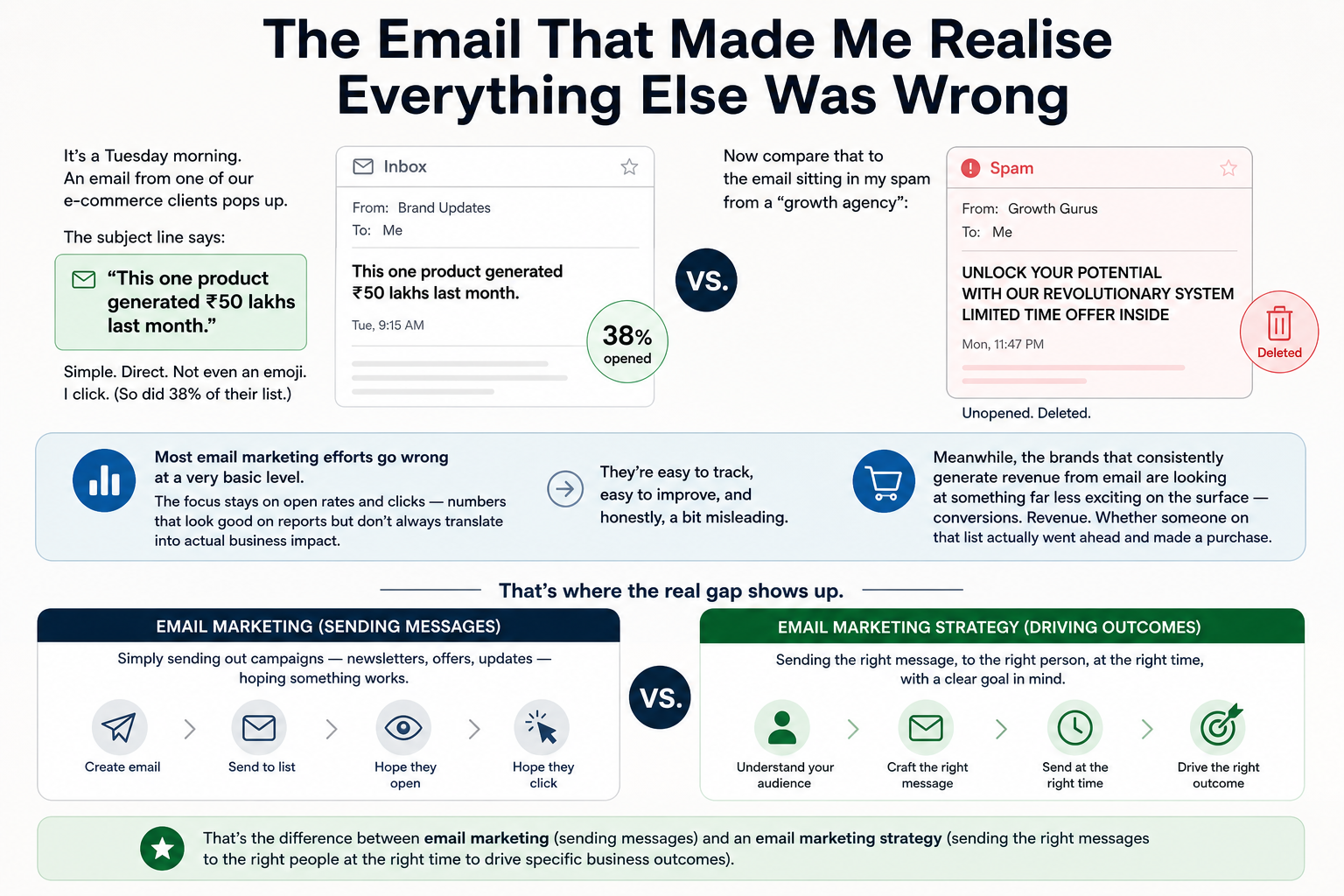
“It’s a Tuesday morning. An email from one of our e-commerce clients pops up. The subject line says: ‘This one product generated ₹50 lakhs last month.”
Simple. Direct. Not even an emoji. I click. (So did 38% of their list.)
Now compare that to the email sitting in my spam from a “growth agency”: “UNLOCK YOUR POTENTIAL WITH OUR REVOLUTIONARY SYSTEM LIMITED TIME OFFER INSIDE”
Unopened. Deleted.
Most email marketing efforts go wrong at a very basic level. The focus stays on open rates and clicks — numbers that look good on reports but don’t always translate into actual business impact. They’re easy to track, easy to improve, and honestly, a bit misleading.
Meanwhile, the brands that consistently generate revenue from email are looking at something far less exciting on the surface — conversions. Revenue. Whether someone on that list actually went ahead and made a purchase.
That’s where the real gap shows up.
Because there’s a clear difference between just doing email marketing and having a proper email marketing strategy.
Email marketing is simply sending out campaigns — newsletters, offers, updates — hoping something works.
An email marketing strategy is more deliberate. It’s about sending the right message, to the right person, at the right time, with a clear goal in mind — whether that’s a purchase, a repeat order, or moving someone closer to buying.
And that shift in thinking is what separates activity from actual results.
That’s the difference between email marketing (sending messages) and an email marketing strategy (sending the right messages to the right people at the right time to drive specific business outcomes).
Why Your Email List Is Actually Your Best Asset Already Making You Money
A FMCG client — biscuits and cookies, mid-range brand — was in a panic.
Facebook ads got expensive. CPM jumped 40%. Google Ads competitive. They had no SEO traffic to speak of.
They had 15,000 email subscribers though. Built over two years from website signups.
So we looked at what they were sending: promotional emails once a month. Generic. Broadcast-style. Open rates around 8%.
We restructured everything. Segmented the list by purchase history. Built automated sequences for new subscribers. We just started sending two targeted emails in a week. The same 15,000 people, but this time, with a different strategy. Open rates jumped to 28%. Click rates from 1.2% to 4.8%. And here’s the thing — revenue per email went from Rs 2,000 to Rs 18,000.
That wasn’t hypothetical. Actual revenue.
Email doesn’t work because it’s old-school. It works because it’s one of the few channels you fully own. Platforms like Facebook can change their algorithm. Google can make ads more expensive overnight. You don’t control any of that. Your email list is different. It’s yours. And if you use it properly, it will keep generating revenue for years.
The Three Types of Email Every Brand Uses—Sometimes Incorrectly
1. Transactional Email
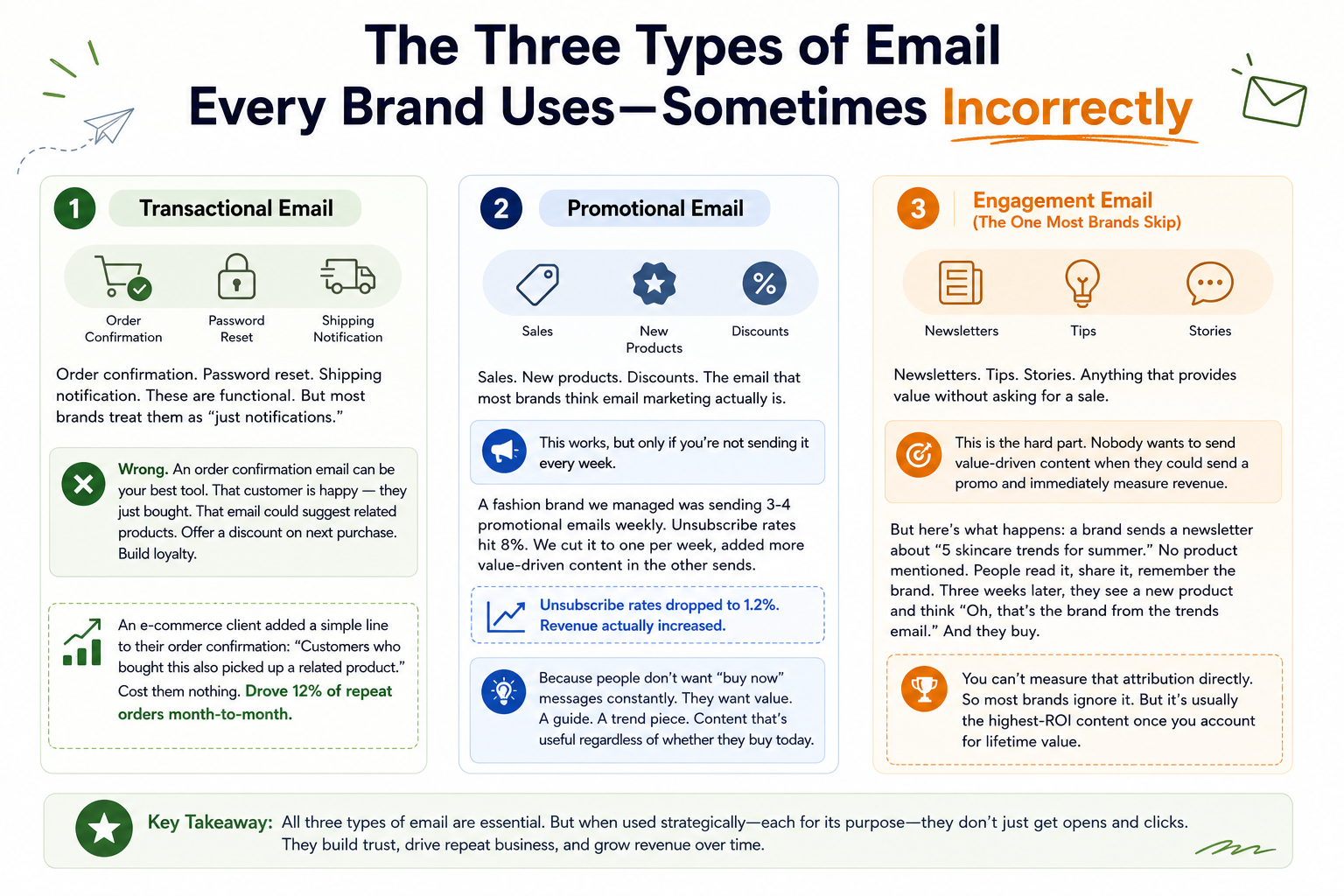
Order confirmation. Password reset. Shipping notification. These are functional. But most brands treat them as “just notifications.”
Wrong. An order confirmation email can be your best tool. That customer is happy — they just bought. That email could suggest related products. Offer a discount on next purchase. Build loyalty.
An e-commerce client added a simple line to their order confirmation: “Customers who bought this also picked up a related product.” Cost them nothing. Drove 12% of repeat orders month-to-month.
2. Promotional Email
Sales. New products. Discounts. The email that most brands think email marketing actually is.
This works, but only if you’re not sending it every week. A fashion brand we managed was sending 3-4 promotional emails weekly. Unsubscribe rates hit 8%. We cut it to one per week, added more value-driven content in the other sends. Unsubscribe rates dropped to 1.2%. Revenue actually increased.
Because people don’t want “buy now” messages constantly. They want value. A guide. A trend piece. Content that’s useful regardless of whether they buy today.
3. Engagement Email (The One Most Brands Skip)
Newsletters. Tips. Stories. Anything that provides value without asking for a sale.
This is the hard part. Nobody wants to send value-driven content when they could send a promo and immediately measure revenue.
But here’s what happens: a brand sends a newsletter about “5 skincare trends for summer.” No product mentioned. People read it, share it, remember the brand. Three weeks later, they see a new product and think “Oh, that’s the brand from the trends email.” And they buy.
You can’t measure that attribution directly. So most brands ignore it. But it’s usually the highest-ROI content once you account for lifetime value.
The Automation Piece (That Scares Most People But Shouldn’t)
A D2C apparel brand — joggers, hoodies, that stuff. Sells mostly through Instagram ads.
Their flow: traffic to landing page → signup to “get 15% off” → email list → dead silence unless a campaign went out.
We set up a simple automation:
Email 1 (sent immediately): “Here’s your 15% discount code.”
Email 2 (Day 3): “Here are three options similar to what you were looking at.”
Email 3 (day 7): “Customer stories — real people wearing our stuff.”
Email 4 (day 14): “Still here? Last chance for your discount.”
Email 5 (day 21): “You’re off the discount. But here’s something else.” (A free shipping offer or exclusive early access to new drops)
That sequence converted at 18% in the first month — out of 1,200 people who signed up, 216 actually went on to buy.
The beautiful part? It runs automatically. Doesn’t matter if you send 100 new signups or 1,000. The sequence does the work.
Most brands don’t build this because it feels complex. Honestly, modern email platforms make it stupidly easy now. We use Mailchimp or Klaviyo depending on the setup. Both have drag-and-drop automation builders that take maybe an hour to set up properly.
Segmentation (The Word That Sounds Boring But Drives 3x ROI)
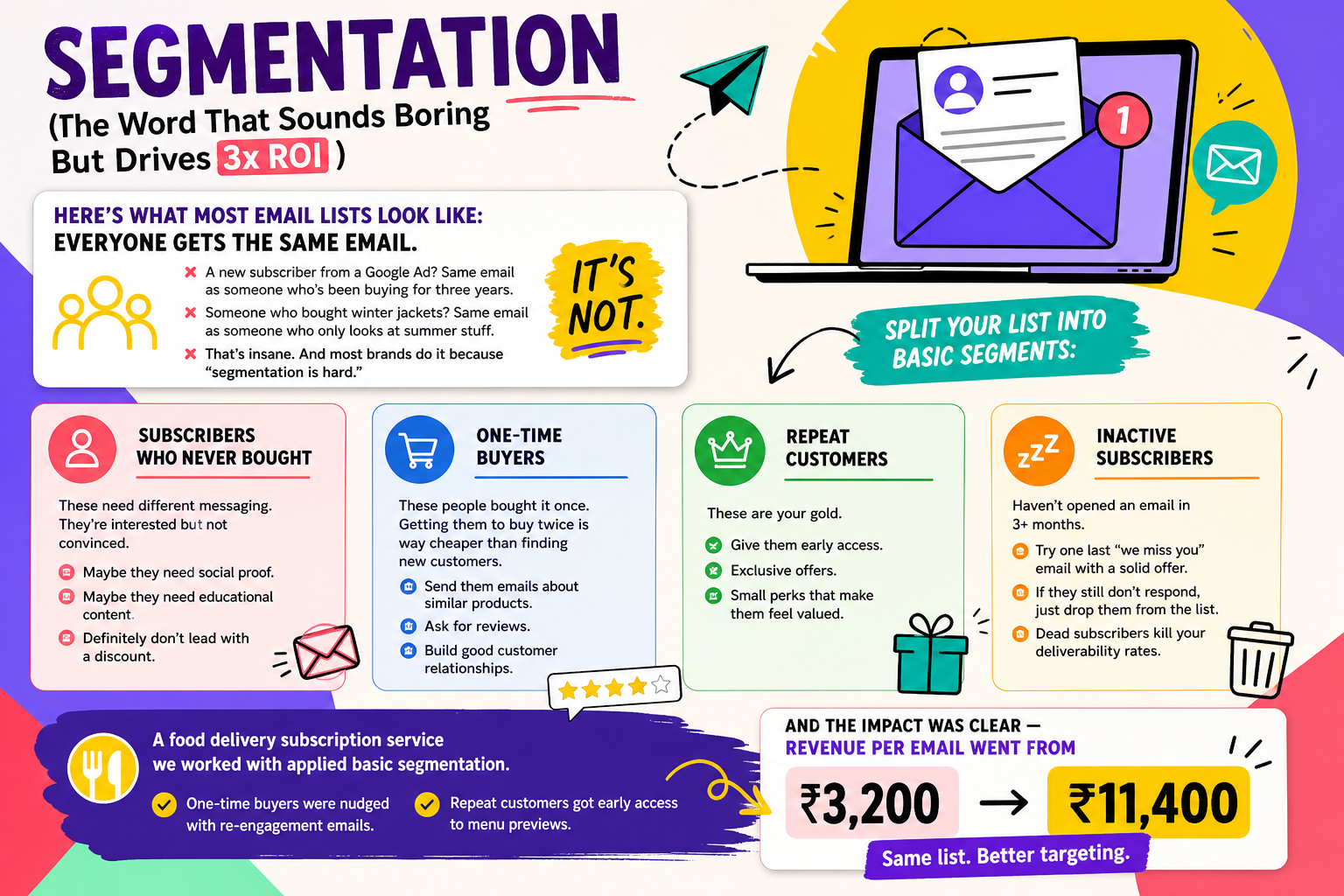
Here’s what most email lists look like: everyone gets the same email.
A new subscriber from a Google Ad? Same email as someone who’s been buying for three years.
Someone who bought winter jackets? Same email as someone who only looks at summer stuff.
That’s insane. And most brands do it because “segmentation is hard.”
It’s not. Split your list into basic segments:
Subscribers who never bought: These need different messaging. They’re interested but not convinced. Maybe they need social proof. Maybe they need educational content. Definitely don’t lead with a discount.
One-time buyers: These people bought it once. Getting them to buy twice is way cheaper than finding new customers. Send them emails about similar products. Ask for reviews. Build good customer relationships.
Repeat customers: These are your gold. Give them early access, exclusive offers, small perks that make them feel valued..
Inactive subscribers: Haven’t opened an email in 3+ months. Try one last “we miss you” email with a solid offer. If they still don’t respond, just drop them from the list. Dead subscribers kill your deliverability rates.
A food delivery subscription service we worked with applied basic segmentation. One-time buyers were nudged with re-engagement emails. Repeat customers got early access to menu previews.
And the impact was clear — revenue per email went from ₹3,200 to ₹11,400.
Same list. Better targeting.
The Subject Line Obsession (And What Actually Matters)
Everyone obsesses over subject lines: “How to write subject lines that get 50% open rates?”
Honestly? Your list quality matters more than your subject line.
A bad subject line on a good list? 22% open rate. A perfect subject line on a dead list? 4% open rate.
But since you probably want both… here’s what we’ve learned from 250+ brands:
Curiosity works: “Why we almost shut down this product.”
Specificity works: “Your Rs 500 credit expires tomorrow.”
Numbers work: “5 things we bought that actually changed our lives.”
Questions work: “What would you change about our packaging?”
Emojis… it depends. For tech products and professional services? No emoji. For FMCG and lifestyle? One emoji works.
All caps and multiple punctuation marks? Almost always bomb. Don’t do that jaldi (quickly).
What doesn’t work: generic subject lines that could apply to 90% of emails. “Check this out.” “You won’t believe this.” “This is important.”
Those read like spam because they kind of are.
The Problem With Templates (And When to Use Them Anyway)
Platforms like Mailchimp have beautiful email templates.
So when 500 brands use the same template, suddenly your email looks like everyone else’s.
But here’s the reality: you don’t need fancy. You need readable and on-brand.
We tested this with a luxury cosmetics brand. Template 1: Instagram-style fancy template with gradients and icons. Template 2:
Plain text email, just like a personal message from the founder.
Plain text crushed it. 42% open rate vs. 28% on the fancy one. More conversions too.
Why? Plain text feels personal. Like someone wrote it to you, not a broadcast.
So use templates for structure, but add something personal. A small line about why you’re writing today. A personal recommendation. Something that feels like it came from a human, not a platform.
The Metrics (And Which Ones Actually Indicate Success)
Open rate: Nice to know. But it’s not the end game. A 15% open rate with 0% conversion is worthless. A 8% open rate with 3% conversion is better.
Click-through rate: Better than open rate. At least someone did something. But clicks ≠ conversions.
Conversion rate: The only metric that matters. What percentage of people who received the email actually bought something, signed up, downloaded something, took the action you wanted?
Revenue per email: Even better. Total revenue generated ÷ number of emails sent. This is how you measure if email marketing is actually working for your business.
Unsubscribe rate: Indicator of health. Below 2% is good. Above 5% means you’re sending too much or irrelevant content.
Most brands report the first two metrics because they sound impressive. Real brands report the last three because that’s what drives business.
The Growth List Playbook (Because Bigger List = More Revenue)
Obviously. But most brands aren’t growing their list at all.
Website signup forms: Obvious. But placement matters. Top of page gets half the conversions of exit-intent pop-ups. Middle of article? Even better. End of article? Almost nobody signs up.
Lead magnets that actually matter: “Sign up for our newsletter” gets 2% of visitors. “Get a free template/checklist/guide” gets 8%. Something people actually want in exchange for their email. Not a generic discount code.
Referral incentives: “Refer a friend, you get Rs 500 cashback.” We’ve seen this grow lists 10x faster than organic signups.
Checkout opt-in. E-commerce especially. “Sign up for product updates and exclusive deals” at checkout. Most people who just bought are willing to get emails.
Content syndication: Medium, LinkedIn, Reddit — write valuable content and link to your signup form. You’re not asking for an email for nothing; you’re sharing useful information first.
Our actual experience: list grows slowly but steadily, or grows fast and dies. Most brands pick the second. They buy cheap lists or do pop-up spam. List grows, quality tanks, unsubscribe rates spike. Month later they’re back to 20% of the list.
Slow and steady actually wins here.
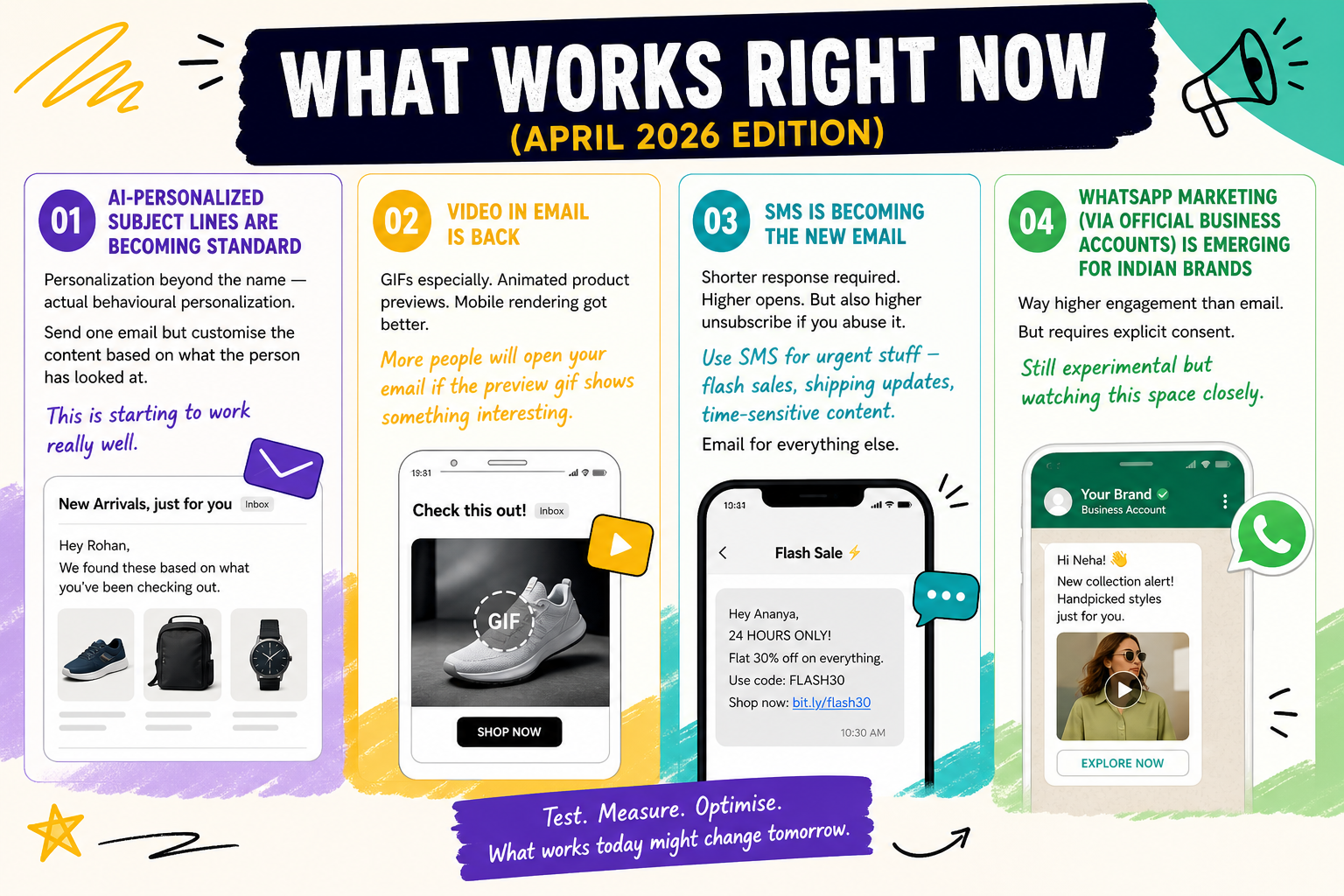
What Works Right Now (April 2026 Edition)
AI-personalized subject lines are becoming standard. Personalization beyond the name — actual behavioural personalization. Send one email but customise the content based on what the person has looked at. This is starting to work really well.
Video in email is back. GIFs especially. Animated product previews. Mobile rendering got better. More people will open your email if the preview gif shows something interesting.
SMS is becoming the new email. Shorter response required. Higher opens. But also higher unsubscribe if you abuse it. Use SMS for urgent stuff — flash sales, shipping updates, time-sensitive content. Email for everything else.
WhatsApp marketing (via official business accounts) is emerging for Indian brands. Way higher engagement than email. But requires explicit consent. Still experimental but watching this space closely.
The Real Talk (Why This Matters)
Most brands treat email like a broadcast channel. It’s not.
Email is permission marketing. Someone said “okay, you can reach me here.” That’s rare. That’s valuable. Most interactions now happen on platforms you don’t control.
So when you use email right — targeted, segmented, valuable, not just selling — you’re using one of your highest-ROI channels.
The ROI isn’t hypothetical. It’s measurable. I literally have a dashboard that shows me: this email sequence cost Rs 15,000 to build and test. It generated Rs 4.2 lakh in revenue this quarter. That’s 28x return.
Show me another channel with that math.
If your email isn’t performing, it’s probably not email’s fault. It’s usually one of three things: wrong list (people who don’t care), wrong strategy (no segmentation, just broadcasts), or wrong content (trying to sell instead of providing value).
Fix those and email stops being your worst channel and becomes your best. Ready to actually do it? We help brands rebuild their email strategy and usually see ROI improvements within 60 days. Let’s talk about your email setup.
FAQs
-
What's a good email open rate?
Ans.20-30% for e-commerce. 25-35% for SaaS. Under 15%? Something's broken — maybe subject lines or sending timing is off. But remember: open rates mean nothing if people don't buy. Conversion rates matter more. I'd rather have 8% opens with 3% conversion than 25% opens with 0.5% conversion. -
How often should I email my list?
Ans.No universal answer. Some lists handle daily emails. Others unsubscribe fast. Start with once a week and test. Watch unsubscribe rates closely. If they jump, you're over-communicating. If clicks are low, you're under-communicating. Your specific audience will tell you what they want through their behaviour. -
How do I grow my email list?
Ans.Pop-ups (exit-intent especially), lead magnets (guides, templates), checkout opt-ins, social media, referral incentives. Fastest growth? Referral programs. Offering Rs 500 for each friend signup. Saw a fashion brand get 200 signups in two weeks from referrals alone. Takes time to set up but the quality is usually better than paid traffic.
Author Details

Latest Posts
-
 26 / Aug
Search Engine Optimization Video SEO: How to Rank Your Videos in Google & YouTube
26 / Aug
Search Engine Optimization Video SEO: How to Rank Your Videos in Google & YouTube -
 25 / Aug
Video Production Corporate Video Production: A Practical Guide for Indian Brands
25 / Aug
Video Production Corporate Video Production: A Practical Guide for Indian Brands -
 24 / Aug
-
21 / Aug
Catalogue Design Catalogue Design: How to Create Catalogues That Actually Sell
-
 20 / Aug

Related Knowledge