-
Author: Anindita Barik
-
Updated Date: Sep-07-2026
-
Views: 2 Min Read
Copywriting vs content writing comes down to purpose: copywriting persuades audiences to take immediate action, while content writing educates, builds trust, and attracts long-term organic traffic. This guide explains the key differences between copywriting and content writing, when to use each, how they impact conversions and SEO, and why businesses often need both. Learn which approach is right for your current goals, whether you need faster conversions, stronger brand authority, or sustainable organic growth.
Neither copywriting nor content writing is the overall winner—they serve different marketing goals. Copywriting is designed to persuade audiences to take action, such as buying a product, booking a service, or signing up. Content writing focuses on educating, informing, and building trust through blogs, guides, articles, and other valuable content. For businesses, the strongest strategy combines both: use content writing to attract and nurture audiences, then copywriting to turn that attention into conversions.
The Day a Designer Ruined a Perfectly Good Landing Page
Client meeting. E-commerce brand, selling premium home furniture. They had a new sofa design, beautiful thing, and they wanted a landing page for it. They hired a good designer. The page looked stunning — really. Typography, imagery, colour hierarchy. Professional.
The copy? “Elegantly Crafted Comfort Solutions for Modern Living Spaces.” I’m not exaggerating. That’s the actual headline.
Conversion rate on that page: 0.8%. They were getting maybe 2,000 visitors a month. That’s about 16 conversions. Averaging Rs 45,000 per sofa, that’s about Rs 7.2 lakh in monthly revenue from paid traffic. Not terrible for a sofa product. But not great either.
We rewrote the copy. Not the design. Just the words.
“Why Your Back Hurts After Sitting for 2 Hours (And How This Sofa Actually Fixes That).”
Same design. Same traffic. Conversion rate went to 2.1% within three weeks. We didn’t change a single pixel. We just changed the words.
That 2.6x lift? That’s the difference between copywriting and content writing colliding with actual user intent. And most people don’t know what that difference is. This is exactly what conversion rate optimisation demonstrates consistently — the words on a page, not the design, are usually the highest-leverage variable between a page that converts and one that doesn’t.

Okay But What’s Actually Different Here
Copywriting is words that sell something. Right now. A landing page. An email. A button. An ad. The job is persuasion. Get someone to take action — buy, click, fill a form, sign up. The copy lives or dies based on whether it moves the needle on conversion rate.
Content writing is words that educate, inform, or entertain. The goal isn’t immediate action. It’s to build trust, rank in Google, answer questions, establish authority. A blog post. A guide. A YouTube script. The job is value delivery. You’re not asking someone to buy. You’re asking them to read and think and maybe come back later.
Huge difference. And yet — I’ve seen clients treat these identically. “Just write some content” and it comes back sounding like a sales brochure. Or they hire a content person to write ad copy and it reads like an encyclopedia entry. Wrong tool for the job.
Think of it this way. Copy is a sprint. Content is a relay race. Understanding which you need is the same foundational clarity that separates a well-structured content marketing programme from a random collection of blog posts and ads that don’t support each other.
Why Your Copywriter and Your Content Writer Don’t Speak the Same Language
Copywriting requires you to know something about human psychology. About friction. About objections. A copywriter asks questions like:
Why wouldn’t someone buy this right now? What’s stopping them? Is it the price? Fear of poor quality? Switching costs? Uncertainty about whether this actually works?
Then they write past those objections. “Comes with a 30-day guarantee” isn’t just a feature. It’s answering the unspoken objection “But what if it’s terrible?”
Content writers ask different questions.
What does my reader want to know? What problem are they trying to solve? What terminology should I use? Should I explain this in steps, or narrative flow? How can I make this valuable enough that they bookmark it?
See the difference? Copywriter is thinking conversion. Content writer is thinking value and relevance.
I worked with a B2B SaaS client last year who had a brilliant content team. They wrote these incredibly thorough guides about their industry. Hundreds of hours of work. Beautiful stuff. But when a prospect landed on their pricing page? The copy was written by the content team too. And it sounded like… well, like someone explaining pricing mechanics. Not like someone who understood why a prospect was scared to commit to software.
The Furniture Client Taught Me Something Else
After the landing page rewrite worked, they asked: “Can we use this approach for our blog?”
I said no. Actually no, not “no but maybe.” I was firm about it.
Their blog wasn’t selling furniture. Not directly. It was building authority. “10 Ways to Arrange Small Living Rooms on a Budget.” “Why Your Bedroom Feels Cramped (Spoiler: It’s Not the Size).” “How to Choose a Sofa That Lasts 10 Years.”
These posts needed to rank. They needed to be comprehensive. They needed to answer the actual questions people search for. Using aggressive, sales-focused copy would’ve tanked them. This is exactly what good on-page SEO is built around — content that genuinely answers the search intent rather than trying to close a sale where the reader isn’t ready to be closed.
The copy that worked for the landing page — that urgency, that objection-handling — would’ve made the blog feel smarmy. Untrustworthy. Like you’re being sold to when you just want information.
Their Google rankings were already mediocre. Rewriting the blog in “conversion-focused” style would’ve made them worse. So instead, we kept the blog as pure content. No hard sells. Just useful information and a soft link back to products at the very end.
The “build karo, show karo, grow karo” approach — build value first, showcase expertise, growth follows naturally — that only works if the growth part doesn’t feel like a sales pitch.
Where You Actually See Both In Action
Email marketing is where this gets interesting because you need both.
Your welcome sequence? That’s content. “Here’s what to expect from us.” “Here’s how to use this thing you just signed up for.” You’re setting expectations, building trust. Content mindset.
Your promotional emails? That’s copy. “We have a sale for 48 hours.” “You abandoned a cart with this exact sofa in it.” Urgency, objection handling, clear call-to-action. Copy mindset. Short, punchy, focused.
Most email programmes I see do one or the other. Either all utility (boring), or all urgency (exhausting). The best ones mix them. And yes, you need different writers for those, ideally.
Social media is similar. Your educational carousel posts? Content writing. Your promotional stories? Copy writing. Your YouTube long-form? Content. Your TikTok hook? Copy. This distinction is what makes a social media content creation strategy actually work — treating every post as either information-first or action-first, not trying to do both simultaneously in the same piece.
I had a conversation with Sayantan — our Creative Director — about this last month. He was frustrated because his social team was writing copy for educational posts and it was coming out too salesy. Then they’d flip and write content for promotional posts and nothing happened. I pointed out they probably needed different frameworks for different content types. He just stared at me. Then went and briefed the team differently. Suddenly the stuff started working.
The Money Question: Which One Actually Pays For Itself Faster
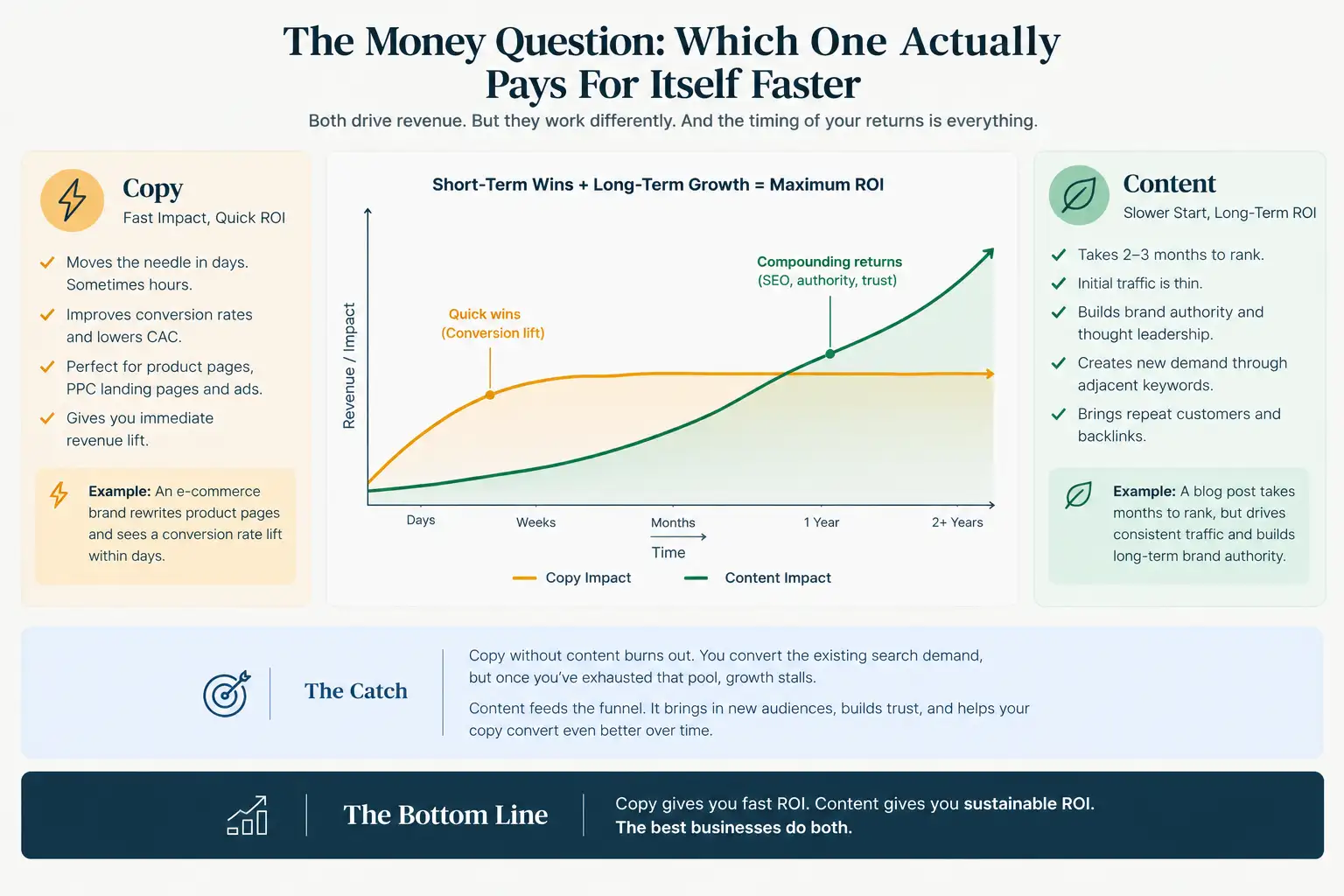
Copy. No debate.
A good piece of copy moves the needle in days. Sometimes hours. An e-commerce brand rewrites their product pages and sees conversion rate lift immediately. An SaaS company tweaks their PPC landing page and suddenly cost-per-acquisition drops 30%. Real impact, measurable, quick.
Content is slower. A blog post takes two to three months to rank. Even if it ranks, the traffic is thin initially. You’re investing now to get returns later. SEO, thought leadership, brand authority — these compound over time. But time is the operative word.
However — and this is important — copy without content burns out. You’ve got, let’s say, 10,000 people searching for your product category every month. You write amazing copy and convert 5% of them. That’s 500 customers a month. But you’ve nearly exhausted that search demand. Next month, same 10,000 searches, but now some of them have already bought from you. Your pool shrinks.
Content changes that equation. It doesn’t just convert the existing search demand. It creates new demand by ranking for adjacent keywords. It builds trust so repeat customers come back. It generates backlinks and authority that help your copy convert even better.
So copy gives you fast ROI. Content gives you sustainable ROI. Best businesses do both. They optimise copy for immediate conversions while investing in content for long-term dominance.
What Happens When You Confuse The Two
Let me give you examples from real projects because these are instructive.
Mistake 1: Writing Content Copy
A fintech startup hired a fantastic content writer. They’d worked for major publications. Their blog was genuinely good — thorough, well-researched, helpful. Then the startup asked them to write the landing page for their new investment product. The page came back as… a 2,000 word explanation of how equity markets work. Super educational. Completely unusable for conversion.
It felt like a Wikipedia article trying to be a sales page. Nobody knew what to do with it. We eventually scrapped it and brought in a copywriter who wrote 400 words that actually converted.
Mistake 2: Writing Copy Content
An e-commerce brand with decent paid traffic wanted to rank for organic keywords. They had a copywriter rewrite their category pages using all the aggressive, objection-handling techniques that worked on their PPC ads. “DON’T MISS OUT.” “Last 3 items left!” “Hurry before prices go back up!”
Google looked at these pages and — understandably — thought they were thin, manipulative garbage. They didn’t rank. Pages got worse rankings than they had before because the duplicate content (same copy as the ads) created issues.
Content writer came in later, restructured the pages as educational resources first, with product recommendations as a secondary benefit. Three months later, organic traffic started moving.
Wrong tool each time.
A Practical Question: What Should YOU Invest In
Here’s how I usually advise clients:
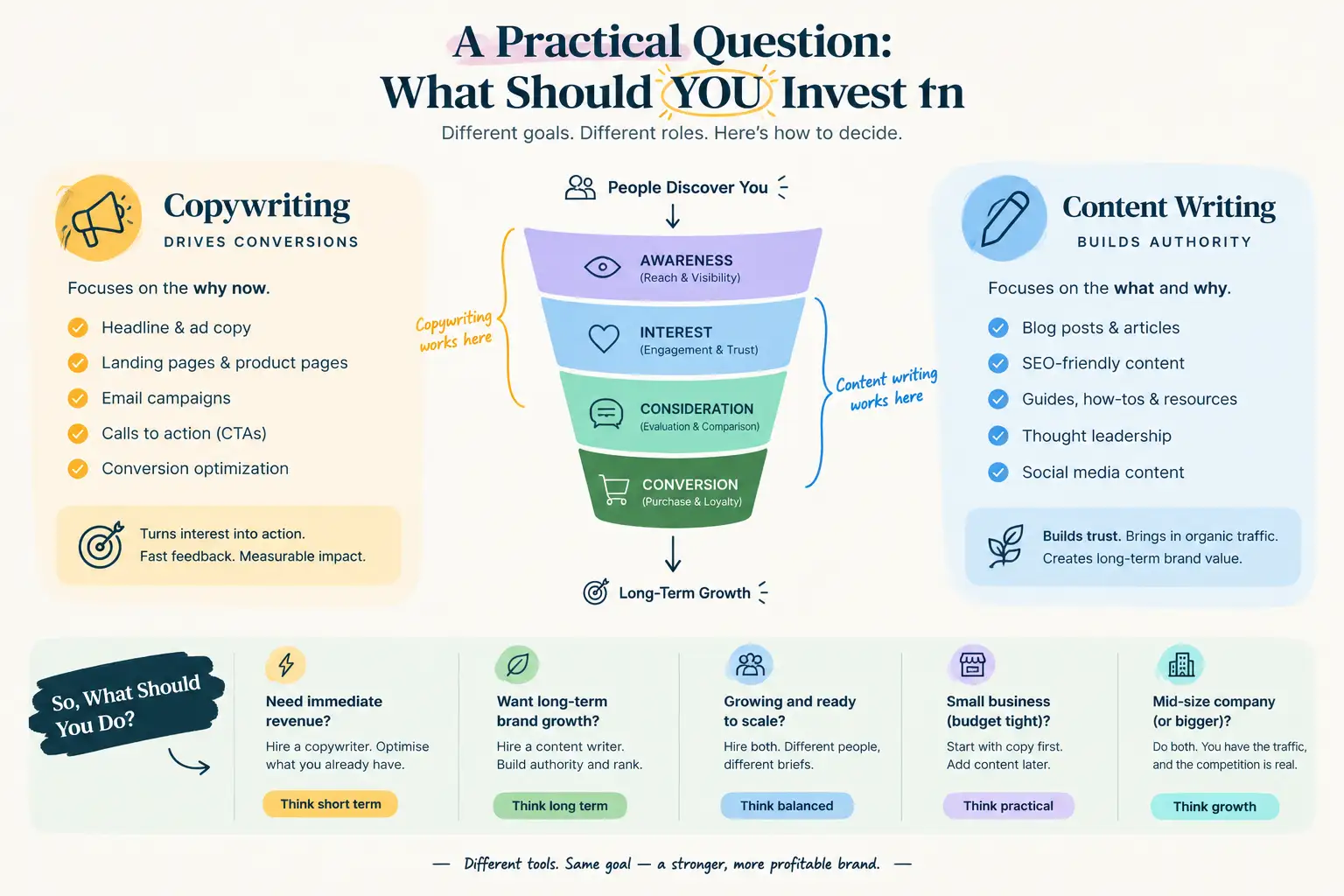
If you have an immediate revenue goal — “We need to hit Rs 50 lakh in sales this month” — hire a copywriter. Optimise what you already have. Conversions, email, landing pages. Fast feedback loop, measurable impact.
If you have a long-term brand goal — “We want to own the conversation in our category in two years” — hire a content writer. Build authority, create assets, rank in Google.
If you’re smart (and growing)? You hire both. Different people, different briefs. Copywriter handles the conversion machine. Content writer handles the authority machine. They should barely talk to each other.
Most small businesses can’t afford both, so they pick. And honest take? Pick copy first. You can always add content later. But if you lean pure-content, you’ll run out of traffic to convert quickly.
Mid-size companies should absolutely be doing both. Real estate agencies, B2B SaaS, e-commerce brands, professional services — they have enough traffic to justify conversion optimization (copy) AND enough competitive pressure to justify building authority (content). Your competitors are doing one. Do both and you’ll win.
The Sofa Company, Six Months Later
They’d done the copy rewrite on their landing page. Conversions up 2.6x. Great. But they were still limited to paid traffic. Google wasn’t sending them anything organic.
So they did what I recommended: hired a content writer (actually, one of our team — someone good with interior design content) to build a real blog strategy. “How to Choose a Sofa Size for Your Room.” “Sofa Materials Compared: Leather vs Linen vs Microfiber.” That kind of thing.
Six months in, not much. They were getting maybe 200 organic visits a month to their content. And conversions from organic were thin — like 1% because these people were just researching, not ready to buy yet.
But here’s what changed month nine onward: backlinks. Home design publications started linking to their guides. They got mentioned in a couple of industry roundups. Nothing major, but enough that their site authority started climbing.
Then something weird happened in month eleven: the conversion rate on the landing page went from 2.1% to 2.8%. Same page, same copy, no changes to the page itself. The reason? Google was sending them better-qualified traffic because the site authority was higher, so they trusted the brand more and visitors were more committed to buying.
So the content didn’t directly convert. But it made the copy work better by building trust in the brand.
That’s the real relationship. Copy and content aren’t competitors. They’re partners. But they have different jobs and need different people.
Quick Reality Check On This Whole Thing
I think copywriters sometimes act like they’re geniuses who are uniquely gifted at persuasion. They’re not. They’re just applying frameworks that have worked across millions of conversions. Psychology, testing, iteration. Anyone can learn it. Content writers are similar — they act like they’re uniquely gifted at storytelling. Also learnable. But yes, some people have more natural talent for one or the other. The best ones specialise.
Also: if you’re a solopreneur or very early-stage, you don’t need separate people. You need one person who’s decent at both. Just know which mode you’re in when you’re writing. Are you selling something right now (copy mode) or building authority (content mode)? Different strategies.
And one more thing. Just because someone claims to be a “copywriter” doesn’t mean they’re good at conversion. They might just be good at writing punchy stuff. Get samples. Test. Track conversion rate. Same with content writers — just because they wrote for a publication doesn’t mean they’ll rank your website. Ask about their SEO knowledge.
Wrong hire is worse than no hire.
What Your Brand Probably Needs Right Now
Audit time. Look at your business:
Are you generating enough traffic but not converting? Copywriting problem. Landing pages, email, value prop. You need copy.
Are you not generating enough traffic at all? Content problem. SEO, authority, being found. You need content.
Are you doing both but neither is working well? You probably have the wrong people doing it. A content person writing copy or vice versa. Get specialists.
Are you growing solidly? You probably need both but aren’t thinking about it strategically. One team handles awareness and authority (content). Another optimises conversion (copy). They should coordinate on messaging but operate independently.
Most businesses I talk to need both and don’t have either. If you’re there, start with copy (faster ROI) and layer in content as you scale. But don’t mistake one for the other. They sound similar. They’re actually pretty different.
| Approach | Best for | Watch out for |
|---|---|---|
| DIY | Small teams, tight budgets | Slow ramp-up, trial-and-error |
| Freelancer | Specific project bursts | Inconsistency, limited ownership |
| Agency | Ongoing work, senior input | Higher retainer, less control |
Quick checklist before you start:
- Define the one thing you want: leads, sales, awareness — pick one.
- Baseline your numbers: write down where you are today.
- Pick a 90-day window: nothing moves in 2 weeks.
- Agree on success metrics: with whoever is paying the bill.
- Set up proper tracking: GA4, UTMs, call tracking.
- Review monthly: kill what doesn’t work, double down on what does.
The Bottom Line
If you take one thing from this: copywriting vs content writing which one actually wins rewards patience and specificity, not volume or clever tricks. Start small, measure honestly, fix what breaks, and compound what works. The brands doing this well in India aren’t smarter — they’re just consistent. Need a hand with this for your business? Talk to us.
Need the Right Writer for Your Goals?
PromotEdge has been helping Indian brands build, showcase, and grow for 11 years. We know when you need copy that converts and when you need content that builds authority. Let’s talk about your situation.
FAQs
-
Can one person do both copywriting and content writing well?
Ans.Technically, yes. But should they? I've seen copywriters try content and produce thin, sales-focused guides that nobody reads. And content writers try copy and sound like they're writing Wikipedia entries. The mindsets are genuinely different — one's about objection handling and urgency, the other's about depth and trust. If you're small and bootstrapped, hire someone competent at both. But if you can afford specialists, do that. You'll see better results in both areas. -
Which should I invest in first, copywriting or content writing?
Ans.Copy, usually. It moves the needle faster. A rewrite of your landing page or PPC ad copy can lift conversions in weeks. Content takes months to build traction. But copy without content burns out eventually — you exhaust your addressable market. Content creates new markets, builds authority, compounds over time. Ideal scenario: copy first (immediate revenue), content second (sustainable growth). Then both working together. -
How do I know if my copy or content writing is actually good?
Ans.Copy: measure conversion rate. That's it. Everything else is opinion. Content: measure organic traffic, rankings, backlinks. In the beginning, measure nothing — just read it and ask, "Would I read this if I wasn't obligated to?" If the answer is no, it's not good enough. Get outside perspective from people in your audience. Not your mum. Not your friends. Actual customers.
Author Details

Latest Posts
-
07 / Sep
Content Writing Copywriting vs Content Writing: Which One Actually Wins
-
 26 / Aug
Search Engine Optimization Video SEO: How to Rank Your Videos in Google & YouTube
26 / Aug
Search Engine Optimization Video SEO: How to Rank Your Videos in Google & YouTube -
 25 / Aug
Video Production Corporate Video Production: A Practical Guide for Indian Brands
25 / Aug
Video Production Corporate Video Production: A Practical Guide for Indian Brands -
 24 / Aug
-
21 / Aug
Catalogue Design Catalogue Design: How to Create Catalogues That Actually Sell




Related Knowledge