-
Author: Anindita Barik
-
Updated Date: Aug-25-2026
-
Views: 2 Min Read
Corporate video production helps Indian brands turn complex ideas, products, and company stories into engaging visual content. This practical guide explains how to choose the right video type, plan pre-production, manage shooting and post-production, understand costs, and measure ROI. It also covers common mistakes, audience targeting, video length, authenticity, and performance tracking. Whether you need a brand film, product demo, testimonial, or behind-the-scenes video, the guide shows how to build videos around clear business objectives.
Corporate video production helps Indian brands communicate their story, products, services, and values through engaging visual content. A well-planned corporate video can strengthen brand credibility, explain complex offerings, showcase company culture, and support marketing, sales, recruitment, and customer engagement.
Effective corporate video production starts with a clear objective, defined target audience, strong script, professional visuals, and a distribution strategy. Indian brands should also consider regional audiences, cultural relevance, language preferences, and platform-specific formats to create videos that feel authentic and deliver measurable business value. This is the same audience-first thinking that makes any channel work — as we cover in why video marketing is the ultimate tool for promoting businesses, the medium is powerful but only when it’s built around a specific person and a specific problem, not around what looks impressive in a showreel.
The Manufacturing CEO Who Didn’t Know What He Wanted
Textile manufacturer. Tier-2 city. October, I think. One of our clients calls — actually, his PA calls first — says he wants a “corporate video.” That’s it. No brief. No objectives. Just… a video.
We set up the call. Spend 45 minutes asking questions. By minute 40, it’s clear he hasn’t thought past “our website needs a video because our competitor has one.” Classic situation. We’ve seen it at least 15 times in the last three years.
So we built the thing anyway. Three-week shoot. Professional crew. Locations across the factory. Colour grading. Sound design. 2.5 min piece on “innovation through tradition” or something equally generic.
Uploaded to their website. Got 340 views in three months. Maybe 8 of those were actual customers.
That video cost them 1.2 lakhs.
Then — this is the actual useful part of this story — we pivoted. Asked him: “Who actually buys from you?” Turns out, his biggest customers are mid-size garment exporters in Tiruppur and Surat who call him directly. They don’t search his website. They ring him up.
So we made a different video. Short. Informal. Shot him on-camera explaining why his fabric quality matters for export markets. No script. Just his voice, his hands moving, his confidence. Uploaded it to YouTube. Sent it in sales emails. Referenced it in LinkedIn posts.
In month one, three leads came through that channel. Month two, five. The video didn’t make him famous. But it moved people from “should I call this guy?” to “I’m calling this guy.”
That’s the split. And it perfectly illustrates what we describe in fixing a backwards digital marketing strategy — investing in reach before understanding who you’re reaching is one of the most common and expensive mistakes in any marketing channel, including video.
Why “Corporate Video” Is Actually Three Different Things
When clients say they want a corporate video, they’re usually being too broad. There are actually distinct types — different purposes, different production needs, different ROI profiles.
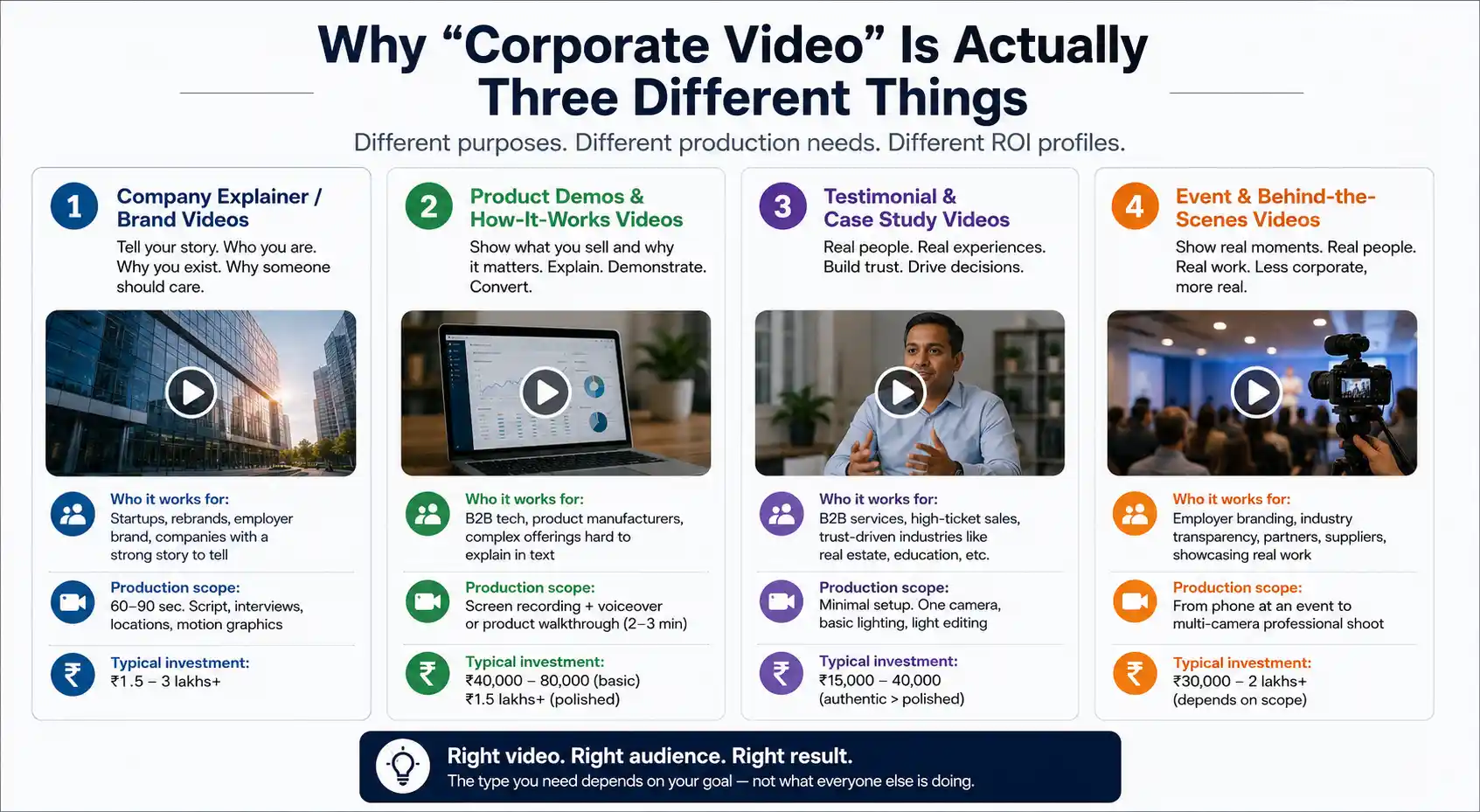
1. Company Explainer / Brand Videos
These tell your company story. Who you are. Why you exist. Why someone should care. Most common type, most expensive when done right, and — honestly — most likely to be a waste of money if you’re not clear on your audience.
Who it works for: Startups positioning themselves. Established brands doing a rebrand. Companies wanting to improve employer brand perception. Anyone saying “our story is interesting and unique.”
Production scope: Usually 60-90 seconds. Needs script development, potentially interviews, location shooting, maybe motion graphics. Cost for this done properly? 1.5-3 lakhs minimum. Could be more depending on complexity.
2. Product Demos & How-It-Works Videos
These show what you sell and why it matters. Software demos. Manufacturing process videos. “Here’s what happens when you use our product” format. Actually convert better than brand videos in most cases.
Who it works for: B2B tech companies. Niche product manufacturers. Anyone with a complex offering that’s hard to explain in text.
Production scope: Can be simple. Sometimes a screen recording plus voiceover. Sometimes a 2-3 minute walk-through of a physical product. 40,000-80,000 for something basic. 1.5 lakhs+ if you want it polished.
3. Testimonial & Case Study Videos
A customer or employee on camera saying why your product/service works. These often perform best. People trust other people more than companies.
Who it works for: B2B service companies. High-ticket sales. Anyone competing on trust or results. Real estate, education, professional services.
Production scope: Can be minimal. One camera, basic lighting, minimal editing. 15,000-40,000 if you’re being cost-conscious. The authenticity matters more than production quality here — actually, rough footage sometimes converts better than polished.
4. Event & Behind-the-Scenes Videos
Corporate events. Factory tours. Team culture. Manufacturing processes. Growing in popularity because they feel less “corporate” and more real.
Who it works for: Employer branding. Industry transparency. Building trust with suppliers or partners. Anyone wanting to show “this is what we actually do, not a PR story.”
Production scope: Highly variable. Could be one person with a phone at an event. Could be multi-camera professional shoot. 30,000-2 lakhs depending on what you’re capturing.
The Production Process — And Where Most Companies Mess Up
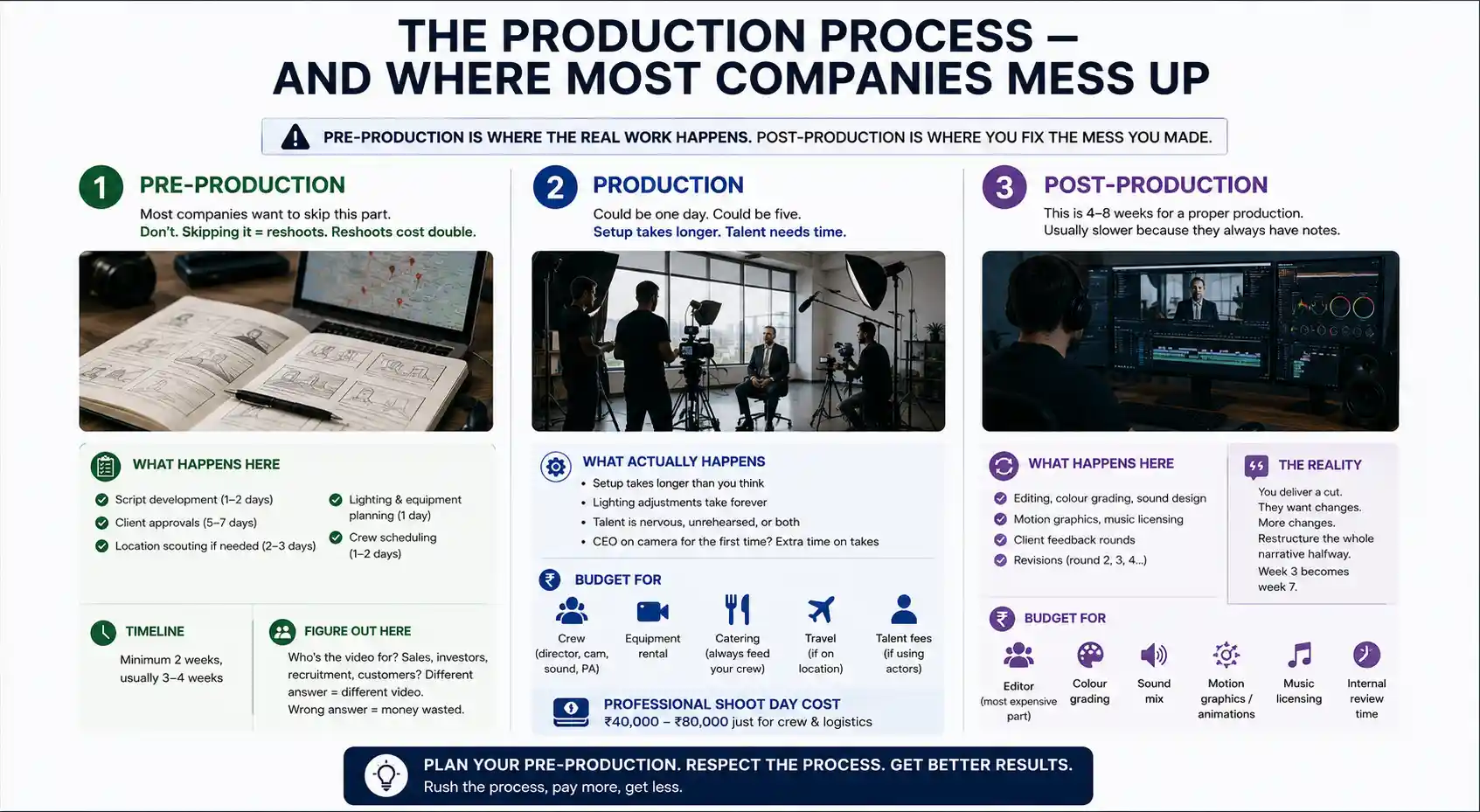
Pre-production is where the real work happens. Post-production is where you fix the mess you made in pre-production.
1. Pre-Production
This is script, storyboard, logistics, location scouting, equipment planning. Also the part where most companies want to skip ahead because “can’t we just start filming?”
No.
Skipping pre-production is like building a website without a wireframe. You’ll shoot footage, come back, realise it doesn’t tell the story you wanted, and have to do reshoots. Reshoots cost double.
What happens here: Script development (rough 1-2 days), client approvals (add 5-7 days because someone’s always in a meeting), location scouting if needed (2-3 days), lighting and equipment planning (1 day), crew scheduling (1-2 days). Total: minimum 2 weeks, usually 3-4 if you’re coordinating with a company that’s busy.
This is also where you figure out: Who’s the video for? Sales, investor relations, employee recruitment, customer education? Different answer = different video. Wrong answer = money wasted.
2. Production
Could be one day. Could be five. Depends on complexity. We’ve done a two-day shoot for a pharmaceutical company. Beautiful facility, professional actors, multiple setups. We’ve done a one-afternoon shoot for a food packaging company that turned out better.
What actually happens: Setup takes longer than you think. Lighting adjustments take forever. If you’re working with talent, they’re nervous or they’re unrehearsed or both. A client’s CEO who’s never been on camera before? You’re spending extra time on takes.
Budget for: crew (director, cinematographer, sound, maybe a PA), equipment rental if needed, catering (always feed your crew), travel if shooting on location, talent fees if you have professional actors. A professional shoot day costs 40,000-80,000 just for crew and logistics.
3. Post-Production
Editing, colour grading, sound design, motion graphics, music licensing, client feedback rounds, revisions. This is 4-8 weeks for a proper production. Could be faster if the client approves early. Usually slower because they always have notes on round two.
The client feedback loop is real. You deliver a cut. They want the CEO to sound “more authoritative.” You adjust. Then they want to add a voiceover. Then they want to restructure the entire narrative halfway through. This actually happened with a pharma brand we worked with — took us from week 3 to week 7 just on revisions.
Budget for: editor (most expensive part of post), colour grading, sound mix, motion graphics or animations if needed, stock music or original score, and your internal review time.
The Actual Costs — And Why Quotes Vary So Wildly
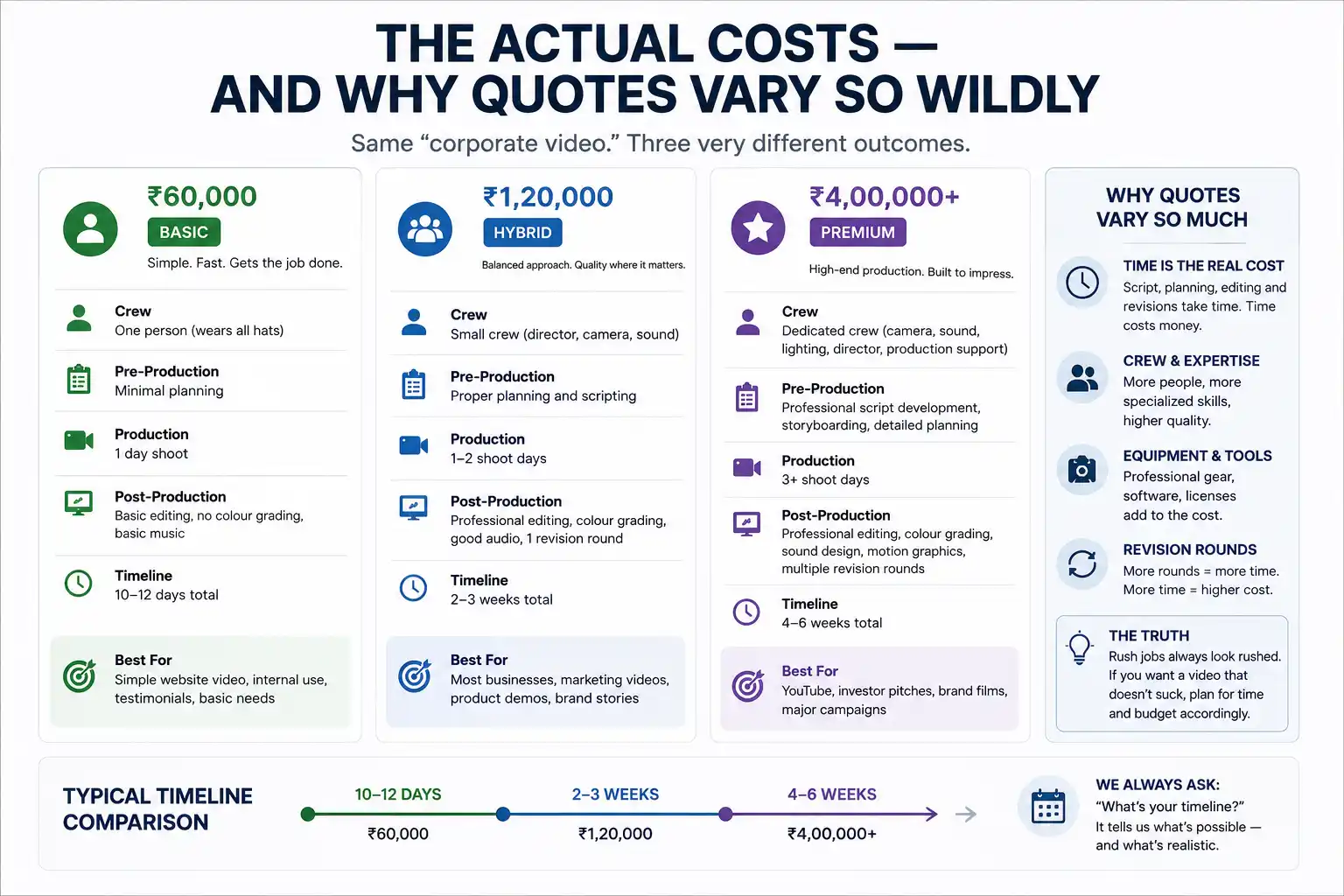
Two production companies quote you: one at 60,000, another at 4 lakhs. For the same “corporate video.” Both could be right. Both could be wrong. Here’s why.
A 60,000-rupee quote probably means: one-person shoot (director does all roles), minimal pre-production, simple editing, no colour grading, basic music. Done in 10-12 days total. Works if you just need something on your website and you’re not expecting miracles.
A 4-lakh quote means: dedicated crew (camera, sound, lighting), professional script development, 3+ shoot days, professional colour grading, sound design, possible motion graphics, multiple revision rounds. 4-6 weeks total. Produces something you could put on YouTube and not feel embarrassed.
Between those? A 1.2-lakh quote might mean a hybrid approach. Smaller crew, professional standards on what matters (audio, lighting, editing) but lean on others (no motion graphics, one revision round).
The truth nobody tells you: the most expensive part of video isn’t cameras or editing software. It’s time. If you want a video that doesn’t suck, someone has to spend meaningful time on script, editing, and revisions. That costs money. Rush jobs always look rushed.
Which brings us to the question we ask every potential client: “What’s your timeline?” If they say “two weeks from now,” we know we’re either doing a quick testimonial video or we’re about to underpromise and overdeliver. Usually the latter.
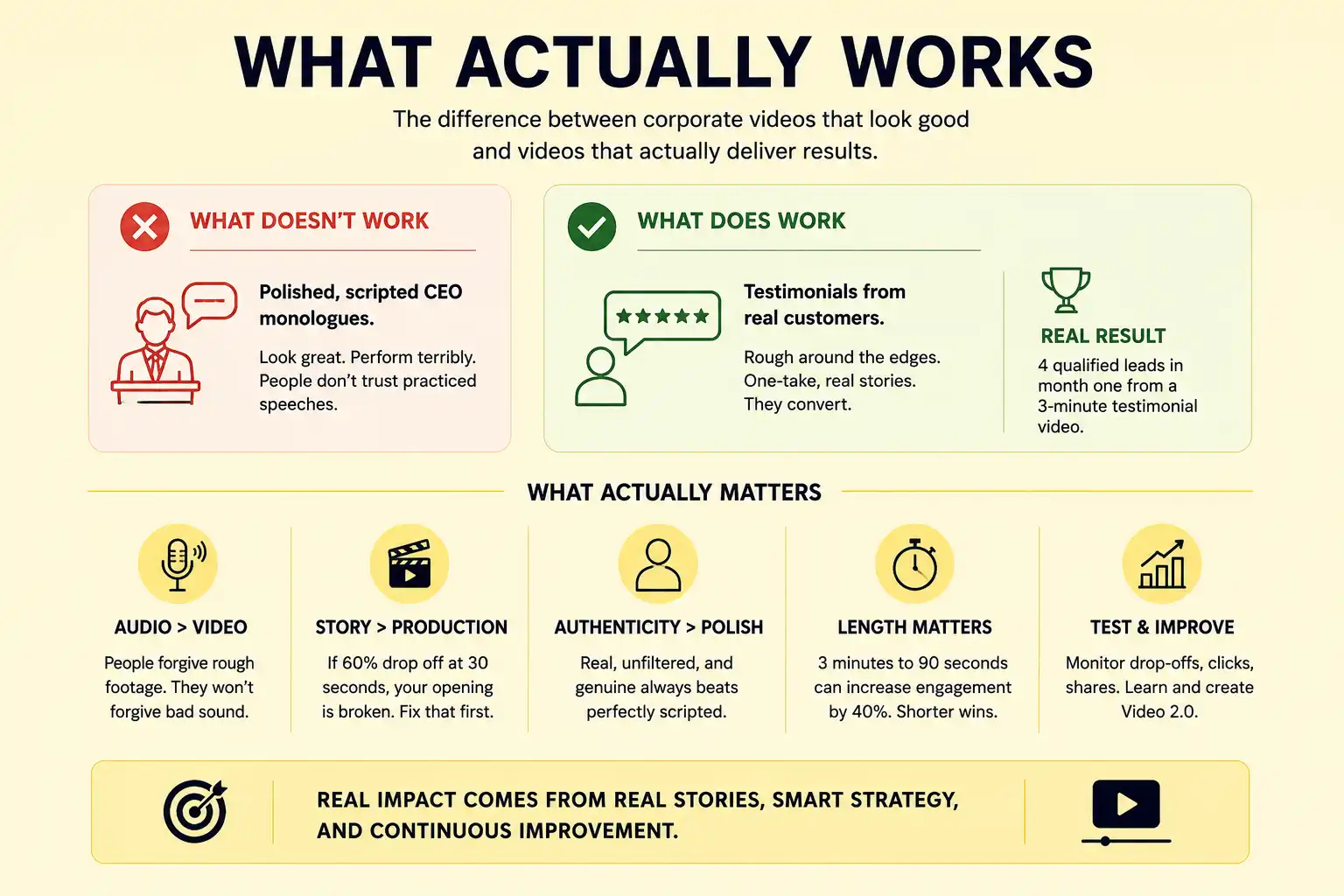
What Actually Works
There’s a difference. And it’s worth talking about because most corporate videos fail at the “actually works” part.
Polished, scripted CEO monologues? Look great in the editing suite. Perform terribly. People don’t trust practiced speeches. They trust authenticity.
Testimonials from real customers? Often rough around the edges. One-take, no script, just conversation. These convert. We had a real estate client get four qualified leads in month one from a three-minute testimonial video. And it was honestly… not super well-shot. The lighting was uneven. But the customer’s story — how the property solved a real problem for him — that worked.
Here’s what actually matters for corporate video:
Audio quality matters more than video quality : People will forgive rough footage. They won’t forgive bad sound. Invest in decent microphones and sound editing. This is the video equivalent of corporate video production best practice — every professional production prioritises clean audio above everything else because viewers tolerate visual imperfection far better than audio distortion.
Story beats matter more than production value : Where do people drop off in your video? If 60% of viewers quit after 30 seconds, your opening is broken. Not enough budget to fix the ending — fix the opening first.
Authenticity beats polish : A CEO genuinely uncomfortable on camera, fumbling through explanation, genuine frustration about his industry problem… that plays better than a professionally scripted executive delivering lines.
Length matters : We’ve seen videos drop from 3 minutes to 90 seconds and increase engagement 40%. Shorter usually works better, especially for social.
What most companies don’t do: they test. They make one video, upload it, and call it done. Actually good production means you’re monitoring where people drop off, what drives clicks, what gets shared. Then you make adjustments. Video 2.0 based on what you learned from video 1.0.
Common Production Mistakes
- Trying to say too much. A 90-second video should communicate one idea. Maybe two. If you’re trying to convey your entire company history, mission, vision, product line, and competitive advantage in 60 seconds, it won’t work. You’ll end up with a mushy middle that convinces nobody.
- Treating it like a deliverable, not a business tool. “We need to make a video because our competitor has one” is the wrong starting point. Right starting point: “We want to move X number of people from awareness to action, and video is the medium we think will work.”
- Neglecting the CTA. Your video ends. And then… what? People don’t know what to do next. Always have a clear next step. “Visit our website.” “Schedule a demo.” “Book a call.” Make it obvious.
- Overestimating production timeline. “We need this video in one week” guarantees a bad video. Or a very simple one. Plan for 4-6 weeks minimum. If you need it faster, lower expectations on scope. Jugaad (smart resourcefulness) is fine — rushing a proper production isn’t.
- Shooting without script. This works for testimonials. It doesn’t work for explaining complex concepts. A script doesn’t need to be rigid, but you need structure. Otherwise, you’re filming conversations that wander.
- Not locking in approvals early. If you’re filming the CEO, make sure he’s on board with the script before you book the shoot day. Nothing worse than spending a day shooting and then having the CEO say “I don’t like this narrative” on playback.
Measuring Video ROI
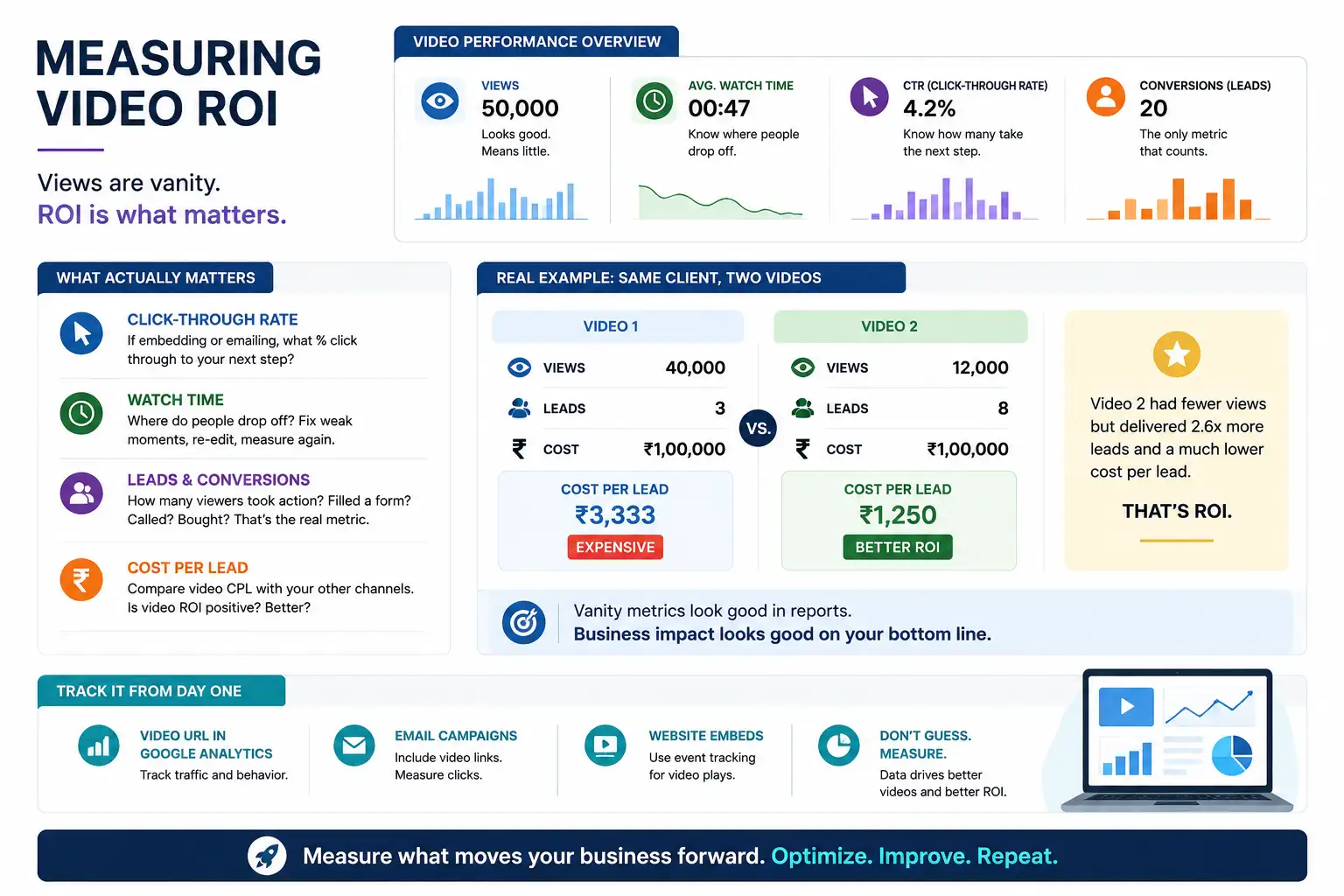
Most agencies tell you to measure views. That’s useless. A YouTube video with 50,000 views but zero leads is just… entertainment.
What actually matters:
- Click-through rate : If you’re embedding on a webpage or sending via email, what percentage of people who start the video click through to your next step?
- Watch time : Where do people drop off? If you have a 3-minute video and 80% of viewers quit at 45 seconds, your first minute is weak. Fix that, re-edit, measure again.
- Leads and conversions : How many people who watched your video took an action? Filled a form? Called your number? Bought something? That’s the actual metric.
- Cost per lead from video vs other channels. Say you spent 1 lakh on the video. It generated 20 leads. That’s Rs 5,000 per lead. Compare that to your Google Ads cost per lead, your content marketing cost per lead, etc. Is video ROI positive? Better than your other channels? That’s your answer.
We had a B2B software client track this properly. First video, 40,000 views, 3 leads. Cost per lead: Rs 3,333 — expensive compared to their paid search. Second video, targeted better, simpler, 12,000 views, 8 leads. Cost per lead: Rs 1,250. See the difference? The second video “performed worse” on vanity metrics but crushed on actual ROI. That’s what matters.
Track it from day one. Your video URL in Google Analytics. Your email campaigns including video links. Your website video embeds with event tracking. Don’t guess. Measure.
The Real Reason Most Corporate Videos Fail
It’s not production quality. It’s clarity of purpose.
Every video that’s flopped in our experience — and we’ve made hundreds that worked and dozens that didn’t — flopped because the company wasn’t clear on: Who’s the audience? What problem do we solve for them? What do we want them to do after watching?
A manufacturing firm spent 80,000 on a video about their “commitment to quality.” Beautiful shoot. Professional edit. Meant for their website. Got watched by… people who were already buying from them. Not prospects. Just existing customers or random traffic.
Meanwhile, when they made a 30-second product comparison video targeted at people searching “best thermal packaging India,” that one converted like crazy. Smaller budget. Smaller scope. Better ROI.
The lesson, and honestly we’re still learning this: start with audience and objective. The production follows from that. Not the other way around.
If you’re clear on those two things — who and what — you can make video work on almost any budget. Sabse pehle ROI (ROI first), even in video production. Build it, show it, grow it. That’s the sequence.
Where to Start If You’ve Never Made a Corporate Video
Step one: Define your audience and objective before you talk to any production company. Who are you talking to? What do you want them to do? Write that down. One paragraph.
Step two: Pick your video type. Testimonial? Explainer? Demo? Product showcase? Employer brand? Your objective determines this.
Step three: Get multiple quotes. Talk to 2-3 production teams. You’ll quickly see who understands your objective and who’s just trying to make the most expensive video possible.
Step four: Allocate time. Don’t try to rush production. 4-6 weeks minimum for something proper. 2 weeks for something simple.
Step five: Have an approval process but lock it in early. Script approval before shooting. One round of revisions before final delivery. Otherwise, you’re endlessly iterating.
Step six: Set up tracking. How will you measure if this video is actually working? Know this before you launch, not after.
And honestly? If you’re still unsure, talk to our creative team. We can do a quick audit of your needs and either tell you “video’s perfect for you” or “you’d be better off investing in something else.” No pressure either way.
| Approach | Best for | Watch out for |
|---|---|---|
| DIY | Small teams, tight budgets | Slow ramp-up, trial-and-error |
| Freelancer | Specific project bursts | Inconsistency, limited ownership |
| Agency | Ongoing work, senior input | Higher retainer, less control |
Quick checklist before you start:
- Define the one thing you want: leads, sales, awareness — pick one.
- Baseline your numbers: write down where you are today.
- Pick a 90-day window: nothing moves in 2 weeks.
- Agree on success metrics: with whoever is paying the bill.
- Set up proper tracking: GA4, UTMs, call tracking.
- Review monthly: kill what doesn’t work, double down on what does.
The Bottom Line
If you take one thing from this: corporate video production a practical guide for indian bran rewards patience and specificity, not volume or clever tricks. Start small, measure honestly, fix what breaks, and compound what works. The brands doing this well in India aren’t smarter — they’re just consistent. Need a hand with this for your business? Talk to us.
Ready to Produce a Video That Actually Converts?
We’ve produced 200+ corporate videos across manufacturing, B2B, real estate, and tech. Some were grand productions. Some were simple but effective. All were built around one principle: clarify audience and objective first, production second.
FAQs
-
How much does corporate video production cost in India?
Ans.Depends on scope. A simple product demo video shot in-house with basic editing? 40,000-80,000. A proper two-day shoot with crew, location scouting, colour grading? 2-5 lakhs. Full production with script development, professional actors, outdoor shoots? Easily 10 lakhs+. The biggest variable isn't the video itself — it's how much pre-production work goes into it. -
What types of corporate videos actually work?
Ans.Testimonials and product demos convert better than brand videos. Employee testimonials beat CEO voiceovers. Behind-the-scenes manufacturing footage outperforms polished studio shoots when you're B2B. The mistake most companies make is treating video like a checkbox instead of thinking about what story moves your specific audience. -
How do we measure if a corporate video is working?
Ans.Forget views. Track engagement — click-through rates, shares, watch time, where people drop off, leads generated. What's your cost per lead from video compared to other channels? These are the actual metrics. Everything else is vanity.
Author Details

Latest Posts
-
25 / Aug
Video Production Corporate Video Production: A Practical Guide for Indian Brands
-
 24 / Aug
-
21 / Aug
Catalogue Design Catalogue Design: How to Create Catalogues That Actually Sell
-
 20 / Aug
-
 19 / Aug
Brand Identity Design How to Build a Brand from Scratch: The Real Playbook
19 / Aug
Brand Identity Design How to Build a Brand from Scratch: The Real Playbook




Related Knowledge