-
Author: Anindita Barik
-
Updated Date: May-21-2026
-
Views: 2 Min Read
A successful LinkedIn marketing strategy for B2B starts with precise audience targeting, not broad reach. Focus on job title, company size, and behaviour-based filters to maximise every rupee of ad spend. Post thought leadership content 2–3 times weekly — case studies and industry insights outperform promotional posts. Use Lead Gen Forms for faster conversions, follow up within 24 hours, and track cost per lead and pipeline influence to know exactly what’s working.
For B2B success on LinkedIn, focus on these proven tactics: optimize your company page with a clear value proposition and keyword-rich description. Post thought leadership content 3–5 times weekly — case studies, data insights, and industry commentary outperform promotional posts. Use LinkedIn Sales Navigator to identify and engage decision-makers directly.
Run Sponsored Content campaigns targeting by job title, industry, and company size. Encourage employee advocacy to amplify organic reach. Engage consistently in niche LinkedIn Groups. Track metrics like engagement rate, lead form conversions, and pipeline influence to refine your strategy continuously.
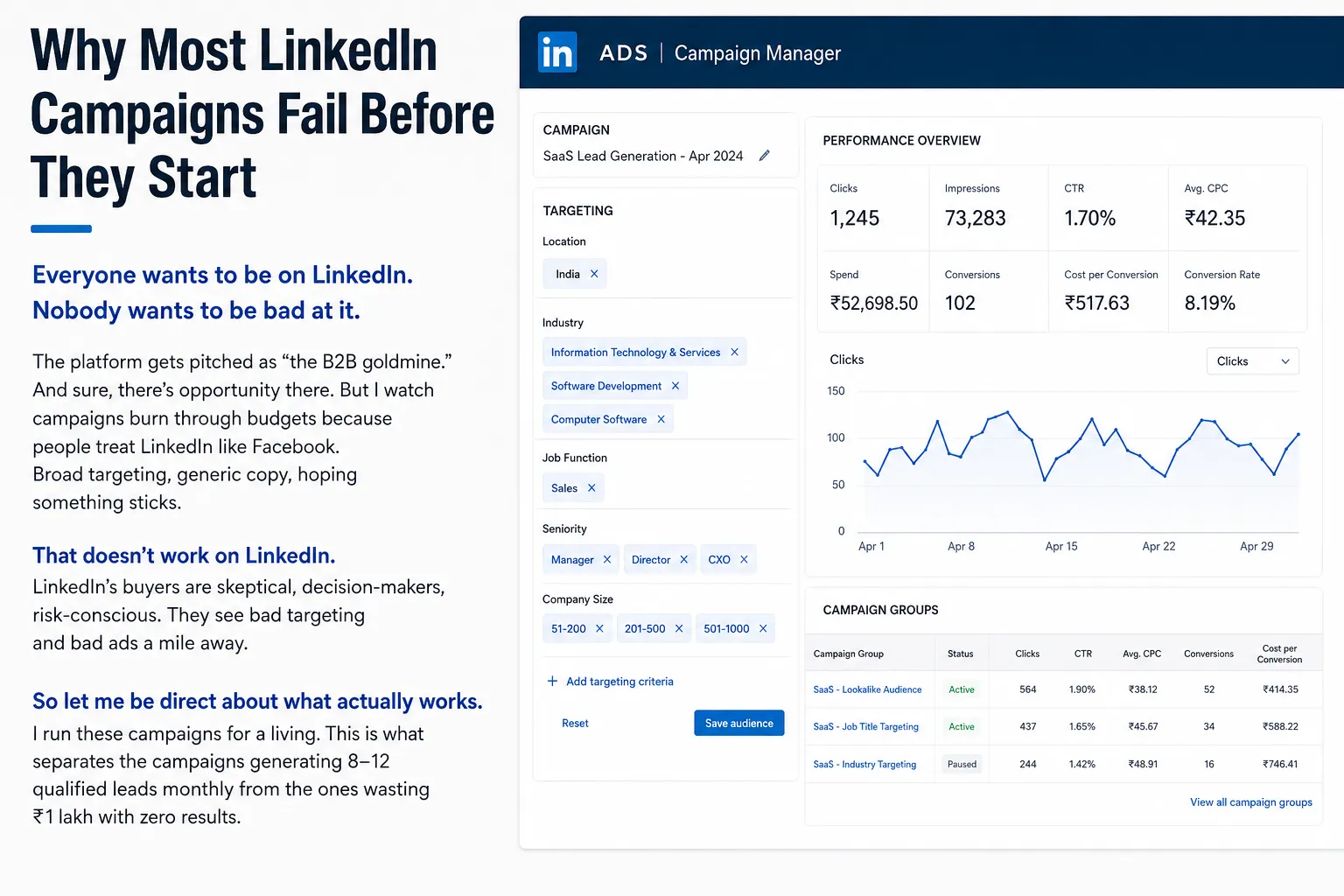
Why Most LinkedIn Campaigns Fail Before They Start
Everyone wants to be on LinkedIn. Nobody wants to be bad at it.
The platform gets pitched as “the B2B goldmine.” And sure, there’s opportunity there. But I watch campaigns burn through budgets because people treat LinkedIn like Facebook. Broad targeting, generic copy, hoping something sticks.
That doesn’t work on LinkedIn. LinkedIn’s buyers are skeptical, decision-makers, risk-conscious. They see bad targeting and bad ads a mile away.
So let me be clear about what actually works. We run digital marketing services that generate real business outcomes. This is what separates campaigns bringing in 8–12 qualified leads every month from the ones wasting ₹1 lakh with zero results.
The First Reality Check
Is LinkedIn even for you?
If your customers are C-suite, procurement heads, operations managers — yes, they’re on LinkedIn. Researching at odd hours, lurking on competitor pages, seeing what’s trending in their industry.
If your customers are retail workers, small shop owners, farmers — LinkedIn’s wrong. Stop. Invest elsewhere.
Context: A SaaS company selling HR software to mid-market manufacturers. They went to LinkedIn. Each lead cost ₹7,000-₹10,000. Seemed expensive until one converted to a ₹20 lakh annual contract. Suddenly ROI was massive. Different than another client selling to restaurants. LinkedIn there was a waste of money.
Your margin per customer determines if LinkedIn makes sense. Does the economics work? If yes, keep reading.
The Targeting That Separates Winners from Wasters
This is where most campaigns die.
Broad targeting: “All decision-makers in manufacturing” = 400,000 people. Your ₹30,000 budget gets 5-10 impressions per person. That’s not enough. Single impression, no recall, no conversion.
Smart targeting: “Operations managers at companies with 200-500 employees, in Bangalore/Mumbai/Pune, who viewed supply chain content in the last 90 days” = 2,000 people. Your ₹30,000 budget gets 30-50 impressions per person. They see you. They remember you. They convert.
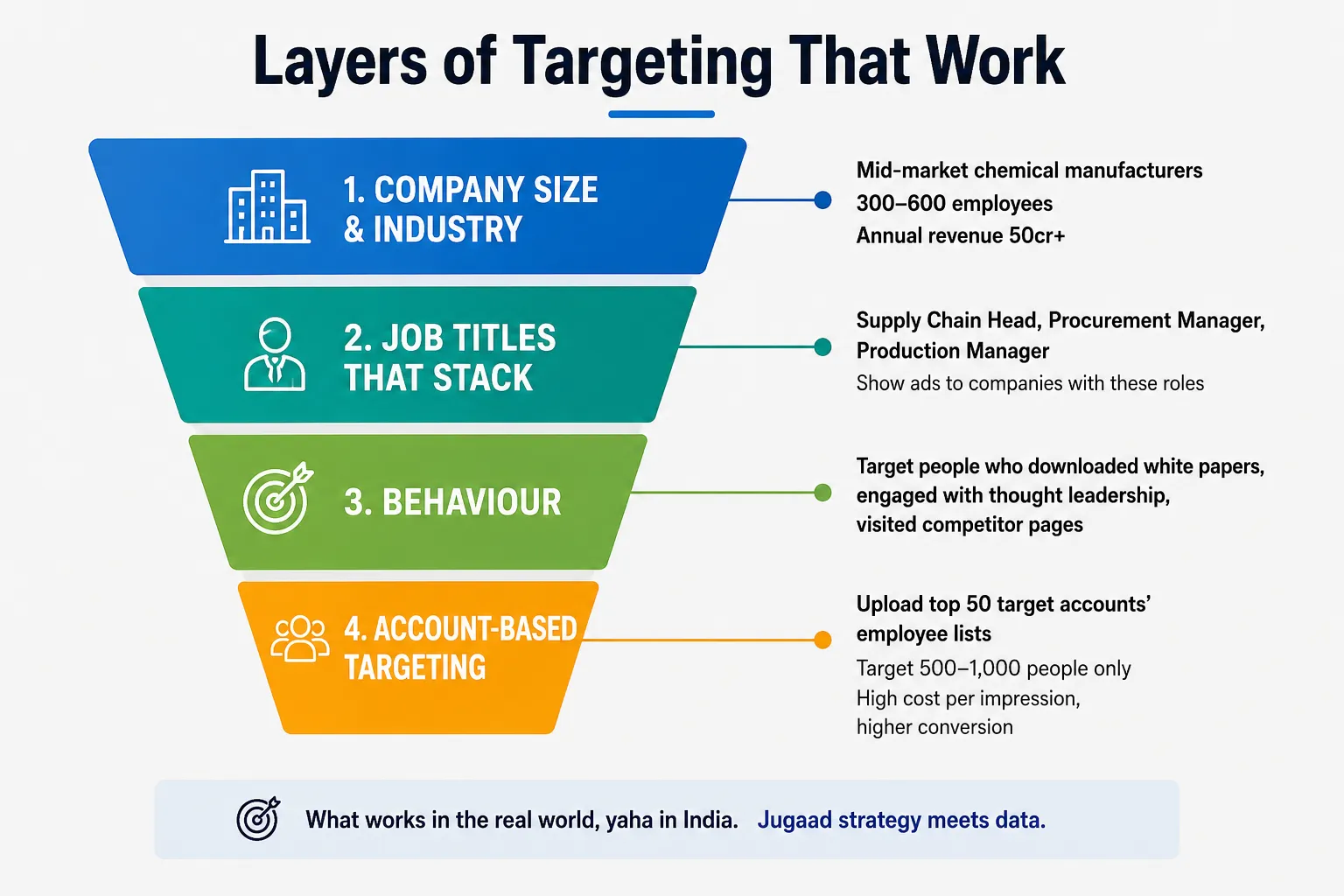
Layers of Targeting That Work
First: Company size and industry. Not “manufacturing.” Try “mid-market chemical manufacturers, 300-600 employees, annual revenue 50cr+.”
Second: Job titles that stack. Not just “Operations Manager.” Include “Supply Chain Head,” “Procurement Manager,” “Production Manager” — show ads to companies with these roles.
Third: Behaviour. LinkedIn knows who downloaded white papers, commented on thought leadership posts, visited competitor pages. Target those people.
Fourth: Account-based if you’re fancy. Top 50 target accounts? Upload their employee lists. Target ads to those specific 500-1,000 people only. High cost per impression, higher conversion.
This is what works in the real world, yaha (here) in India. Jugaad strategy meets data.
The Content That Actually Converts (Not Engagement Vanity)
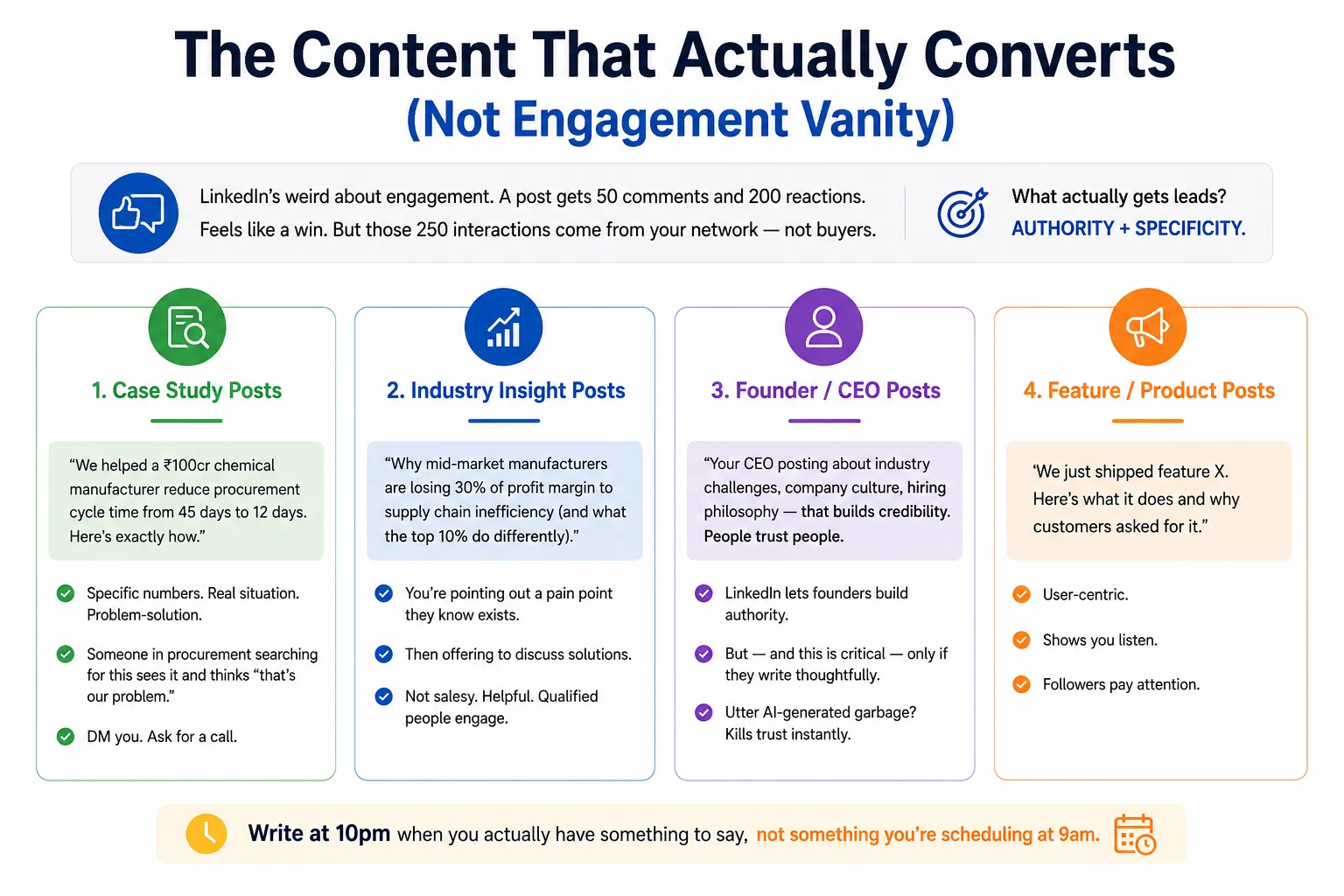
LinkedIn’s weird about engagement. A post gets 50 comments and 200 reactions. Feels like a win. But those 250 interactions come from your network — not buyers.
What actually gets leads? Authority + specificity. Check out our deeper guide on B2B content marketing for more on this.
Case Study Posts
“We helped a ₹100cr chemical manufacturer reduce procurement cycle time from 45 days to 12 days. Here’s exactly how.”
Specific numbers. Real situation. Problem-solution. Someone in procurement searching for this sees it and thinks “that’s our problem.” DM you. Ask for a call.
Industry Insight Posts
“Why mid-market manufacturers are losing 30% of profit margin to supply chain inefficiency (and what the top 10% do differently).”
You’re pointing out a pain point they know exists. Then offering to discuss solutions. Not salesy. Helpful. Qualified people engage.
Founder/CEO Posts
Your CEO posting about industry challenges, company culture, hiring philosophy — that builds credibility. People trust people. LinkedIn lets founders build authority. But — and this is critical — only if they write thoughtfully. Utter AI-generated garbage? Kills trust instantly.
Write at 10pm when you actually have something to say, not something you’re scheduling at 9am.
Feature/Product Posts
“We just shipped feature X. Here’s what it does and why customers asked for it.” User-centric. Shows you listen. Followers pay attention.
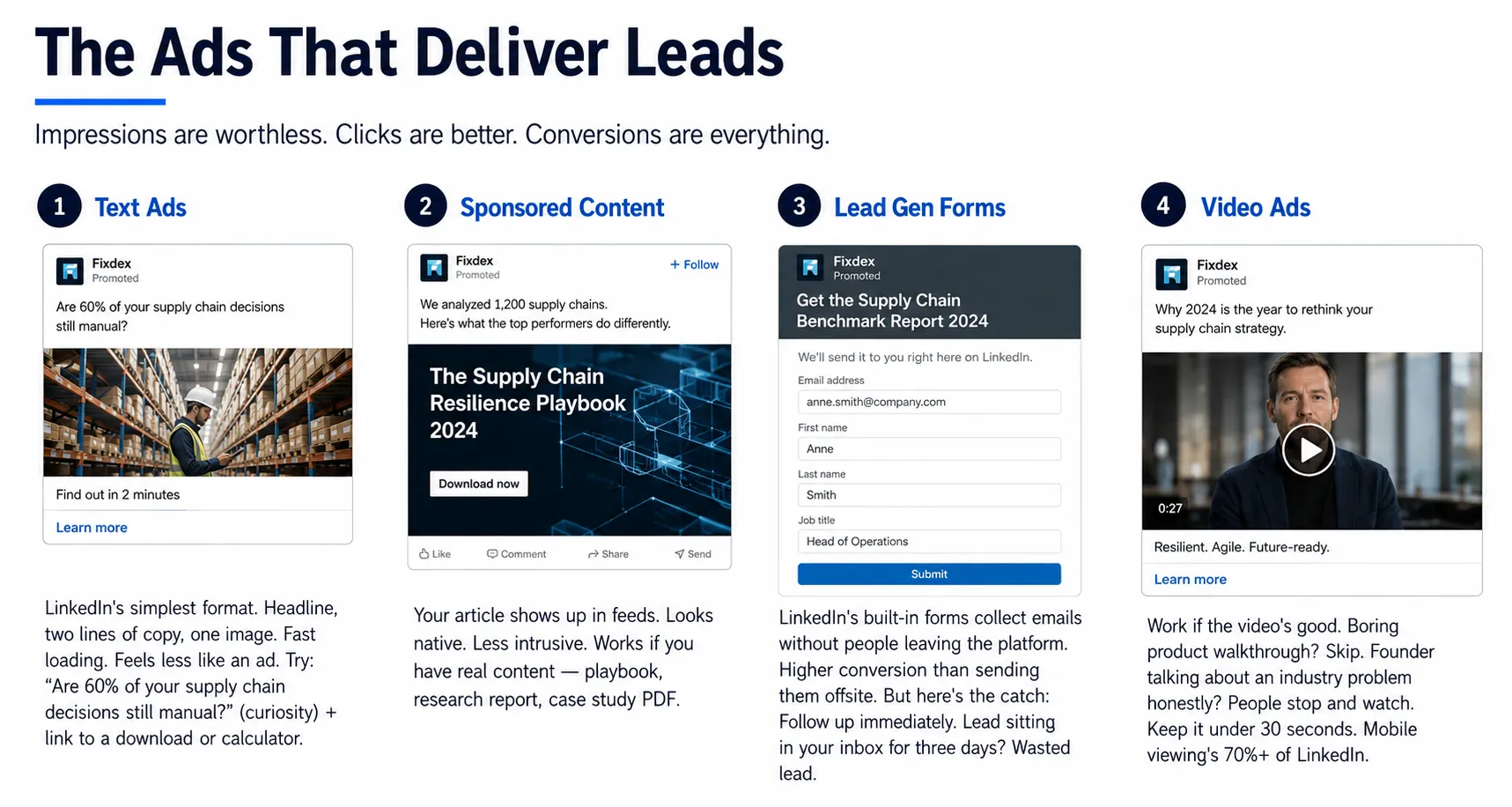
The Ads That Deliver Leads
Impressions are worthless. Clicks are better. Conversions are everything.
1. Text Ads
LinkedIn’s simplest format. Headline, two lines of copy, one image. Fast loading. Feels less like an ad. Try: “Are 60% of your supply chain decisions still manual?” (curiosity) + link to a download or calculator.
2. Sponsored Content
Your article shows up in feeds. Looks native. Less intrusive. Works if you have real content — playbook, research report, case study PDF.
3. Lead Gen Forms
LinkedIn’s built-in forms collect emails without people leaving the platform. Higher conversion than sending them offsite. But here’s the catch: Follow up immediately. Lead sitting in your inbox for three days? Wasted lead.
4. Video Ads
Work if the video’s good. Boring product walkthrough? Skip. Founder talking about an industry problem honestly? People stop and watch. Keep it under 30 seconds. Mobile viewing’s 70%+ of LinkedIn.
The Campaign That Tanked and Taught Us Everything
SaaS client. HR software. ₹1.2 lakhs spent over three months. Got 23 clicks. Two semi-qualified leads. Brutal numbers.
What happened? Targeting was so broad — “all HR managers in India” — that ₹1.2 lakhs got lost in noise. No frequency. No recall.
We narrowed it. HR Directors at 500-2,000 employee companies in Bangalore, Mumbai, Pune, Delhi. Same budget, ₹30,000/month now. Different result: 80 clicks. 8-10 meetings. One converted to ₹25 lakh annual contract.
Targeting’s 70% of success. Creative’s 20%. Timing’s 10%. Most people get it backwards.
Budget That Actually Works
You have ₹50,000 monthly to spend on LinkedIn. Here’s how:
- ₹30,000 to high-intent ads (case studies, product-focused, retargeting past visitors)
- ₹15,000 to awareness/thought leadership (industry insights, founder content)
- ₹5,000 to testing new audiences and new creative
70/15/10 split roughly. Keep 70% working hard. Let 15% build authority. Use 10% to find tomorrow’s winners.
Never put all ₹50,000 into one campaign. Diversify. When algorithm changes or targeting weakens, you have backups.
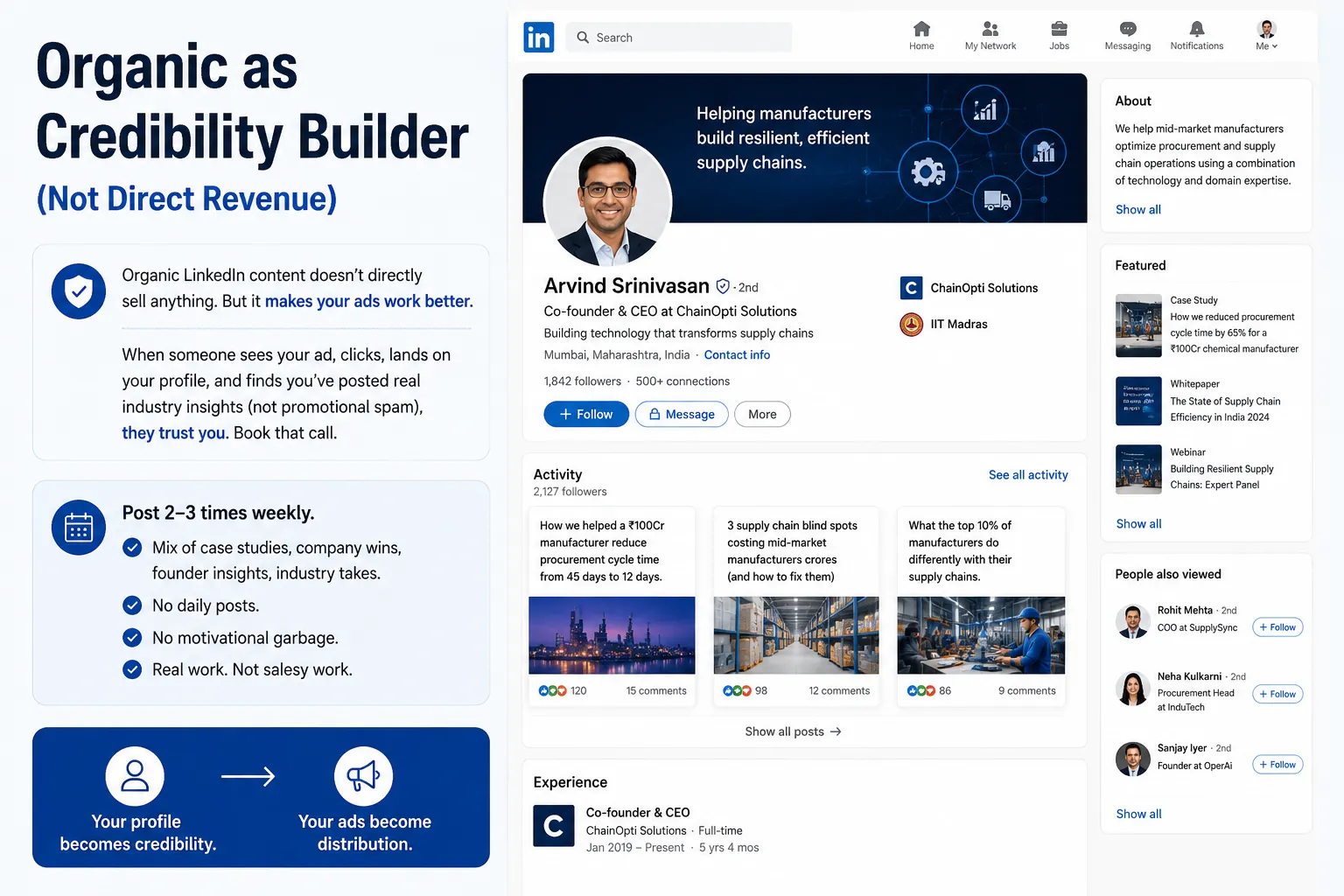
Organic as Credibility Builder (Not Direct Revenue)
Organic LinkedIn content doesn’t directly sell anything. But it makes your ads work better.
When someone sees your ad, clicks, lands on your profile, and finds you’ve posted real industry insights (not promotional spam), they trust you. Book that call. This is exactly why strong B2B branding collateral matters — it gives your ads something credible to land on.
Post 2-3 times weekly. Mix of case studies, company wins, founder insights, industry takes. No daily posts. No motivational garbage. Real work. Not salesy work.
Your profile becomes credibility. Your ads become distribution.
The Follow-up That Wins
Lead fills your form. Now what?
Most teams email. No response. Lead dies.
Right: Call within 24 hours. Or message on LinkedIn directly. “Hey, saw you filled this out, following up, is now good?”
Response rate jumps from 5% to 30%+ when you’re fast and personal. Speed matters. Personalization matters. Actually talking matters.
Track where leads come from. LinkedIn lead? Tag it. How many convert? That data tells if LinkedIn’s working or burning cash.
Mistakes Even We Make
Bad targeting. Spreading budgets too thin across too many campaigns. Weak follow-up. Not nurturing long sales cycles.
The biggest? Running ads without organic presence. You can’t just buy attention. You have to earn it first.
Spend a month building profile credibility. Post real content. Get followers. Then buy ads. The combination works.
Also — LinkedIn’s algorithm’s moody. What worked last month might fail this month. Test constantly. First campaign might flop. Doesn’t mean LinkedIn doesn’t work. Means your angle was wrong.
When LinkedIn’s Actually Wrong For You
Be honest. LinkedIn’s not for you if:
- Your buyers aren’t decision-makers online
- Deal size is under ₹50,000 (cost per lead kills margins)
- Sales cycle is under two weeks (no nurturing time)
- You’re B2C selling to consumers (use Facebook/Instagram instead)
LinkedIn’s for B2B relationships with real deal value. If that’s not you, invest elsewhere.
The Numbers That Tell the Truth
Track these:
- Cost per click (CPC)
- Click-through rate (CTR) — how many see ad, how many click
- Cost per lead (CPL) = total spend ÷ form submissions
- Lead to meeting rate
- Meeting to close rate
- Customer acquisition cost (CAC) = LinkedIn spend ÷ customers acquired
If CAC is lower than your gross margin per customer, it works. Higher? It doesn’t. Simple math.
| Approach | Best for | Watch out for |
|---|---|---|
| DIY | Small teams, tight budgets | Slow ramp-up, trial-and-error |
| Freelancer | Specific project bursts | Inconsistency, limited ownership |
| Agency | Ongoing work, senior input | Higher retainer, less control |
Quick checklist before you start:
- Define the one thing you want: leads, sales, awareness — pick one.
- Baseline your numbers: write down where you are today.
- Pick a 90-day window: nothing moves in 2 weeks.
- Agree on success metrics: with whoever is paying the bill.
- Set up proper tracking: GA4, UTMs, call tracking.
- Review monthly: kill what doesn’t work, double down on what does.
The Bottom Line
If you take one thing from this: linkedin marketing strategy for b2b real world tactics that rewards patience and specificity, not volume or clever tricks. Start small, measure honestly, fix what breaks, and compound what works. The brands doing this well in India aren’t smarter — they’re just consistent. Need a hand with this for your business? Talk to us.
LinkedIn Ads Getting Weak Results?
We manage 100+ LinkedIn campaigns across B2B. Made every mistake. Know what works. Your campaign flat? Let’s find the leak.
FAQs
-
Is LinkedIn marketing worth it for B2B?
Ans.Yes, if customers are decision-makers researching solutions there. CPL can be ₹5,000-₹20,000, but if one customer's worth ₹20+ lakhs, math works. Do it wrong? Waste money. Do it right? Sustainable lead channel. -
Organic or ads first?
Ans.Organic first for credibility. Ads second for distribution. Together. Ads without active profile = wasting money on credibility-less messaging. -
Starting budget?
Ans.₹20,000-₹30,000/month. Enough to test targeting. Scale after you find what works. Pehle data, phir scale.
Author Details

Latest Posts
-
 26 / Aug
Search Engine Optimization Video SEO: How to Rank Your Videos in Google & YouTube
26 / Aug
Search Engine Optimization Video SEO: How to Rank Your Videos in Google & YouTube -
 25 / Aug
Video Production Corporate Video Production: A Practical Guide for Indian Brands
25 / Aug
Video Production Corporate Video Production: A Practical Guide for Indian Brands -
 24 / Aug
-
21 / Aug
Catalogue Design Catalogue Design: How to Create Catalogues That Actually Sell
-
 20 / Aug
Related Knowledge