-
Author: Anindita Barik
-
Updated Date: May-14-2026
-
Views: 2 Min Read
A social media marketing strategy is a clear plan defining who you’re targeting, which platforms you’ll use, what you’ll post, and how you’ll measure results. It includes choosing 2–3 platforms, building content pillars, maintaining a consistent posting calendar, balancing organic and paid efforts, and tracking metrics like leads and conversions — not just likes and followers.
Keep the story, add the payoff “I scrolled through a fashion brand’s Instagram yesterday. 47 followers. Two years of perfect posts. Zero sales. The content wasn’t the problem — the strategy was missing. That’s exactly what this guide covers: a real social media marketing strategy, no buzzwords, no fluff.
Why Most Brands’ Social Media Is Pointless
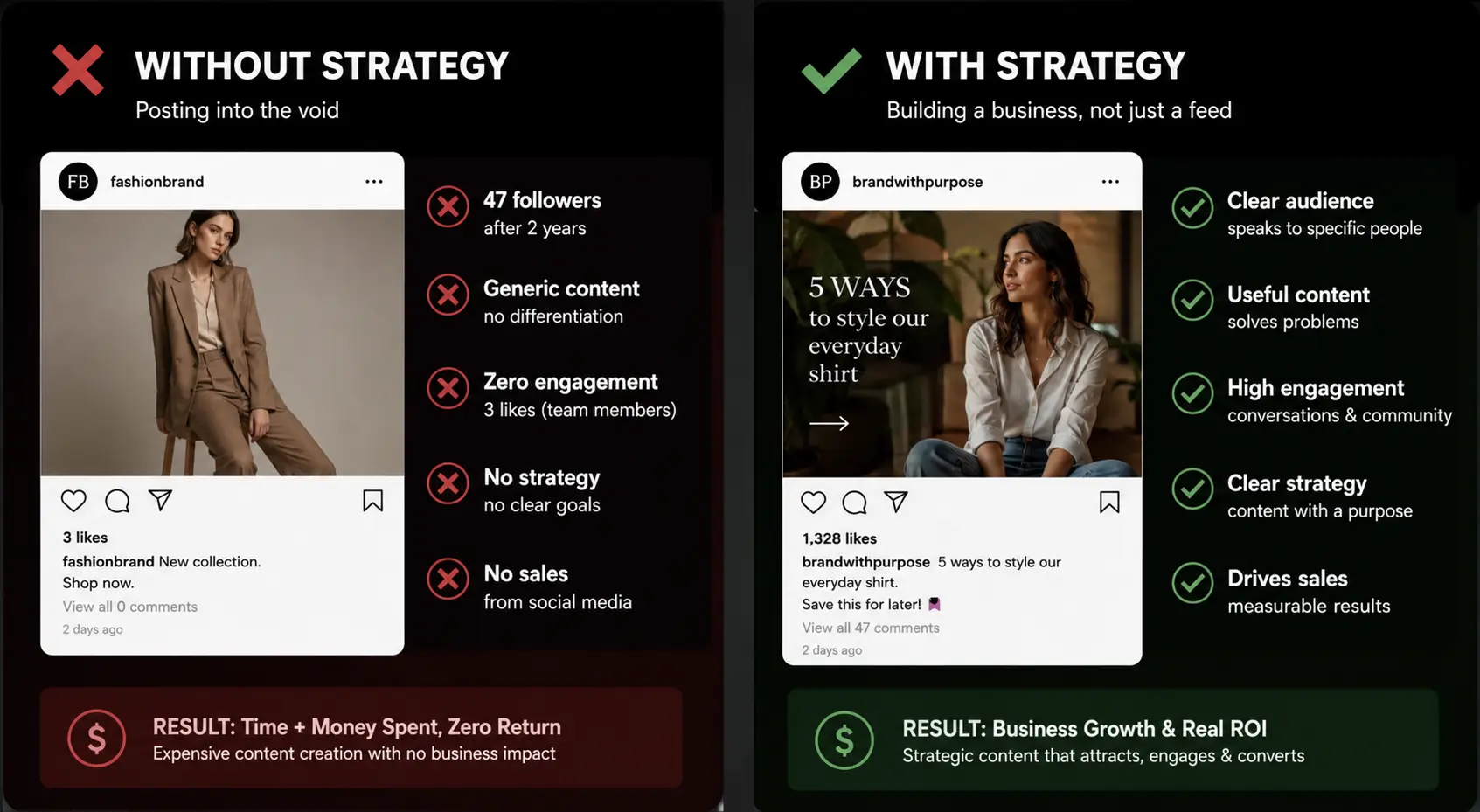
I scrolled through a fashion brand’s Instagram yesterday. 47 followers. They’ve been posting for 2 years. Every post looks perfect. Studio photography. Professional lighting. Captions that are… generic marketing speak.
Zero engagement. Zero sales from social. Their last post got 3 likes (probably team members).
You know why? Because they’re posting into the void with no strategy.
They never asked: Who am I actually trying to reach? What problem am I solving? Why would someone follow me? What action do I want them to take?
Without those answers, social media is just expensive content creation with no return. I’ve seen brands spend 2 lakhs a month on content creation and get zero business back. Meanwhile, a competitor with 1/10th the production value is crushing it because they actually have strategy. That’s what separates amateur posting from what social media marketing companies in Kolkata actually do for their clients.
Strategy is what separates “we post on social media” from “social media marketing drives actual business for us.”
Step One: Choose Your Platforms (And Ignore the Others)
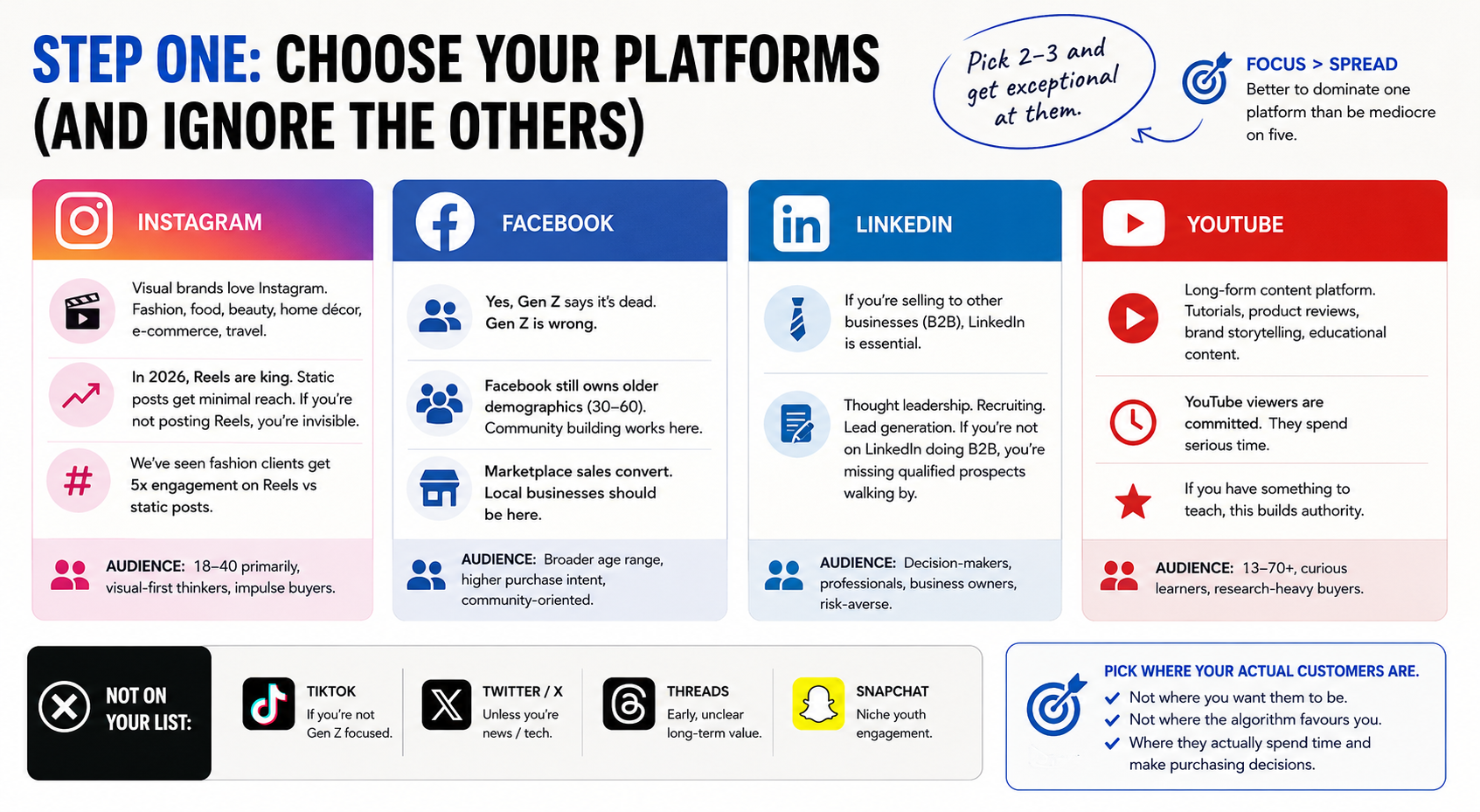
There are probably 12 social platforms worth considering. Pick 2-3 and get exceptional at them.
1. Instagram
Visual brands love Instagram. Fashion, food, beauty, home décor, e-commerce, travel. In 2026, Reels are king. Static posts get minimal reach. If you’re not posting Reels, you’re invisible. We’ve seen fashion clients get 5x engagement on Reels vs static posts.
Audience: 18-40 primarily, visual-first thinkers, impulse buyers.
2. Facebook
Yes, Gen Z says it’s dead. Gen Z is wrong. Facebook still owns older demographics (30-60). Community building works here. Marketplace sales convert. Local businesses should be here.
Audience: Broader age range, higher purchase intent, community-oriented.
3. LinkedIn
If you’re selling to other businesses (B2B), LinkedIn is essential. Thought leadership. Recruiting. Lead generation. If you’re not on LinkedIn doing B2B, you’re missing qualified prospects walking by.
Audience: Decision-makers, professionals, business owners, risk-averse.
4. YouTube
Long-form content platform. Tutorials, product reviews, brand storytelling, educational content. YouTube viewers are committed. They spend serious time. If you have something to teach, this builds authority.
Audience: 13-70+, curious learners, research-heavy buyers.
Not on your list: TikTok (if you’re not Gen Z focused), Twitter/X (unless you’re news/tech), Threads (early, unclear), Snapchat.
Pick where your actual customers are. Not where you want them to be. Not where the algorithm favours you. Where they actually spend time and make purchasing decisions.
Content Pillars: The Boring But Essential Part
This is where strategy lives. Content pillars are 3-5 themes that you’ll consistently post about.
Example: If you’re a fitness brand, your pillars might be :
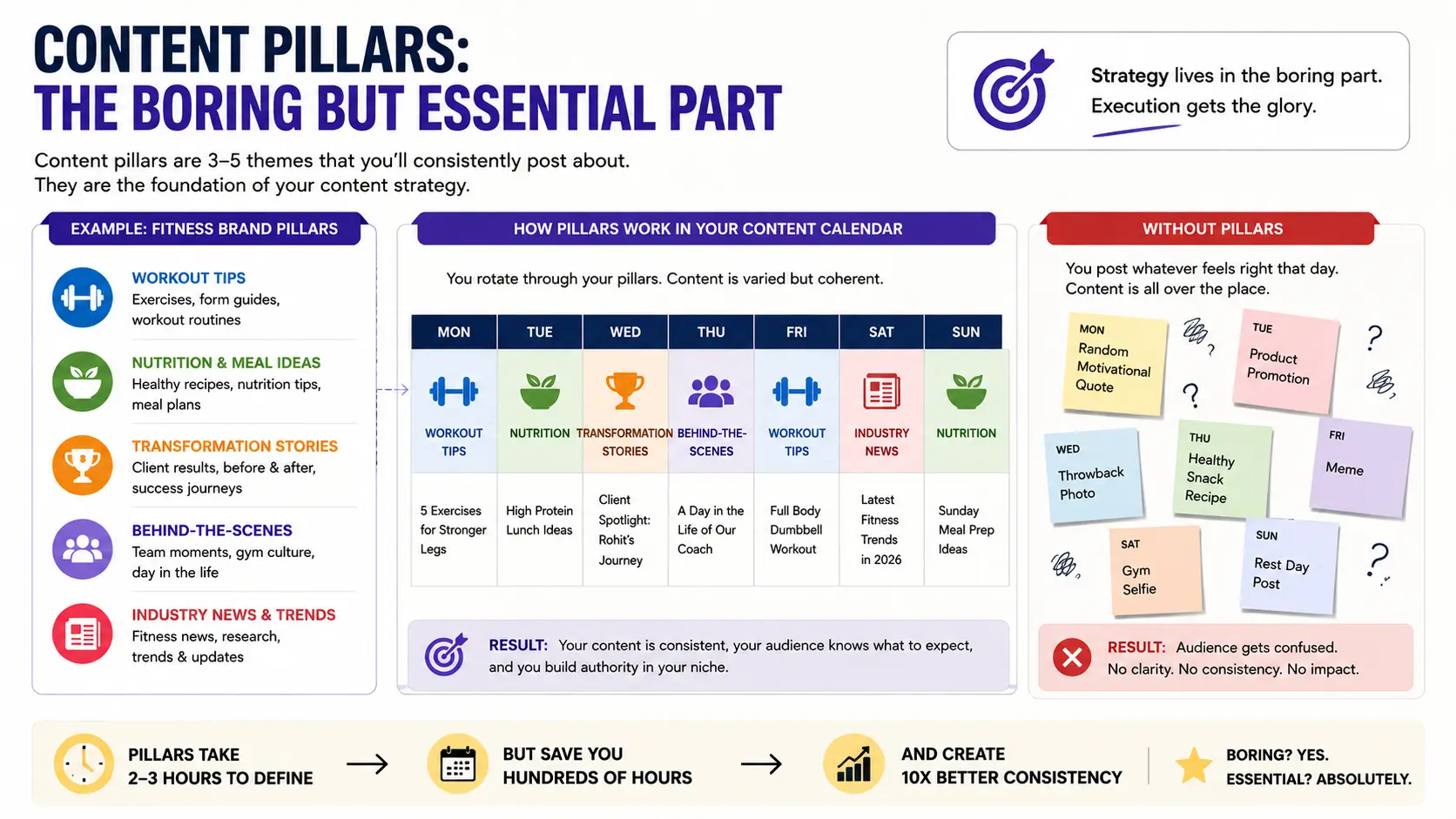
- Workout tips and exercises
- Nutrition and meal ideas
- Transformation stories
- Behind-the-scenes team content
- Industry news and trends
Now, when you create a content calendar, you rotate through these pillars. Monday is workout content. Wednesday is nutrition. Friday is transformation stories. This removes decision fatigue and keeps audiences engaged because content is varied but coherent.
Without pillars? You post whatever feels right that day. Content is all over the place. Audience gets confused about what you actually stand for.
Pillars take 2-3 hours to define but save you hundreds of hours in planning and create 10x better consistency.
The Content Calendar That Doesn’t Feel Like Work
Plan 4 weeks of content at a time. Use a simple spreadsheet. Include:
- Date and time to post
- Which pillar it addresses
- Type of content (Reel, carousel, single post, video, text)
- Caption and hashtags
- Call-to-action (what do you want people to do?)
Consistency beats perfection. Post 3-4 times per week consistently over 6 months beats posting 10 times one week and going silent for 2 months.
Your audience needs to know when to expect content from you. It’s like a TV show—people tune in because they know Wednesday at 7 PM there’s new content.
Organic vs Paid: The Balance That Works
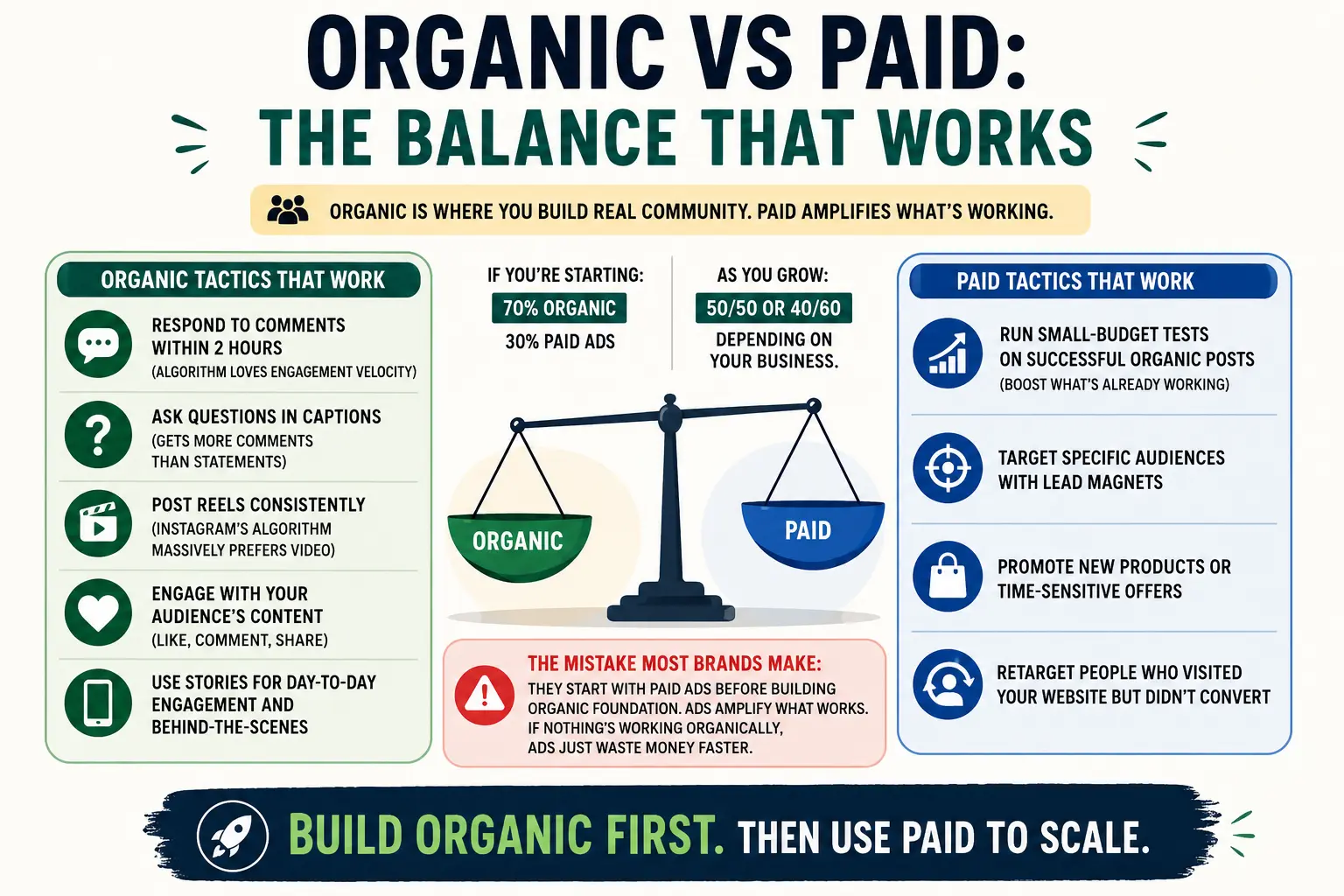
Organic is where you build real community. Paid amplifies what’s working.
If you’re starting: 70% energy on organic, 30% on paid ads. As you grow: maybe 50/50 or 40/60 depending on your business.
Organic tactics that work:
- Respond to comments within 2 hours (algorithm loves engagement velocity)
- Ask questions in captions (gets more comments than statements)
- Post Reels consistently (Instagram’s algorithm massively prefers video)
- Engage with your audience’s content (like, comment, share)
- Use stories for day-to-day engagement and behind-the-scenes
Paid tactics:
- Run small-budget tests on successful organic posts (boost what’s already working)
- Target specific audiences with lead magnets
- Promote new products or time-sensitive offers
- Retarget people who visited your website but didn’t convert
The mistake most brands make: they start with paid ads before building organic foundation. Ads amplify what works. If nothing’s working organically, ads just waste money faster.
Build organic first. Then use paid to scale.
Metrics That Actually Matter (Not Vanity Metrics)
Vanity metrics make you feel good. Real metrics tell you if it’s working.
- Website traffic from social: Use UTM parameters to track which platform sends visitors.
- Leads generated: How many people signed up, called, or filled a form from social?
- Cost per lead: What are you spending to get one lead from social?
- Conversion rate: What percentage of visitors from social actually buy?
- Engagement rate: (Likes + Comments + Shares) ÷ Followers = Engagement %
- Click-through rate: Links in bios, stories, posts—track how many people actually click.
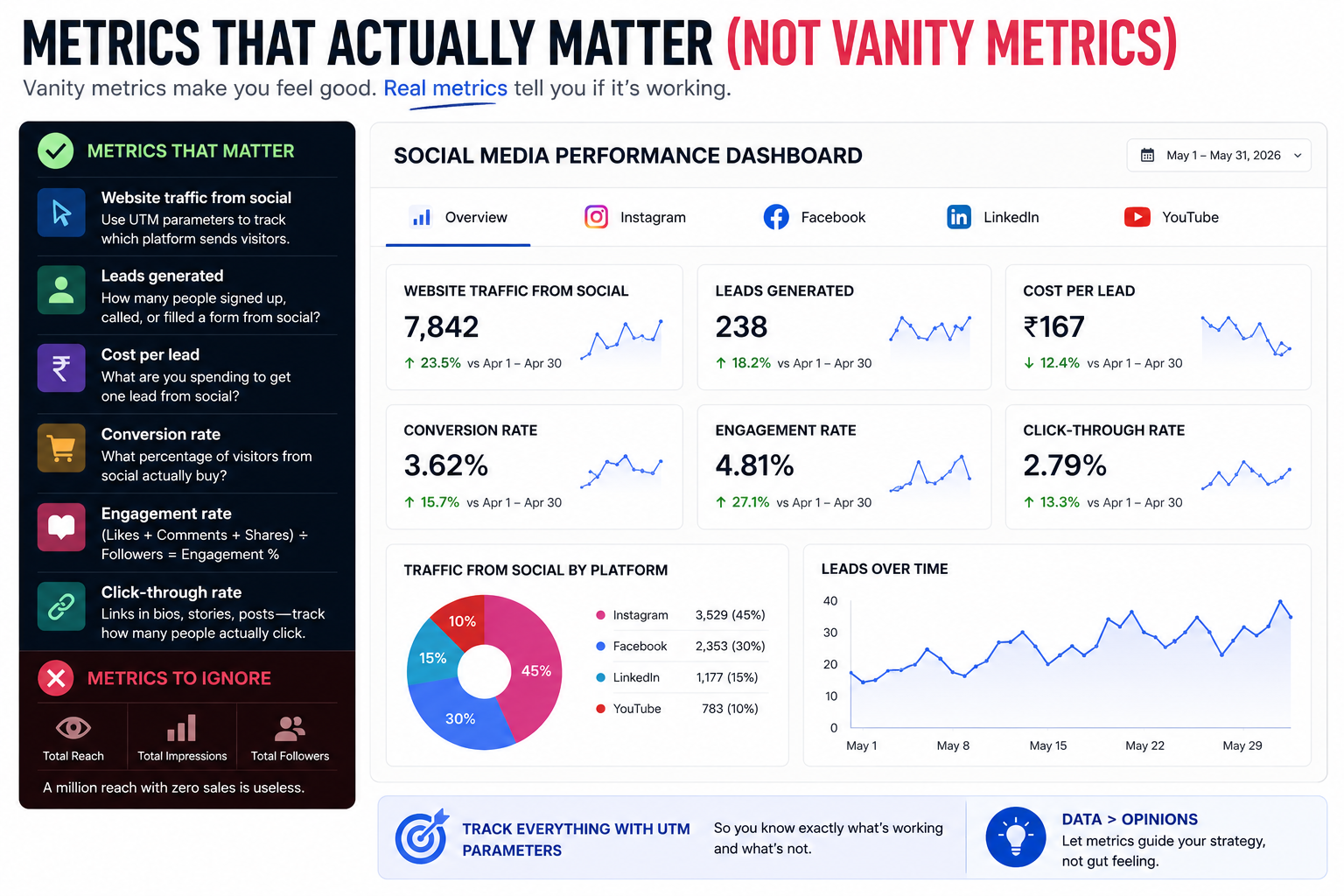
Ignore: total reach, total impressions, total followers. A million reach with zero sales is useless.
Track everything with UTM parameters so you know exactly what’s working and what’s not.
Why Authenticity Actually Beats Polish in 2026
Heavily edited, corporate, perfect content gets ignored. Raw, authentic, real content gets shared and remembered.
Gen Z can smell BS from a mile away. They prefer phone videos over professional production. Real people over celebrity endorsers. Honest stories over polished narratives.
Our best-performing content? Phone videos. Candid team moments. Customer stories where people actually talk like humans, not marketing robots. (Sachche baat, unfiltered, with personality.)
Stop trying to look like Nike or Apple. Look like yourself. Your team. Your actual business.
Tools You Actually Need (And Which Ones You Can Skip)
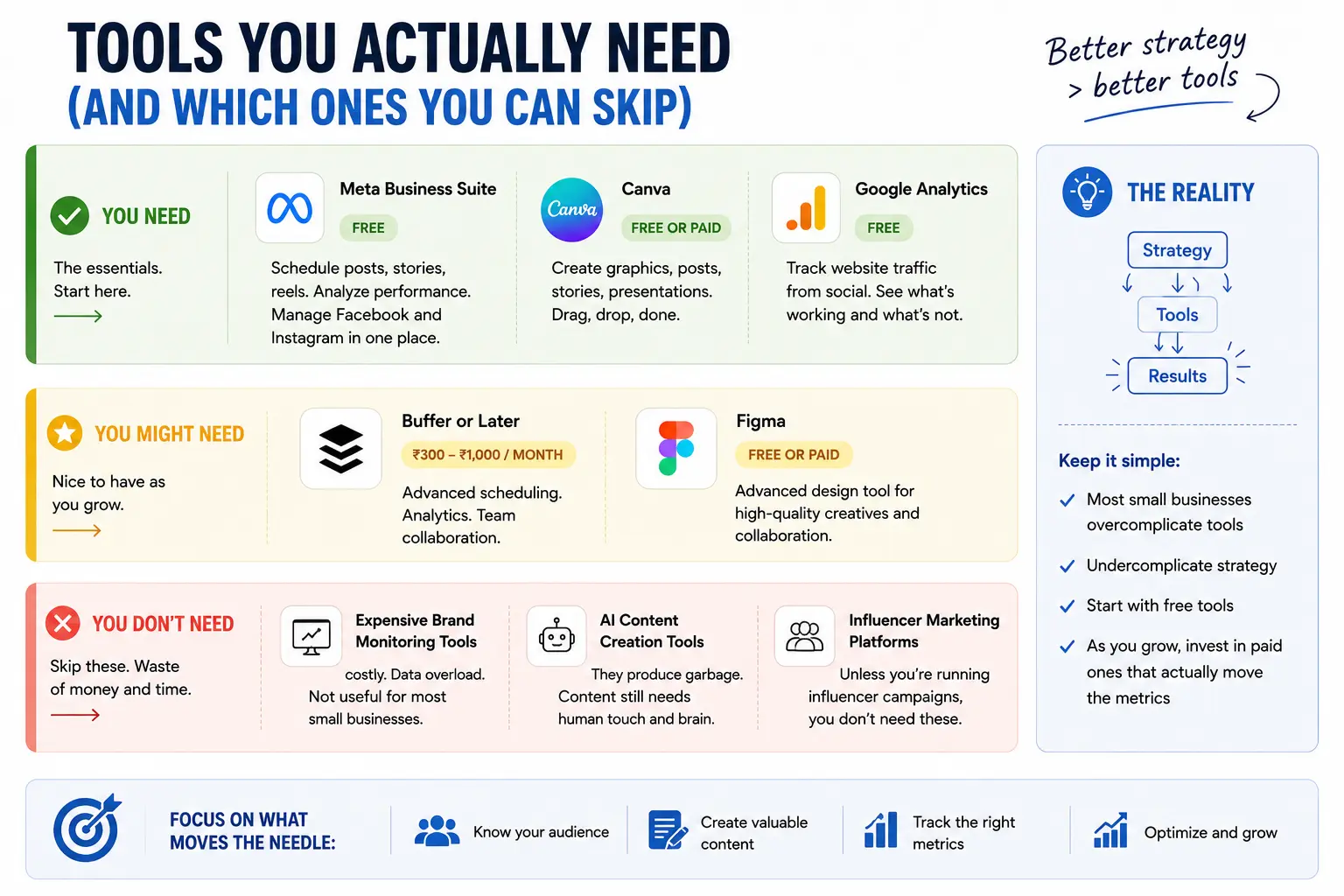
You need:
- Meta Business Suite (free, for Facebook and Instagram scheduling)
- Canva (free or paid, for graphics)
- Google Analytics (free, to track traffic from social)
You might need:
- Buffer or Later (scheduling tool with analytics, Rs 300-1000/month)
- Figma (design tool, free or paid)
You don’t need:
- Expensive brand monitoring tools
- AI content creation tools (they produce garbage—content still needs human touch)
- Influencer marketing platforms (unless you’re specifically doing influencer campaigns)
Most small businesses overcomplicate tools and undercomplicate strategy. Start with free tools. As you grow, invest in the paid ones that actually move metrics.
Common Social Media Mistakes (I’ve Seen Them All)
- Posting without a strategy : Just guessing what to post daily leads to chaos and zero results.
- Going silent for months then posting 10 times : Algorithms punish inconsistency.
- Not responding to comments : Social is about engagement, not broadcasting.
- Ignoring your competitors : Spend 2 hours seeing what works for them (not to copy, but to understand landscape).
- Using trends incorrectly : Jumping on a trend that has nothing to do with your brand just wastes effort.
- Focusing on followers instead of engagement : 10K followers with zero engagement is worse than 1K followers who actually care.
- Selling hard on every post : People follow for value, entertainment, or connection. Not to be sold to constantly.
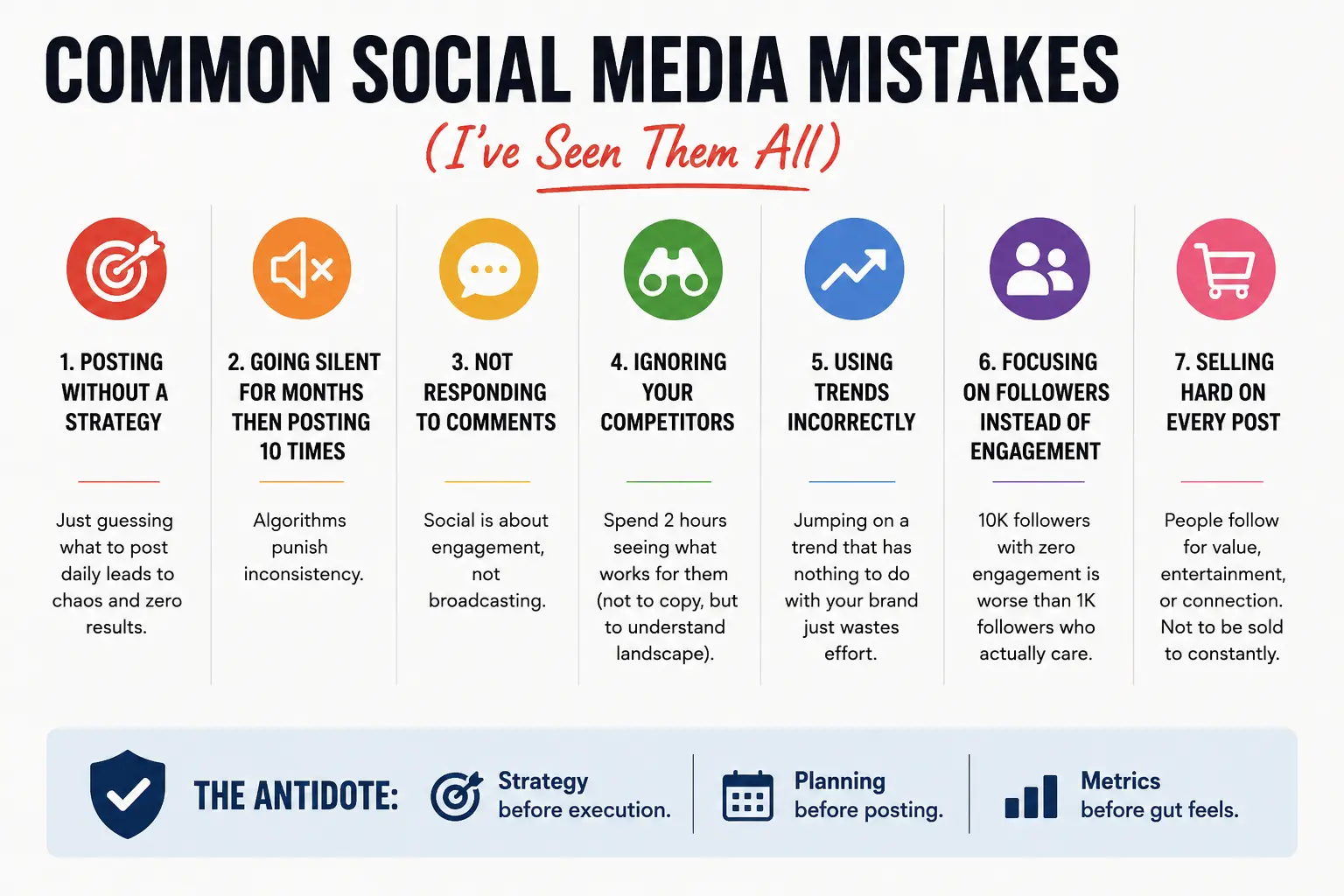
The antidote: Strategy before execution. Planning before posting. Metrics before gut feels. If you’re already making some of these, here’s a closer look at the 3 social media mistakes you must avoid.
Your 30-Day Social Media Challenge
If you’re starting from scratch:
Week 1: Define 3-4 content pillars. Map out your audience. Pick 2 platforms.
Week 2: Create content calendar for 4 weeks. Get visuals ready (use Canva or hire someone).
Week 3: Start posting on schedule. Set up UTM parameters for tracking.
Week 4: Engage with comments. Check analytics. Notice what’s working.
By end of month: You’ll have a foundation. You’ll see what resonates. You’ll have actual data instead of guesses.
Then? Keep that rhythm for 6 months before expecting big results. Social media compounds. The best posts often come in month 4-6, not week 1.
| Approach | Best for | Watch out for |
|---|---|---|
| DIY | Small teams, tight budgets | Slow ramp-up, trial-and-error |
| Freelancer | Specific project bursts | Inconsistency, limited ownership |
| Agency | Ongoing work, senior input | Higher retainer, less control |
Quick checklist before you start:
- Define the one thing you want: leads, sales, awareness — pick one.
- Baseline your numbers: write down where you are today.
- Pick a 90-day window: nothing moves in 2 weeks.
- Agree on success metrics: with whoever is paying the bill.
- Set up proper tracking: GA4, UTMs, call tracking.
- Review monthly: kill what doesn’t work, double down on what does.
The Bottom Line
If you take one thing from this: social media marketing strategy a no jargon guide rewards patience and specificity, not volume or clever tricks. Start small, measure honestly, fix what breaks, and compound what works. The brands doing this well in India aren’t smarter — they’re just consistent. Need a hand with this for your business? Talk to us.
Ready To Build Social That Converts?
We can help you build a strategy that gets real engagement and drives actual business results. No guessing. Just data-driven execution.
FAQs
-
Should we be on all platforms?
Ans.No. You'll burn out. Pick 2-3 and dominate them. Once you've built real presence and team capacity on 2-3, expand. But starting on everything is a recipe for mediocre content and no engagement. Better to own Instagram and LinkedIn really well than be average on 7 platforms. -
How long until social media pays off?
Ans.Months 1-3: building foundation, seeing modest engagement. Months 3-6: real traction emerging, some traffic and leads. Months 6-12: compounding results, you're clearly seeing business impact. If strategy is right, social becomes a consistent lead/sales channel by month 12. If it isn't, you'll know by month 6 and can pivot. -
Organic or paid—which is better?
Ans.Both. Organic builds real community and long-term brand equity. Paid amplifies good content and reaches new audiences. Start with organic foundation because there's no point paying to amplify mediocre content. Once organic is working, paid scales it. Most successful brands do 60-70% organic, 30-40% paid.
Author Details

Latest Posts
-
 26 / Aug
Search Engine Optimization Video SEO: How to Rank Your Videos in Google & YouTube
26 / Aug
Search Engine Optimization Video SEO: How to Rank Your Videos in Google & YouTube -
 25 / Aug
Video Production Corporate Video Production: A Practical Guide for Indian Brands
25 / Aug
Video Production Corporate Video Production: A Practical Guide for Indian Brands -
 24 / Aug
-
21 / Aug
Catalogue Design Catalogue Design: How to Create Catalogues That Actually Sell
-
 20 / Aug