


-
Author: PromotEdge
-
Updated Date: Feb-18-2026
-
Views: 2 Min Read
Did you know why so many websites lose traffic after a redesign, even when the new version looks better? To answer this question, you need to first know why website redesign is so important.
A freshly designed website is commonly seen as a visual or usability-based upgrade. But from an SEO standpoint, it is one of the most sensitive phases in a website’s lifecycle. Many businesses have reviewed their redesigns, where they were surprised to find that their years of organic traffic had disappeared within weeks!
Not because the design was bad, but because SEO fundamentals were missing. Most website redesign mistakes happen because the entire focus is given to visuals and user experience rather than how search engines read, crawl, and evaluate a website.
Search engines don’t assume a redesigned website is an improved version of your existing website. Every change forces them to reassess URLs, content relevance, internal linking, crawl paths, page speed, and user behaviour signals.
When these elements change without proper SEO planning, rankings can drop fast and take months to recover. This is why website redesigns that aren’t SEO-led often lead to traffic loss, indexing problems, and weaker conversion performance.
In this blog, we will help you understand common website redesign mistakes from a practical SEO perspective. Whether you’re working with a website design company or coordinating with your in-house UI/UX designer, we are going to help you protect your organic visibility and avoid costly post-launch fixes.
Why Do Most Website Redesigns Fail in SEO?
Website redesign projects fail primarily because they prioritise aesthetics over strategy. Many businesses approach redesigns as visual refresh. While this is an important factor as research suggests 48% people consider the credibility of business by their website design, data-driven optimisation is equally important. This mindset leads to rushed planning, ignored analytics, and structural decisions that damage long-standing SEO equity.
When your redesign is executed without having knowledge of your site’s existing performance, even high-value URLs can get removed. A content might rank well, but without checking the SEO ranking status, you might end up rewriting it again. This results in the website being visually impressive, but struggling to attract organic traffic or convert users effectively.
12 Website Redesign Mistakes To Watch Out For
Most SEO-related problems during redesigns do not occur because of major technical failures, but by small oversights made at the analysis and compilation stage.
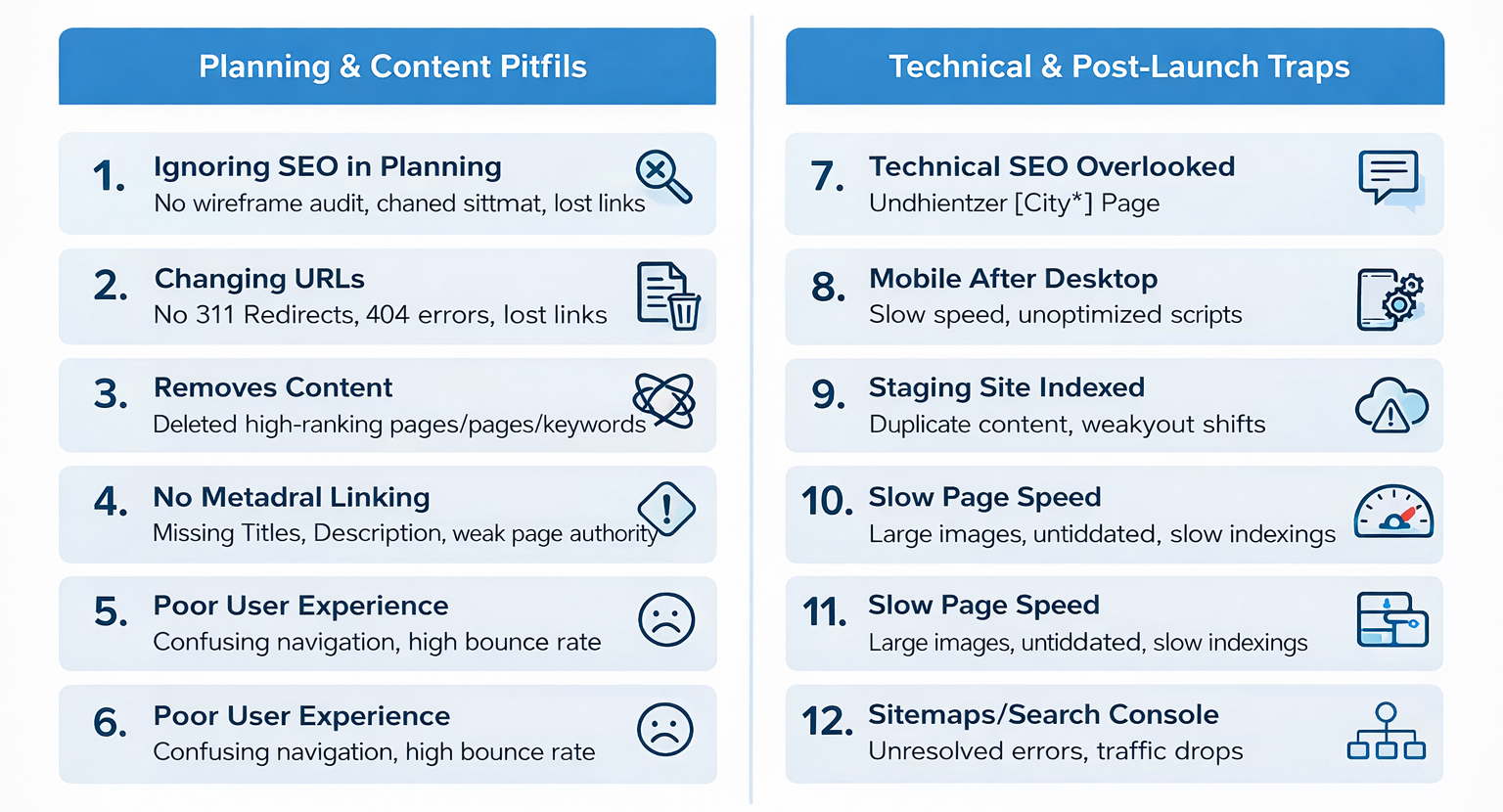
Here are 12 website redesign mistakes that businesses should always keep an eye on.
1. Ignoring SEO During the Redesign Planning Phase
One of the earliest and costliest website redesign mistakes is treating SEO as a post-launch task. Many redesign projects begin with wireframes, visual themes, and layout discussions without analysing existing organic performance. When SEO is excluded from the planning phase, high-value pages, ranking URLs, and keyword-driven structures get altered or removed unintentionally.
SEO should influence sitemap architecture, page hierarchy, navigation depth, and content prioritisation. Without this foundation, the redesigned website may look modern, but it loses relevance in search engines.
2. Changing URL Structures Without Proper Redirects
URL restructuring is common during redesigns. But changing URLs without implementing proper 301 redirects is a critical SEO failure. Search engines treat URLs as unique entities, and removing or altering them breaks the connection between indexed pages and their authority.
When old URLs are not redirected, users encounter 404 errors, and search engines drop previously indexed pages. This leads to immediate ranking loss and wasted crawl budget.
PromotEdge is a technically sound web design agency in Kolkata that can redesign your existing website. We make sure that every old URL maps accurately to its new version using permanent redirects.
3. Removing or Rewriting High-Performing Content
Content is one of the strongest elements of SEO on a website. During redesigns, most businesses delete or rewrite the content on their landing pages or service pages. Sometimes it’s done solely based on design preferences, without reviewing their search performance. This is a BIG website redesign mistake that drops the ranking of highly ranked keywords.
Pages that drive organic traffic, backlinks, or featured snippets should be preserved or carefully optimised rather than replaced on a frequent basis. Even small changes to headings, keyword placement, or content length can alter the search engine rankings of the content. Always keep in mind that SEO-driven content decisions must be data-backed, not aesthetic-driven.
4. Overlooking Technical SEO During Visual Upgrades
Visual-filled redesigns often give rise to technical issues, such as;
– Unoptimised scripts,
– Back-to-back animations, and
– Complex frameworks.
Though it might look visually appealing, these elements slow down your page speed and affect crawl efficiency.
Search engines prioritise fast and accessible websites. Ignoring technical SEO elements like clean HTML, optimised CSS, JavaScript handling, and proper rendering can result in lower rankings.
At PromotEdge, we have a team of UI/UX designers who ensure that your redesign has a perfect blend of visual experience with technical performance to avoid SEO regression.
5. Mobile Optimisation After Redesign
Mobile-first indexing means Google primarily evaluates the mobile version of a website when determining rankings. Despite this, many redesigns still prioritise desktop visuals and adapt them for mobile later. This approach often results in
– Usability gaps,
– Layout shifts, and
– Weaker engagement across mobile devices.
But we approach this in a different way altogether. We redesign websites that are ‘TESTED OK’ for mobile optimization. We test your website across different types of devices before launch so that there is no need for any kind of adjustments in the initial stage.
6. Changing Internal Linking Structure
Internal linking plays a major role in distributing page authority and guiding search engine crawlers. During redesigns, navigation menus, footer links, and contextual links are simplified without understanding their SEO value.
Moreover, removing internal links from high-authority pages affects the ranking of the most important pages. No need to worry. Choosing a UI/UX design company in Kolkata that also has an SEO team can help you create a list of keywords and link them internally.
7. Neglecting Metadata and On-Page SEO Elements
During redesign migration, title tags, meta descriptions, header tags, and image alt attributes are frequently lost or duplicated. Many CMS migrations overwrite metadata, leaving pages without unique or optimised tags.
This website redesign mistake directly impacts click-through rates and keyword relevance. Collaborating with a reliable agency, make sure each redesigned page retains or rather improves its metadata structure to align with the search intent.
8. Launching the Site Without a Proper Staging Environment
Most website redesigns use a staging or development environment to test the changes before going live. Problems arise when these development platforms are not managed correctly. If a staging site is accidentally indexed, search engines may crawl incomplete, duplicated, or test versions of the website instead of the final one.
This creates confusion for search engines, weakens the ranking signals, and can result in duplicate content issues. To prevent this, staging environments must be properly restricted throughout the development and testing phase, using
– No-index tags,
– Password protection, and
– Correct robots.txt rules.
At PromotEdge, we index your site from the start and conduct final checks before finally publishing it to ensure that only the intended live version of the website is visible to search engines.
9. Failing to Optimise Page Speed Post-Redesign
Page speed is responsible for both boosting rankings and enhancing user experience. During redesigns, websites often become slower due to:
– Large image formats,
– Custom fonts, animations, and
– Third-party plugins.
While these elements may enhance design, they can also increase the loading time if not optimised.
If we see it from the SEO point of view, these slow pages reduce crawl efficiency and lead to higher bounce rates, especially on mobile devices. A successful redesign must include performance optimisation measures such as image compression, lazy loading, script minimization, and server-level improvements.
Our UI/UX designer team is highly skilled in redesigning such websites. They mainly solve issues related to performance optimization measures such as image compression, slow loading, script minimisation, and server-level improvements. They test every page continuously throughout the development phase to evaluate the loading speed, rendering behaviour, and SEO readiness.
10. Poor User Experience
SEO today goes far beyond keywords and backlinks. Search engines closely analyse how users interact with a website, including time spent on:
– Pages,
– Bounce rates, and
– Overall engagement.
When a redesign makes navigation less intuitive or layouts harder to understand, users tend to leave sooner, sending negative signals that can affect search rankings.
An experienced UI/UX design company in Kolkata connects SEO objectives with strong UX principles from the start of the redesign process. They review navigation structures, page layouts, and interaction flows to ensure users can move through the site easily. They reinforce positive engagement signals that support long-term search performance.
11. Not Updating XML Sitemaps and Search Console Data
After redesigning a website, many businesses forget to update and resubmit their XML sitemaps to search engines. When this step is missed, new or updated URLs take longer to be discovered and indexed, which delays the recovery of organic rankings and traffic.
Search engines rely on updated sitemaps and Search Console data to understand structural changes made during a redesign. Without these signals, crawl inefficiencies and indexing gaps can persist unnoticed.
As part of our post-launch SEO process at PromotEdge, we ensure that XML sitemaps are updated and submitted. Search Console properties are verified. And crawl errors are closely monitored. This helps search engines process the redesigned website accurately and supports faster stabilisation of organic performance.
12. Skipping Post-Launch SEO Monitoring and Fixes
One of the most common website redesign mistakes is assuming the work is finished once the new site goes live. Ranking fluctuations, crawl errors, and indexing issues are normal during this phase. However, it must be addressed promptly to prevent long-term performance loss.
We treat post-launch SEO as an essential phase of the redesign process. We continuously track search performance, review crawl and indexation data, and conduct performance audits to identify and resolve issues early. This ongoing approach helps ensure the redesigned website stabilises quickly and continues to improve in visibility, traffic, and overall credibility of the ongoing SEO process for your website.
Final Thoughts
From our experience, a website redesign is never just about how a site looks. It directly affects how search engines crawl, understand, and rank a website. When redesigns are treated only as visual upgrades, businesses often face avoidable drops in organic visibility caused by common website redesign mistakes.
A successful redesign strikes a balance between design, usability, and search performance. It requires close collaboration between SEO specialists, developers, and designers. Whether the work is done with a website design company, a dedicated UI/UX designer, or a full-service digital partner. Each decision is made with some intent.
This is why we approach website redesigns with an SEO-first mindset. By basing decisions on data, search intent, and real user behaviour, we help ensure that visual improvements support long-term performance rather than disrupt it. At PromotEdge, our focus remains on building websites that evolve visually while staying stable, discoverable, and ranking on top in search results.
Frequently Asked Questions
1. Why Does My Website Traffic Drop After a Redesign?
Ans. Your web traffic usually drops after a redesign when the SEO fundamentals are ignored. Common issues such as missing redirects, removed high-performing content, broken internal links, slower page speed, or mobile usability problems are a big reason.
2. Can a Website Redesign Be Done Without Affecting SEO?
Ans. Yes, a redesign can be done without losing SEO, only if it is planned correctly.
3. Is SEO Required During the Redesign Phase or Only After Launch?
Ans. SEO is required throughout the redesign process, not just after launch. We integrate SEO during planning, design, development, and post-launch.
4. How Important Are Redirects During a Website Redesign?
Ans. Redirects are very important. When page URLs change without proper 301 redirects, search engines lose track of those pages, which can affect rankings and traffic.
5. Does Mobile Optimisation Really Impact SEO After a Redesign?
Ans. Absolutely. Google uses mobile-first indexing, meaning it primarily evaluates the mobile version of a website for rankings. If a redesigned site performs poorly on mobile, it sends negative user signals that affect SEO.
Latest Posts
-
18 / Feb
Uncategorized 12 Website Redesign Mistakes to Avoid Losing SEO
-
 11 / Feb
Digital Marketing What is 7P and 7C of Digital Marketing?
11 / Feb
Digital Marketing What is 7P and 7C of Digital Marketing? -
 22 / Jan
-
 22 / Dec
Digital Marketing Google December 2025 Core Update
22 / Dec
Digital Marketing Google December 2025 Core Update -
 17 / Dec
Blogs


