-
Author: Anindita Barik
-
Updated Date: May-14-2026
-
Views: 2 Min Read
The agency conversation that actually matters focuses on specifics: real project results, how success is measured for your business, and what happens when goals aren’t met. Most agencies avoid this because vague answers protect them. Learn the right questions, red flags, and evaluation framework to hire an agency that actually delivers.
The agency conversation that actually matters isn’t about creativity or credentials — it’s about accountability and results. Most agencies avoid it because specificity exposes gaps in their execution. Ask the right questions upfront and you’ll instantly separate agencies that deliver from ones that just pitch well.
The Pitch Deck Was Perfect. The Results Were Invisible
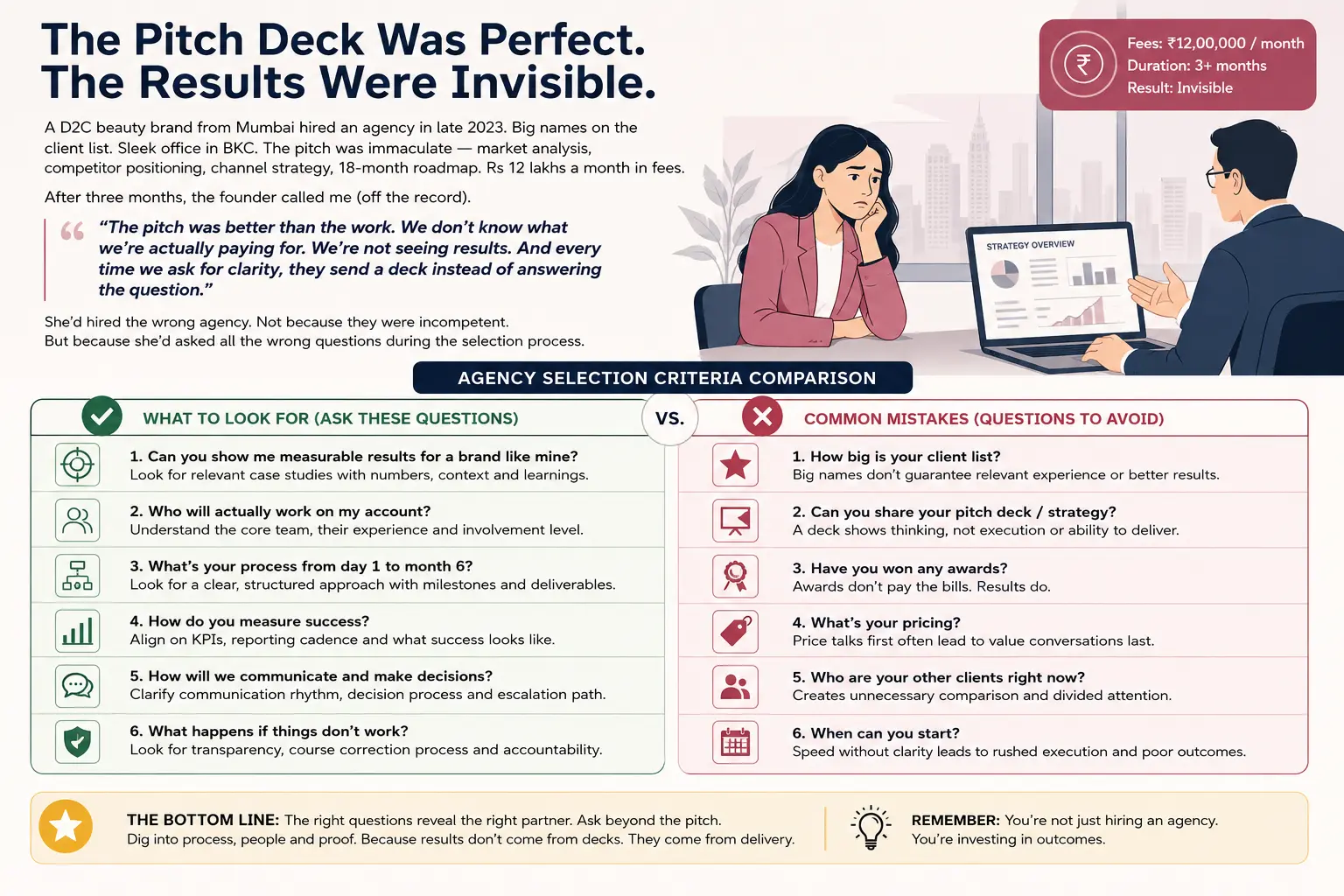
A D2C beauty brand from Mumbai hired an agency in late 2023. Big names on the client list. Sleek office in BKC. The pitch was immaculate — market analysis, competitor positioning, channel strategy, 18-month roadmap. Rs 12 lakhs a month in fees.
After three months, the founder called me (off the record).
“The pitch was better than the work. We don’t know what we’re actually paying for. We’re not seeing results. And every time we ask for clarity, they send a deck instead of answering the question.”
She’d hired the wrong agency. Not because they were incompetent. But because she’d asked all the wrong questions during the selection process.
This article is about asking the right questions — the ones that actually reveal whether an agency will deliver for your business.
What An Agency Actually Does And What It Doesn’t
Here’s the confusion most businesses have: they think an agency brings ideas.
Wrong. An agency executes your strategy. They execute really well, hopefully. But the strategy? That comes from you. Or it should.
If you walk into an agency saying “we want to grow but don’t know how,” a good agency will dig. They’ll ask about your business, your customers, your margins, your competitive situation. Then they’ll recommend a strategy.
A bad agency will try to convince you that they know what you need. They’ll talk about “digital transformation” and “integrated omnichannel campaigns” and you’ll get confused and just say yes.
An agency is a tool. A really expensive tool. But a tool. The strategy is yours. They execute it.
That distinction matters a lot when you’re comparing agencies.
The Questions That Actually Matter
“What’s your process?” is useless. Every agency says their process is “strategic, data-driven, and creative.”
Ask instead:
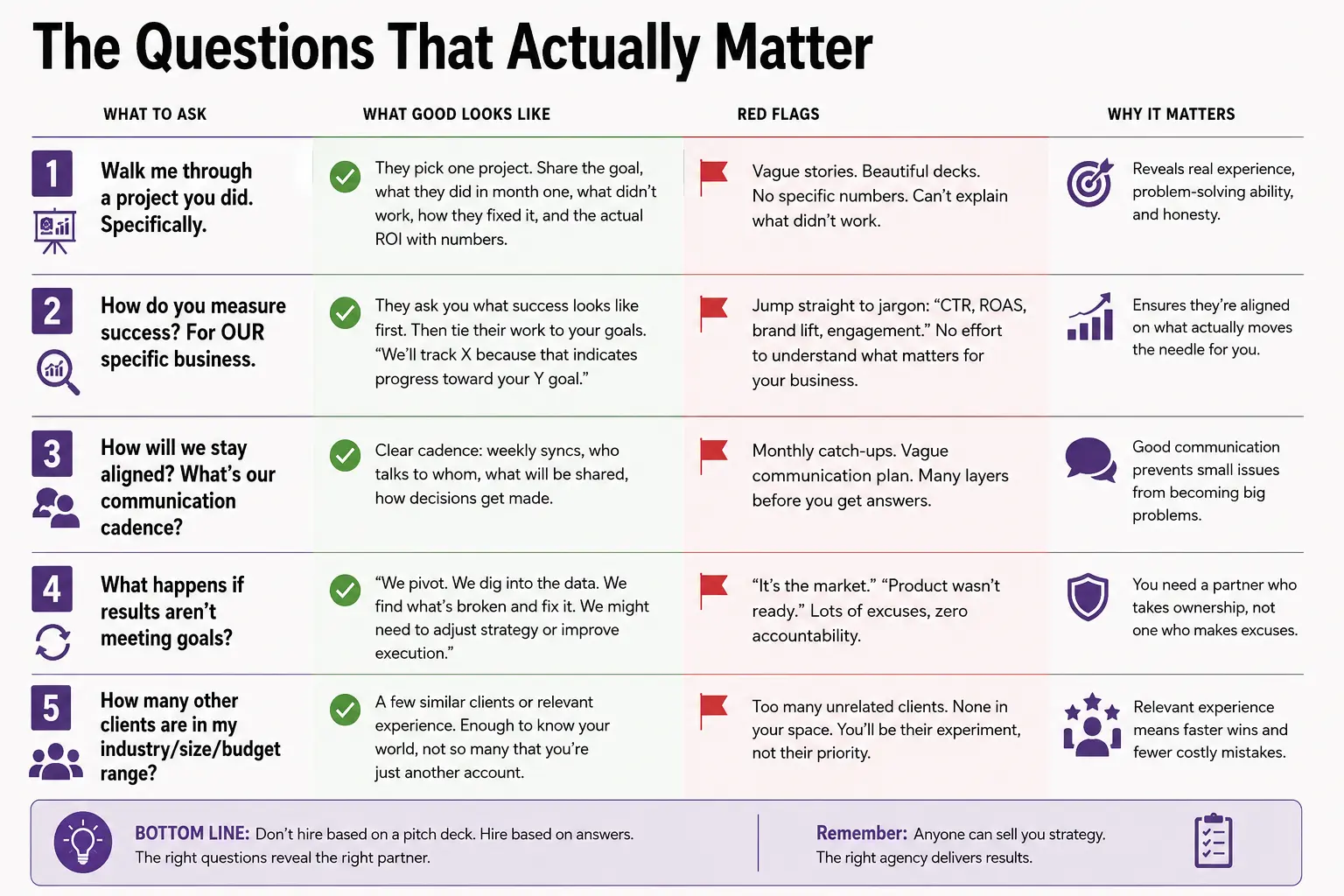
1. Walk me through a project you did. Specifically.
Don’t let them slide into generalities. Pick one project. Ask: “What was the goal? What did you do in month one? What didn’t work? How did you fix it? What was the actual ROI?”
If they can’t give specific numbers, that’s a red flag.
If the project looks like a deck — beautiful pitch, unclear execution, vague results — that’s a red flag.
2. How do you measure success? For OUR specific business.
They shouldn’t have a canned answer. They should ask YOU first. “What does success look like for you? More leads? More revenue? Better brand awareness? Different mix of customers?”
Then they should tie their work to that. “We’ll track X because that indicates progress toward your Y goal.”
If they jump straight to “we track CTR, ROAS, brand lift, engagement” without understanding what matters for your business — that’s a process that won’t work for you.
3. How will we stay aligned? What’s our communication cadence?
Once a month? Once a week? Who talks to whom?
The best agencies we know do weekly syncs — 30 minutes, no nonsense, “what happened, what’s broken, what’s next.”
Agencies that talk to clients once a month are usually hiding something. They don’t want scrutiny.
4. What happens if results aren’t meeting goals?
Listen carefully to this answer.
Good agencies will say: “We pivot. We dig into the data. We find what’s broken and fix it. We might need to adjust the strategy, or we might just improve execution.”
Bad agencies will say: “Well, that usually means the market conditions, or the product wasn’t ready, or…” — lots of external blame.
Accountability matters. If results are bad and the agency immediately blames everything except themselves, that’s not a partnership.
5. How many other clients are in my industry/size/budget range?
Some diversity is healthy — they learn across industries. But if they have 50 other e-commerce clients and you’re a B2B manufacturer, they don’t really understand your specific challenges.
If they have no one in your space, they’ll be learning on your dime.
Red Flags That Are Actually Warning Lights
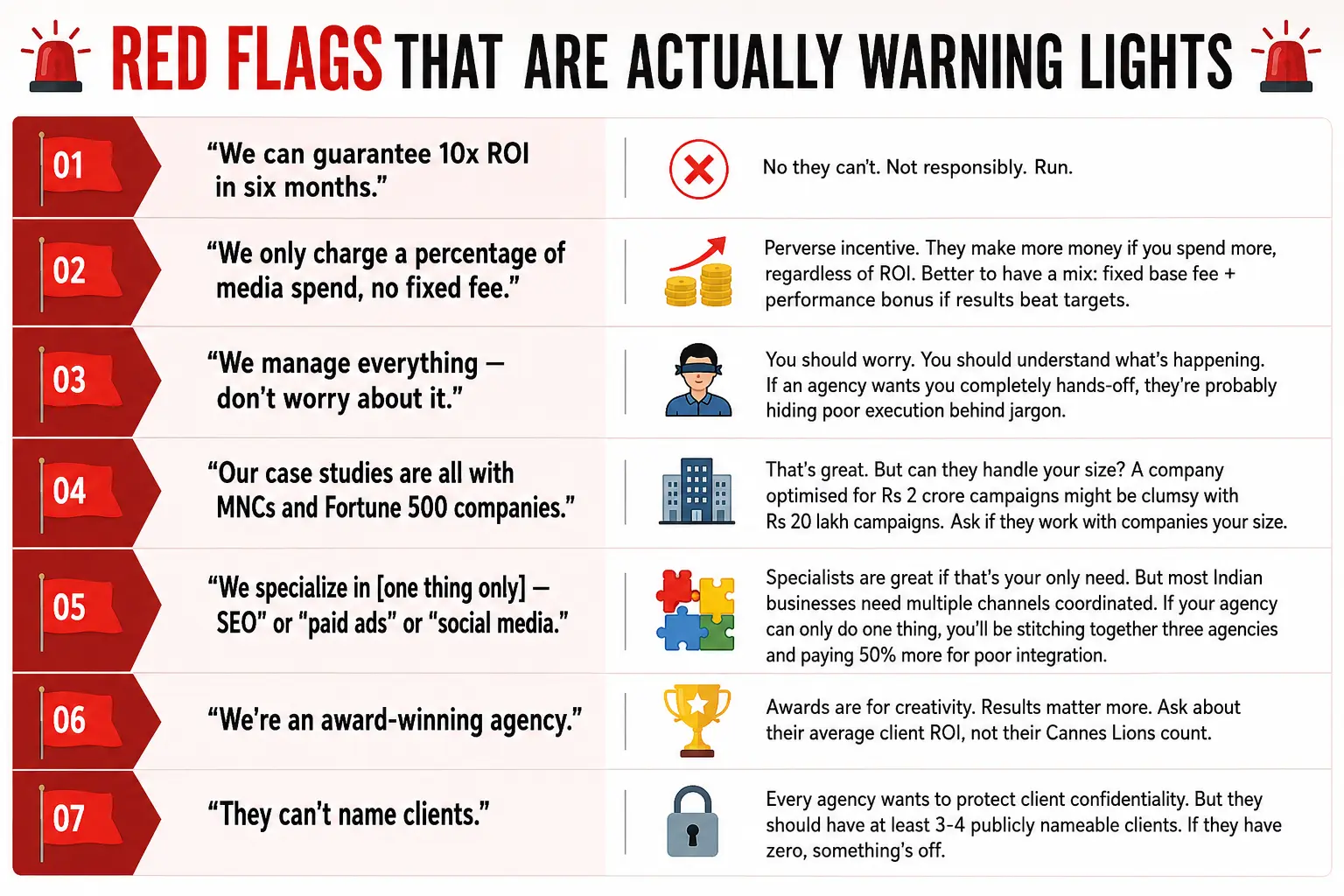
- “We can guarantee 10x ROI in six months.” No they can’t. Not responsibly. Run.
- “We only charge a percentage of media spend, no fixed fee.” Perverse incentive. They make more money if you spend more, regardless of ROI. Better to have a mix: fixed base fee + performance bonus if results beat targets.
- “We manage everything — don’t worry about it.” You should worry. You should understand what’s happening. If an agency wants you completely hands-off, they’re probably hiding poor execution behind jargon.
- “Our case studies are all with MNCs and Fortune 500 companies.” That’s great. But can they handle your size? A company optimised for Rs 2 crore campaigns might be clumsy with Rs 20 lakh campaigns. Ask if they work with companies your size.
- “We specialize in [one thing only] — SEO” or “paid ads” or “social media.” Specialists are great if that’s your only need. But most Indian businesses need multiple channels coordinated. If your agency can only do one thing, you’ll be stitching together three agencies and paying 50% more for poor integration.
- “We’re an award-winning agency.” Awards are for creativity. Results matter more. Ask about their average client ROI, not their Cannes Lions count.
- They can’t name clients. Every agency wants to protect client confidentiality. But they should have at least 3-4 publicly nameable clients. If they have zero, something’s off.
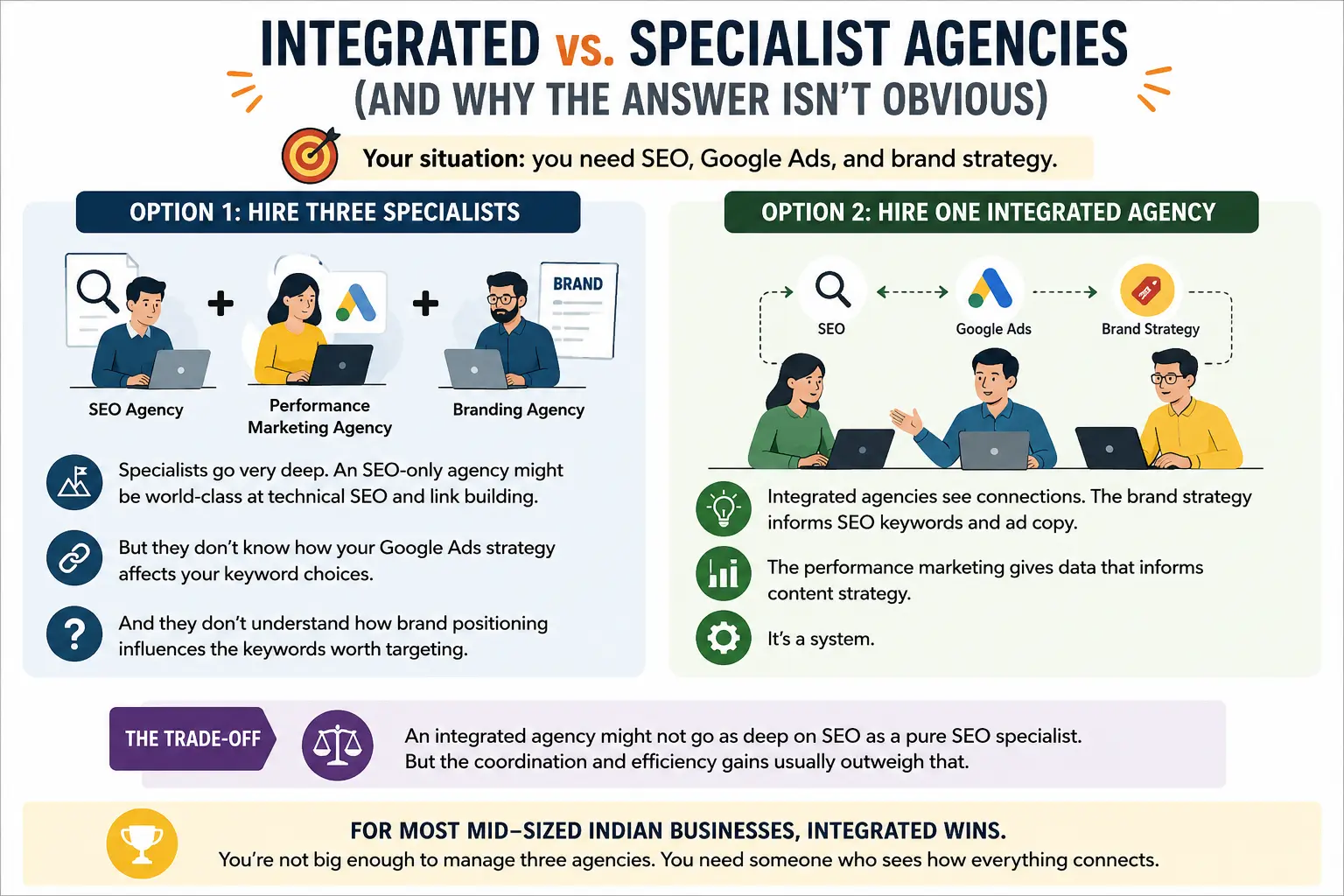
Integrated vs. Specialist Agencies (And Why The Answer Isn’t Obvious)
Your situation: you need SEO, Google Ads, and brand strategy.
Option 1: Hire three specialists — an SEO agency, a performance marketing agency, a branding agency.
Option 2: Hire one integrated agency that does all three.
Specialists go very deep. An SEO-only agency might be world-class at technical SEO and link building. But they don’t know how your Google Ads strategy affects your keyword choices. And they don’t understand how brand positioning influences the keywords worth targeting.
Integrated agencies see connections. The brand strategy informs SEO keywords and ad copy. The performance marketing gives data that informs content strategy. It’s a system.
Trade-off: an integrated agency might not go as deep on SEO as a pure SEO specialist. But the coordination and efficiency gains usually outweigh that.
For most mid-sized Indian businesses, integrated wins. You’re not big enough to manage three agencies. You need someone who sees how everything connects.
The Cost Conversation (And Why Fixed-Fee Is Probably Wrong)
Agencies charge three ways:
Percentage of media spend: “15% of what you spend on ads.” Incentivises the agency to get you to spend more. Bad.
Fixed monthly fee: “Rs 2 lakhs a month.” Easy to budget. But then what happens if you add a new product line that requires 2x the work? The agency either does it for the same fee (bad for them, they’ll deprioritise you) or asks for more (awkward conversation).
Mixed — fixed base + performance bonus: “Rs 1.5 lakhs base + 10% of revenue lift above target.” Aligns incentives. The agency makes more if you make more.
Or: retainer + project basis. “Rs 50,000/month for ongoing management, plus Rs 30,000 per special project like website redesign.”
Best agencies in Mumbai use mixed models because they’re honest about what they’re doing. They make a base so they can invest in you. They make a bonus so they’re incentivised to deliver results.
If an agency quotes you a flat monthly fee without asking about your goals or budget, they’re not pricing based on value — they’re guessing. That’s risky for both of you.
The Onboarding (This Is When You Find Out What You Actually Bought)
First month with an agency is revelation.
Good agencies spend week one understanding your business. Not doing work. Understanding. They’ll audit your current situation, map your customer journey, identify opportunities.
By week two, they’ll present findings. “Here’s what we found. Here’s what we recommend. Here’s the 90-day plan.”
Bad agencies spend week one doing work they planned in the pitch. They haven’t learned anything new about you. But they look productive.
Badwali (bad) onboarding reveals that the agency didn’t really understand your business during the pitch. You’re two weeks in and they’re asking questions you answered before you hired them.
If that happens, escalate immediately. Something’s not aligned.
When To Fire An Agency (And Do It Fast)
Most agencies are under contract for 3-6 months minimum. But that doesn’t mean you have to stay if things are clearly broken.
Trigger points to exit:
They can’t explain what they’re doing and why. Ever ask “why did you do that?” and get back a non-answer? That’s a problem.
Results are flat after 3 months and they don’t have a clear pivot. Some flatness is normal. But if they’re not investigating and adjusting, they’re just executing the original plan and hoping it works. That’s not partnership.
Communication drops off. They go from weekly calls to monthly emails. That usually means they’ve deprioritised you internally.
You realise the strategy doesn’t actually fit your business. They promised “growth” but didn’t define what growth means for you. Now three months in, you’re measuring different metrics than they are.
If any of these happen, address it directly. Give them a chance to fix. If they don’t — move on. Three months of wrong work is worse than no work.
| Approach | Best for | Watch out for |
|---|---|---|
| DIY | Small teams, tight budgets | Slow ramp-up, trial-and-error |
| Freelancer | Specific project bursts | Inconsistency, limited ownership |
| Agency | Ongoing work, senior input | Higher retainer, less control |
Quick checklist before you start:
- Define the one thing you want: leads, sales, awareness — pick one.
- Baseline your numbers: write down where you are today.
- Pick a 90-day window: nothing moves in 2 weeks.
- Agree on success metrics: with whoever is paying the bill.
- Set up proper tracking: GA4, UTMs, call tracking.
- Review monthly: kill what doesn’t work, double down on what does.
The Bottom Line
If you take one thing from this: the agency conversation that actually matters and why most a rewards patience and specificity, not volume or clever tricks. Start small, measure honestly, fix what breaks, and compound what works. The brands doing this well in India aren’t smarter — they’re just consistent. Need a hand with this for your business? Talk to us.
Need A Conversation With An Agency That Actually Explains Themselves?
We work with 250+ brands in India. Most came to us after working with other agencies. We spend the first month understanding you before we execute anything. No pitch decks pretending to be strategy.
FAQs
-
How much should I budget for an agency?
Ans.Typical range: 15-25% of your marketing spend. If you're spending Rs 10 lakhs/month on ads, expect Rs 1.5-2.5 lakhs for agency management. Some charge flat fees, some percentage, some performance-based. Ask for the breakdown — what exactly do you get? If they can't explain clearly, that's a red flag. -
Specialist vs. integrated agency — which is better?
Ans.Specialist agencies go deep on one thing. But your business needs multiple channels working together. An integrated agency might not go as deep on one skill, but they see how SEO feeds email, how content supports ads. Most Indian businesses benefit from integrated agencies because they need cohesion, not isolation. -
What's the biggest red flag?
Ans.Run if they promise guaranteed results. Run if they can't explain their process clearly. Run if they charge upfront without tying it to deliverables. Run if they stare blankly when you ask about attribution. Run if every sentence has 'disruption' or 'synergy.' Those are typically signs of someone compensating for lack of clarity with jargon.
Author Details

Latest Posts
-
 26 / Aug
Search Engine Optimization Video SEO: How to Rank Your Videos in Google & YouTube
26 / Aug
Search Engine Optimization Video SEO: How to Rank Your Videos in Google & YouTube -
 25 / Aug
Video Production Corporate Video Production: A Practical Guide for Indian Brands
25 / Aug
Video Production Corporate Video Production: A Practical Guide for Indian Brands -
 24 / Aug
-
21 / Aug
Catalogue Design Catalogue Design: How to Create Catalogues That Actually Sell
-
 20 / Aug



Related Knowledge